SpaceX lowering orbits of 4,400 Starlink satellites for safety’s sake

When you purchase through links on our articles, Future and its syndication partners may earn a commission.

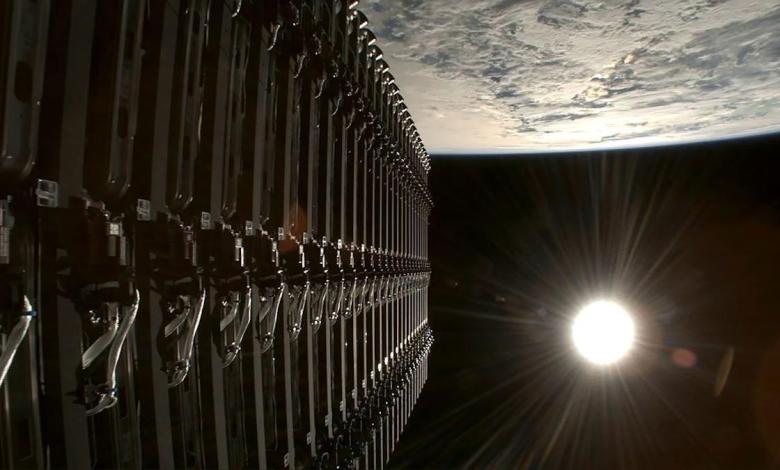
A stack of SpaceX Starlink satellites before being deployed into Earth orbit. | Credit: SpaceX
This year we will see a massive migration of SpaceX Starlink satellites.
All Star link broadband spacecraft currently orbiting about 342 miles (550 kilometers) above Earth – about 4,400 satellites – will descend to an altitude of about 298 miles (480 km) during 2026.
There are two main reasons for this decision, according to Michael Nicolls, vice president of Starlink engineering at EspaceXwho announced the plan via on Thursday (January 1).
“As solar minimum approaches, atmospheric density decreases, which means that the ballistic decay time at a given altitude increases – a decrease will result in a more than 80% reduction in ballistic decay time at solar minimum, or 4+ years reduced to a few months,” Nicolls wrote in his paper X. “As a result, the number of debris objects and the planned satellite constellations are significantly less than 500 km, reducing the overall probability of collision.
Solar activity waxes and wanes in an 11-year cycle. We have probably just passed through the peak of the current phase, known as Solar cycle 25. (Scientists have diligently tracked these cycles since 1755when the numbering system began.) The next solar minimum is expected around 2030.
As Nicolls noted, atmospheric changes caused by solar activity are of great interest and importance to satellite operators. An active sun causes a thicker atmosphere, which increases frictional drag on spacecraft and causes them to fall faster. Low solar activity has the opposite effect.
The downward migration in 2026 involves about half of SpaceX’s Starlink megaconstellation, which currently has nearly 9,400 operational spacecraft (although that number is still growing). The fleet is very reliable; There are only two dead Starlinks currently in orbit, according to Nicolls.
“Nevertheless, if a satellite fails in orbit, we want it deorbited as quickly as possible,” he wrote. “These actions will further improve the security of the constellation, particularly in the face of difficult-to-control risks such as uncoordinated maneuvers and launches by other satellite operators“.
Low Earth orbit (LEO) is getting busier and busier these days. Starlink is the main determining factor; approximately two-thirds of all operational satellites belong to the megaconstellation. But other giant networks are also being formed. For example, China began to develop two LEO Internet constellations, each of them will feature more than 10,000 spaceships if all goes according to plan.


:max_bytes(150000):strip_icc()/Health-GettyImages-2207117261-2302b0b1692d48bbaf948150899efad2.jpg?w=390&resize=390,220&ssl=1 "The Best Time To Take Magnesium To Help Lower Your Blood Pressure")

