Spain’s commitment to renewable energy may be in doubt


Guy HedgecoeAragon, northeastern Spain

 Juan Antonio Dominguez
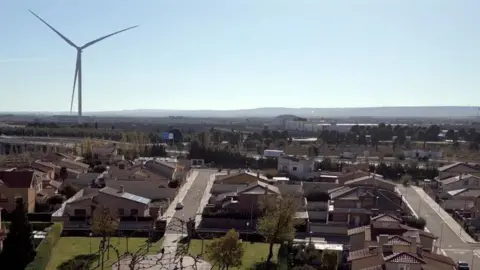
On the outskirts of the sleepy town of Figueruelas, a large, single wind turbine spins, casting its shadow on nearby buildings.
It’s a reminder of the importance of renewable electricity in this windswept region of Aragon in northeastern Spain, whose plains are home to many of the country’s wind and solar farms.
Figueruela’s status as a symbol of Spain’s green transition was further boosted recently, as construction began nearby on a vast factory that will produce batteries for electric vehicles.
Chinese company CATL and Dutch company Stellantis are jointly investing €4 billion ($4.7 billion; £3.5 billion) in the facility. Yao Jing, China’s ambassador to Spain, described it as “one of the biggest Chinese investments Europe has ever seen.”
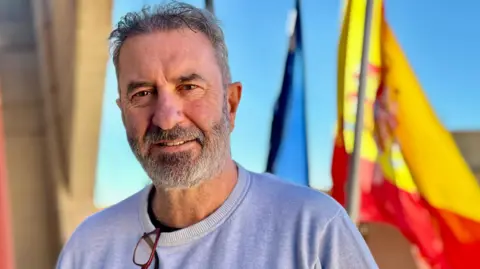
Luis Bertol Moreno, the city’s mayor, says this area was a logical choice for the project.
“We are in Aragon, where it is windy all year round, there are many hours of sunshine and we are surrounded by wind turbines and solar panels,” he says.
“Those [energy sources] will be crucial in generating electricity for the new plant, and I understand that is the main reason why it was built here in Figueruelas. »
The plant can be seen as a vindication of the Spanish energy model, which prioritizes renewable sources. In 2017, renewable energy accounted for only a third of Spain’s electricity production, but last year it accounted for 57%.
By 2030, the government wants them to contribute 81% to electricity production.
Earlier this year, Prime Minister Pedro Sánchez summed up his government’s approach by hitting back at US President Donald Trump’s pro-fossil slogan “Dig, baby, dig.” “Green, baby, green,” the socialist said, emphasizing the benefits of renewable energy.
However, in recent months, Spain’s full commitment to renewable energy has come under scrutiny. This was largely due to the April 28 power outage that left homes, businesses, government buildings, public transport, schools and universities in Spain and neighboring Portugal in darkness for several hours.
With the government unable to provide a full explanation for the outage, the country’s energy mix has become a hotly debated political issue. Alberto Núñez Feijóo, leader of the conservative opposition, accused the government of “fanaticism” in pursuing its green agenda, suggesting that an over-reliance on renewable energy could be to blame for the incident.
Feijóo and others on the right have advocated rethinking the national energy model.
The fact that a week before the outage, solar generation in mainland Spain represented a record 61.5% of the electricity mix fueled these claims.
However, the government and national grid operator Red Eléctrica have denied that the outage is linked to the preponderance of renewable energy sources in Spain.
“We operated the system with higher renewable tariffs [previously] without any effect on the security of the system,” says Concha Sánchez, operations manager of Red Eléctrica. “It’s certainly not a question of renewable energy rates at that time.”
Ms Sánchez said the outage was caused by a combination of problems, including an “unknown event” in the system moments before, which led to abnormal voltage oscillations.
However, Red Eléctrica and the government are still waiting for reports on the incident which they hope will determine the exact cause. A cyberattack has been repeatedly ruled out.
Meanwhile, since April, Spain’s electricity mix has been somewhat altered, with a greater reliance on natural gas, reinforcing the idea that the country is at an energy crossroads.
 AFP via Getty Images
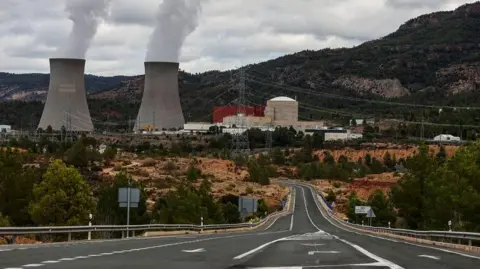
Spain’s nuclear industry, which currently provides around 20% of the nation’s electricity, has been particularly vocal since the outage, opposing government plans to close the country’s five nuclear power plants between 2027 and 2035.
While many European countries are experiencing a nuclear renaissance, the planned shutdowns make Spain an exception. The companies that own the Almaraz factory in southwest Spain, which is expected to be the first to close, have requested a three-year extension of its operating life, until 2030. This request is currently under review.
Ignacio Araluce, president of Foro Nuclear, an association that represents the industry, says Spain is the only country in the world planning to close active nuclear power plants. He believes that nuclear energy brings stability while being compatible with the green energy transition.
“It’s prudent to have a mix of renewable energy and nuclear energy,” he says.
Mr Araluce praises renewable sources because they only need natural elements to produce electricity, but points out that they are not capable of operating 24 hours a day or when weather conditions are unfavorable.
“How can you produce energy during these hours when renewable energy is not producing?” he asks. The answer, he added, is “with a source like nuclear power, which does not produce CO2, but which produces it at any time of the year”.
The political opposition is firmly opposed to stopping nuclear power. The far-right newspaper Vox, criticizing what it sees as a lack of government explanation for the April blackout, recently called nuclear power a “crucial source of stability.”
 AFP via Getty Images
Ms Sánchez acknowledges that there is room for improvement for Spain’s electricity model, highlighting the relative isolation of the Iberian Peninsula from the European grid compared to most of its EU neighbors. She also sees storage as a problem.
“Even though we’ve come a long way in terms of renewable installations, we can’t say the same when it comes to storage,” she says. “We need to encourage the storage facility.”
Spain’s political landscape adds an element of uncertainty to its energy future. The Socialist-led coalition is mired in corruption scandals and its parliamentary majority appears to have collapsed in recent weeks, raising the possibility of snap elections in the coming months.
A right-wing government, polls suggest, would almost certainly place less emphasis on renewable energy and advocate a partial return to more traditional energy sources.
But in the meantime, the transition to renewable energy continues in Spain.
And for Figueruelas, in Aragon, this means not only clean and cheap energy, but also investments. The town’s population of just around 1,000 is expected to increase significantly, with the arrival of 2,000 Chinese workers to help build the new battery factory, which is expected to create up to 35,000 indirect jobs once it is operational.
“This type of investment revitalizes the area, they revitalize the construction and hotel sector,” explains Manuel Martín, a resident of the neighborhood. “And the energy is free – it just depends on the sun and the wind.”


:max_bytes(150000):strip_icc()/Health-GettyImages-1315028731-36c28f4f63344e4d966528df884da592.jpg?w=390&resize=390,220&ssl=1 "What Happens to Your Blood Pressure When You Drink Coffee Daily")

