Spectacular Cosmic Collision Captured in New Hubble Image


December 23, 2025
2 min reading
 Add us on GoogleAdd SciAm
Spectacular cosmic collision captured in new Hubble image
NASA’s Hubble Space Telescope has captured asteroids crashing into each other in a nearby planetary system around a star about 25 light years away.
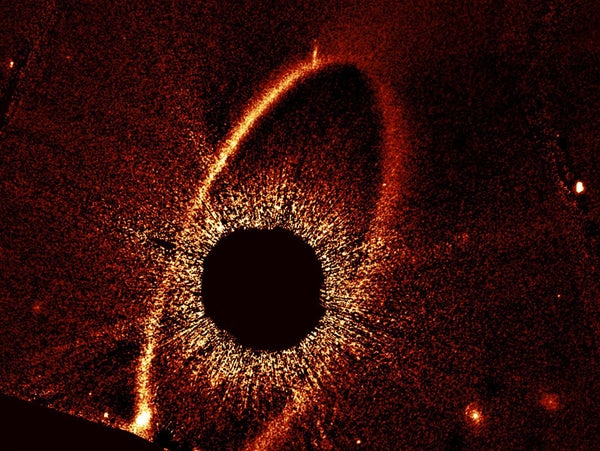
NASA, ESA, Paul Kalas (UC Berkeley); Image processing: Joseph DePasquale (STScI)
When the solar system began to form, everything was chaos. A multitude of rocky materials collided in a maelstrom that would eventually become the baby protoplanets, comets, and asteroids that make up our cosmic neighborhood.
And now NASA’s Hubble Space Telescope has captured a similar violent clash occurring around another star about 25 light years away. The Fomalhaut star stands out as one of the brightest in the night sky and is known for being shrouded in bands of dust and debris.
In 2008, astronomers examining Fomalhaut discovered a potential planet orbiting the star. Later observations, however, showed the orb fading, leading some to wonder whether it was a planet or debris left behind by a collision between two smaller objects. By 2014, he had disappeared. And in a new study published in Science, astronomers describe how, in 2023, they found a different bright spot that resembles the previously discovered object.
On supporting science journalism
If you enjoy this article, please consider supporting our award-winning journalism by subscription. By purchasing a subscription, you are helping to ensure the future of impactful stories about the discoveries and ideas shaping our world today.
Its sudden appearance – and the planet’s proposed disappearance – suggest that both are the remnants of violent collisions between two massive objects. The observations run counter to older hypotheses about such accidents, according to Paul Kalas, an astronomer at the University of California, Berkeley and co-author of the new study.
“Previous theory suggested there should be a collision every 100,000 years, or more. Here, in 20 years, we’ve seen two,” Kalas said in a statement. “If you had a movie of the last 3,000 years, and it was sped up so that each year lasted only a fraction of a second, imagine how many flashes you would see in that time. The Fomalhaut planetary system would sparkle with these collisions.”
In the future, Kalas and his colleagues hope to use the James Webb Space Telescope to glean the composition of the dust left behind by the crash, including any evidence that it contains water ice. These and other observations of Fomalhaut and its surrounding debris could offer new clues about how planetary systems like ours merge and evolve.
It’s time to defend science
If you enjoyed this article, I would like to ask for your support. Scientific American has been defending science and industry for 180 years, and we are currently experiencing perhaps the most critical moment in these two centuries of history.
I was a Scientific American subscriber since the age of 12, and it helped shape the way I see the world. SciAm always educates and delights me, and inspires a sense of respect for our vast and magnificent universe. I hope this is the case for you too.
If you subscribe to Scientific Americanyou help ensure our coverage centers on meaningful research and discoveries; that we have the resources to account for decisions that threaten laboratories across the United States; and that we support budding and working scientists at a time when the value of science itself too often goes unrecognized.
In exchange, you receive essential information, captivating podcasts, brilliant infographics, newsletters not to be missed, unmissable videos, stimulating games and the best writings and reports from the scientific world. You can even offer a subscription to someone.
There has never been a more important time for us to stand up and show why science matters. I hope you will support us in this mission.