
January 19, 2026
2 min read
 Add Us On GoogleAdd SciAm
These spiders weave themselves giant doppelgängers to scare away predators
Spiders scare off predators by seemingly supersizing themselves
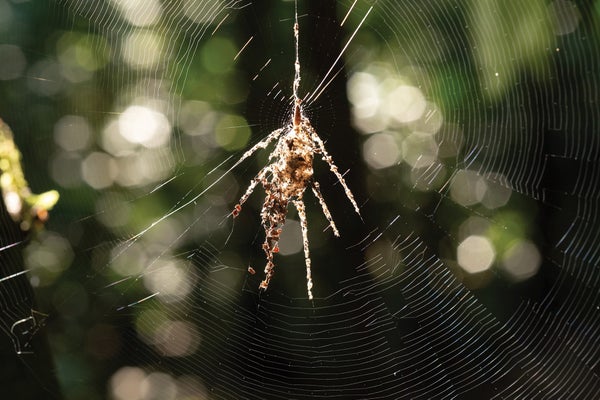
This spiderweb structure presents the illusion of an intimidating bigger spider.
What’s scarier than a spider? A really big spider, of course. A newfound defensive tactic takes advantage of this idea: researchers documented spiders building giant spiderlike silhouettes on their webs to ward off predators.
These decoys are an example of “web decorations” that some spiders are known to produce, often to prevent getting eaten, avoid bird strikes or attract prey. Such ornaments come in many shapes and sizes, but this is the first time scientists have documented spider-shaped decor.
From 2012 to 2022 a research team collected observations of these unusual webs in Peru, the Philippines and Madagascar, focusing on about 300 individuals from the genus Cyclosa that are typically only a few millimeters long. The researchers published their findings in Ecology and Evolution.
On supporting science journalism
If you’re enjoying this article, consider supporting our award-winning journalism by subscribing. By purchasing a subscription you are helping to ensure the future of impactful stories about the discoveries and ideas shaping our world today.
The spider doppelgängers are made of prey carcasses, plant debris, and other organic materials. They have a central structure from which “legs” branch out. The team proposes that the constructions serve primarily as a defense from predators such as hummingbirds or helicopter damselflies. But different species might use them in different ways.
In Peru, the spiders seem to use the decoys “as puppets,” says study co-author Phillip Torres, an entomologist and television host. “They will be on the top of the figure, and they shake the web, so they are pretending to be a bigger spider.” Small predators might be scared by a larger spider, and predators that specialize in eating the real, smaller arachnid might want to avoid a supersized one. In the Philippines, the spiders seem to instead hide inside the structure and wait for the predator to go away.
Dinesh Rao, an ecologist at Veracruzana University in Mexico, who wasn’t involved in the study, emphasizes that figuring out the constructions’ precise function requires more research: “You need either careful observations or experimental conditions where you actually look at how [predators] respond to these structtures.”
It’s Time to Stand Up for Science
If you enjoyed this article, I’d like to ask for your support. Scientific American has served as an advocate for science and industry for 180 years, and right now may be the most critical moment in that two-century history.
I’ve been a Scientific American subscriber since I was 12 years old, and it helped shape the way I look at the world. SciAm always educates and delights me, and inspires a sense of awe for our vast, beautiful universe. I hope it does that for you, too.
If you subscribe to Scientific American, you help ensure that our coverage is centered on meaningful research and discovery; that we have the resources to report on the decisions that threaten labs across the U.S.; and that we support both budding and working scientists at a time when the value of science itself too often goes unrecognized.
In return, you get essential news, captivating podcasts, brilliant infographics, can’t-miss newsletters, must-watch videos, challenging games, and the science world’s best writing and reporting. You can even gift someone a subscription.
There has never been a more important time for us to stand up and show why science matters. I hope you’ll support us in that mission.


