Spot Two Comets at Once as Lemmon and SWAN Soar Across Our Skies This Week


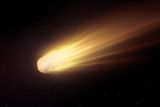
What better way to drag you off your couch and into the dark autumn night than the chance to spot a pair of comets that will never return to Earth in our lifetime?
These celestial bodies, named Lemmon and SWAN, are non-periodic comets, meaning they are unlikely to pass through our solar system for several thousand years, if ever. But this week, they will fly over our skies.
The twin comets will be visible throughout this week. Lemmon peaked in brightness yesterday (October 21, 2025) and SWAN the day before (October 20, 2025).
Learn more: When was Halley’s Comet last seen and will it ever return?
How to Spot Comet Lemmon
Comet Lemmon (C/2025 A4), passing about 90 million kilometers from Earth, was first spotted in January. You can spot it this week using a small telescope or a pair of binoculars.
Observers lucky enough to have a view of a very dark sky will even be able to see it with the naked eye. It will appear after sunset in the western sky. It will move steadily northward throughout the week.
“As the sky darkens, the comet will first move, over a few days, beyond the bright star Arcturus, and then turn further to the southwest, under the stars of the Summer Triangle,” Royal Astronomical Society astronomer Robert Massey said in a press release.
It will look “pretty bright” and “fuzzy,” Massey said. The comet probably won’t appear for another 1,300 years, so this week is your last chance unless you have access to sophisticated cryogenic technology.
How to Spot Comet SWAN
Comet SWAN (C/2025 R2) was first observed on September 10, 2025. It will pass closer than Lemmon, coming up to 24 million kilometers from Earth. To see it, you will have to get up early.
Before dawn, it should appear in the eastern sky. Although it is closer to Earth than Lemmon, SWAN will appear dimmer, but it will still be easy to spot using a pair of binoculars.
To find SWAN, search the Summer Triangle again. The comet should appear halfway between one of these stars – Altaïr, in the constellation Aquila – and the horizon. It won’t return for 20,000 years – even the best cryogenics probably won’t help you see SWAN again.
Learn more: A comet could have caused rapid climate change around 12,800 years ago
Article Sources
Our Discovermagazine.com editors use peer-reviewed research and high-quality sources for our articles, and our editors review the articles for scientific accuracy and editorial standards. See the sources used below for this article:


