The One Percent’s Fear of Death Is Wreaking Havoc on the World


Once you have started to see it, you see it everywhere. First, there is the show by Bryan Johnson, which spends millions to stay young, injecting the blood plasma of his son into his veins, electroshocking His penis, following a strictly regimated diet that seeks the whole world as a diet. When Katie Drummond interviewed Johnson for Cable, She asked him flat: “True or false: you, Bryan Johnson, the man seated in front of me, one day at one point in the future, die”, to which he replied, “false”. He then spoke of the extension of human life “on an unknown horizon” while reproducing simultaneously in AI which will be such a perfect copy of him that it will be indistinguishable. In this, he echoes Peter Thiel developer Ross Douthat THE New York Times That, thanks to technology and surgery, you should “be able to change your heart and change your mind and change your whole body”.
You see it in a less flashy and more banal way, as in the refusal of political gerontocracy – both on the right and on the left – to give up power, apparently contained to allow the country to rot with corruption and ineptus because they simply cannot imagine a world without control. At one point, we begin to recognize that a large part of the political and cultural environment of today is led by those who have obviously, pathologically, fear of death. And many of these people, rather than facing this fear and managing them, rather wreak havoc on the world around us.
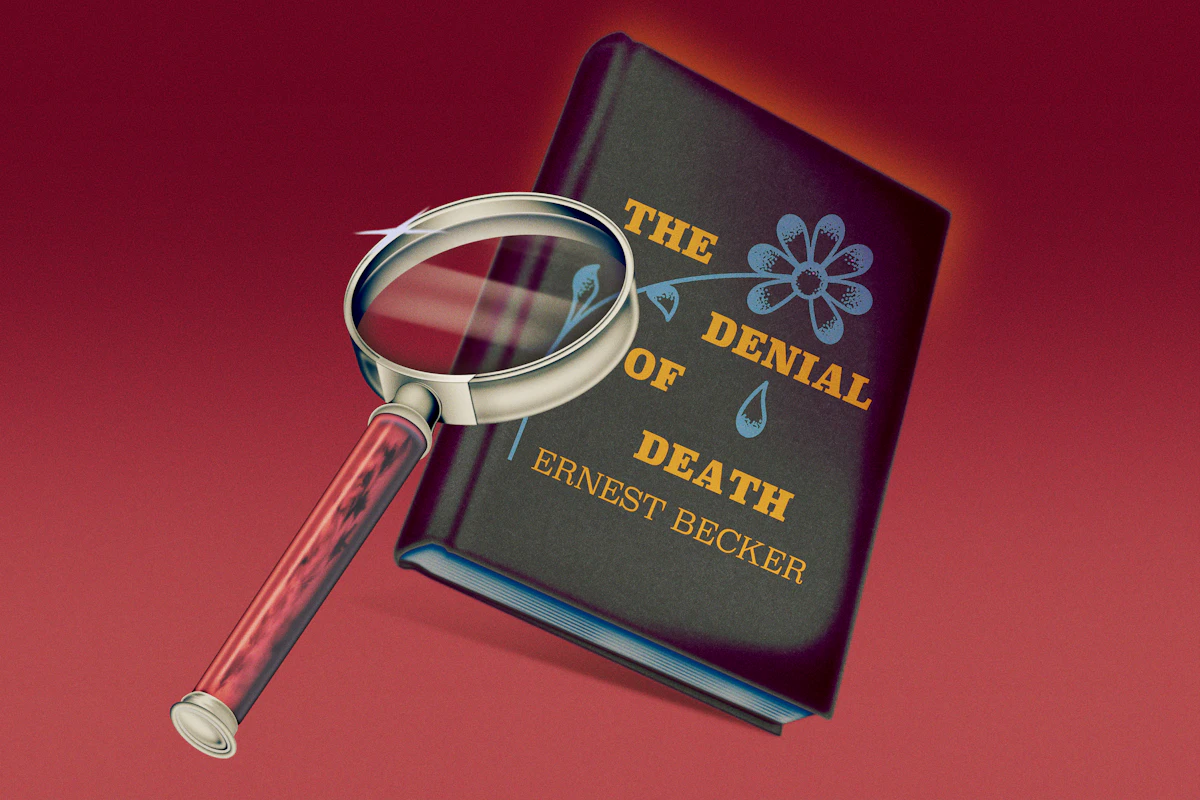
Ernest Becker published a little over 50 years ago The denial of death, An attempt to merge psychology and religion in order to make a great unified theory of the relationship of human culture to mortality. Becker’s thesis was simple (she was there in the title): Sigmund Freud was wrong to affirm that all human behavior and culture can be reduced to questions of infantile sexuality. Rather, it is a fear of death itself that leads us – both an individual level and a cultural level. In addition, we are doing everything possible to remove this fear, to the point where we are barely aware of it. But even deleted, it continues to act on us, and it is this fear that defines us as a species. “We build character and culture,” said Becker to Sam Keen, the psychologist, “in order to protect us from the devastating consciousness of our underlying impotence and the terror of our inevitable death.”
Keen interviewed Becker when he was dying of colon cancer at the age of 49, an interview in the death bed less than a year after The denial of death –What Becker called his “first mature book” – was published. He was posthumously awarded the Pulitzer Prize in general non-fiction, arriving within the framework of a revolution in terms of the death of the Americans (and spoke). Elizabeth Kubler-Ross To death and die (with his famous and often misunderstood, five stages of sorrow) had arrived in 1969; Two years earlier, Cicely Saunders had founded St. Christopher’s Hospice in London, helping to fuel the modern hospice movement.
But while Saunders and Kubler-Ross gave people for the means to better face their own imminent death, Becker had more sociologist’s eye (his doctorate from the University of Syracuse was in cultural anthropology). Rather than focusing on an individual’s confrontation with mortality in the face of a terminal diagnosis, Becker has widened the objective to ask us why and how our conscience of mortality, or his absence, shapes daily life and culture as a whole. And while his language and methodology now feel very dated, The denial of deathCentral ideas have never been so relevant, especially in a world still dug by a pandemic with which we have never completely counted. Because what Becker understood was that when he is confronted with mortality, we not only tend to flee this recognition, but we tend to act in an anti -social and authoritarian manner as an attempt to cover our own imminent disappearance.


