The world’s only dark sky airport sits inside a national park


Airports are generally not known for being the best places to view the night sky. But last spring, Jackson Hole Airport in Wyoming became the first airport in the world to be certified as an International Dark Sky Place, thanks to a community committed to preserving the night sky. Here’s how they did it, why it’s important, and how it’s still as safe to get there as any other airport (because we know you were wondering).
What is an International Dark Sky Venue?
Worldwide, the DarkSky International organization has certified more than 260 cities, parks, preserves and counties on six continents as home to remarkable night skies, places where stargazers are virtually guaranteed to be dazzled by the cosmos due to a relative absence of artificial light, according to Michael Rymer, community program manager at DarkSky International.
DarkSky International offers several different certifications. In the case of a national park like Big Bend in Texas or a sanctuary like Rainbow Bridge National Monument in Utah, certification means that the spaces are far enough from major cities that there is little measurable light pollution obscuring the view. But it’s not just about stars; Dark night skies also preserve ecologically sensitive areas, especially for nocturnal wildlife which can be negatively affected by excessive artificial light at night.
In cities like Flagstaff, Arizona, the world’s premier international dark sky community and dark sky venue, that means the entire community has prioritized public and private lighting that reduces light pollution enough that you can still see a sky full of stars, maybe even the Milky Way, from downtown.
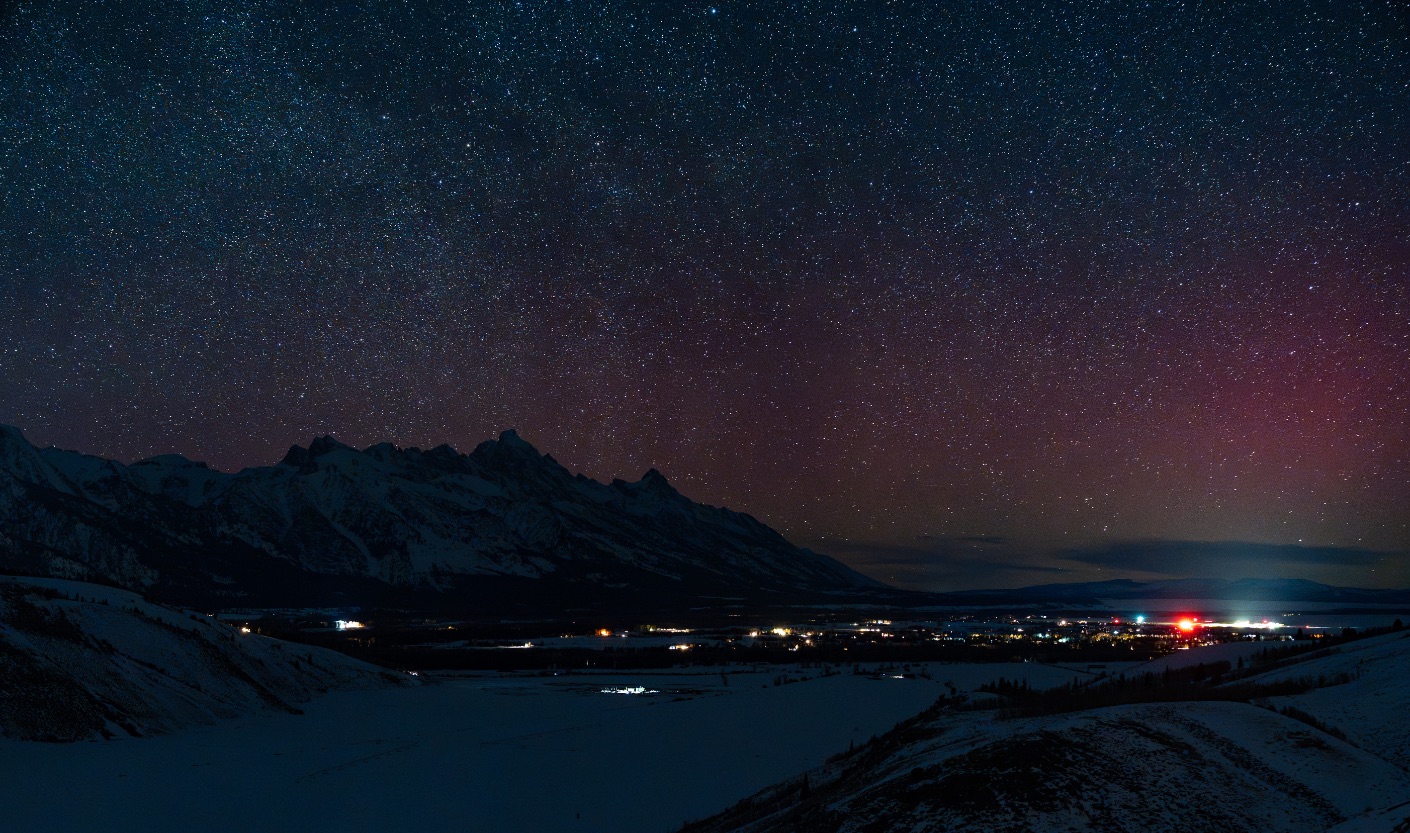
Teton County, a 4,216-square-mile area that includes the city of Jackson, Grand Teton National Park and Jackson Hole Airport, is one of these dark sky communities. With the support of local nonprofit Wyoming Stargazing, the airport itself, the city of Jackson and the county in which it is located are all officially Urban Night Sky Places, a designation reserved for “urban areas that promote an authentic nighttime experience despite being in the midst of significant artificial light,” according to the organization. The county and airport were certified simultaneously in 2025.
Urban night sky locations are a little different. Unlike parks, sanctuaries, and preserves, these places are not required to provide a specific, measurable reduction in light pollution, and their compliance is voluntary, not mandatory. But they must adopt a lighting management plan or policy that covers all outdoor lighting over time and commit to bringing all of its lighting into compliance within 10 years of certification.
There is also a focus on community outreach, collaboration, education and lighting policies depending on the chosen destination. “The city of Jackson was all for it,” Rymer offers, and the airport saw a reduction in light pollution after the change.
“Standing in the parking lot, you can look up and spot the constellations. Once you leave the airport, you can see the Milky Way less than a mile from a commercial runway,” explains Jac Stelly, environmental manager at the airport.
Safety first
If the idea of a dark airport has you worried about security, fear not. “We take safety very seriously,” says Rymer. But perhaps more importantly, airside lighting, including landing strip lights, safety lights and anything along the runway, is mandated and regulated by the Federal Aviation Administration and cannot be changed.
“There’s not much you can do as far as lighting on that side,” says Jeremy Barnum, communications director for the Jackson Hole Airport Board of Directors. “There’s a lot to do on the land side,” he continues of the areas of the airport that travelers encounter, “so that’s where we’ve focused our efforts.”
Lighting Strategies
Those efforts included replacing about 300 light fixtures, spending about 600 hours of direct labor, and at least that much time spent on strategy and deliberations, Stelly says.
Most updates involved relatively minor changes that collectively made a big difference. This involves focusing on where and when light is actually needed. For example, between midnight and 4 a.m., parking lot lighting dims to 30 percent. Sensors allow many of these lights to brighten up to 60% when motion is detected.
Many light bulbs have been replaced with LEDs with a warmer color temperature, resulting in less light pollution, and most landside lighting and in employee areas have been fitted with shields to reduce light spill. Others use dimmers or motion sensors to dim the light when it’s not needed. Dark Sky certification focuses on exterior lighting, but the airport has expanded the scope to also include interior lighting, such as shades and programmed dimmers.
Lights at fuel facilities, the rental car area and all areas not exposed to customers, including private aviation, can now also be turned off completely. “It’s a global project,” says Stelly. The airport also added signs providing information about the importance of dark skies. Education about the importance of responsible light at night and why dark skies are not just for seeing the stars is also an important part of the Dark Sky Places program.
“The airport checked all the boxes. They went above and beyond. Jackson Hole Airport set a strong precedent for airports around the world,” Rymer said.
Why make all this effort and investment? “It’s part of our values,” Barnum says. This is perhaps not surprising since it is the only airport in the United States to be located entirely within a national park, which Stelly says warrants a special commitment to environmental management.
And while Grand Teton National Park isn’t yet a certified park on its own, the largely undeveloped region’s relatively pristine night skies are part of what makes it such a special destination for locals and visitors. “It’s an endorsement from Jackson recognizing that our natural resources are what make us extraordinary,” Barnum says.
Proof of concept
As the first airport to receive this designation, Stelly hopes they can serve as a proof of concept for other airports, proof that airport infrastructure can coexist with natural ecosystems, regardless of the size of the airport. “It’s a great opportunity to expand the idea of what’s possible,” he says.
They created the roadmap; it is now up to other airports to follow this example. Meanwhile, a trip to Jackson, Wyoming, now means visitors can enjoy night skies that are clearer than ever. Even from the airport parking lot.

The best new PopSci 2025 releases


