Stop treating your mini PC like a desktop—it’s basically just a laptop without a screen


I’m tired of seeing mini PCs compared to real desktop computers. People line up specs next to traditional towers, compare part numbers, and declare that the smaller box completely replaces the larger one. And suddenly a palm-sized computer with a soldered mobile chip is held to the same standards as a machine with a socketed CPU, a discrete GPU, and a massive power supply.
This must stop. A mini PC is still a PC, but it’s not a scaled-down desktop, and it’s time to stop pretending that it is.
Mini PCs use desktop language, but mobile rules
This “desktop-class” chip isn’t really a desktop chip, after all
Here’s what trips people up the most: Mini PCs are marketed with processor names and clock speeds that look like something taken from a desktop computer spec sheet, but the silicon inside tells a whole different story.
The vast majority of mini PCs use laptop-class processors, mobile RAM (SO-DIMM), and integrated graphics. These are essentially laptops without a screen.
This distinction is more important than most people think. A mobile chip in a mini PC has a much lower power headroom than its desktop counterpart, and it’s crammed into a tiny chassis where thermals are no joke. Even if the base clock speed looks impressive on paper (and it often is), sustained performance under load is a whole other conversation. Thermal throttling is not a possibility in these machines. This is a design constraint that manufacturers consider from the start.
By the way, this is not a major blow to mobile processors. Modern laptop chips are extremely capable, and for everyday productivity, they punch above their weight. The problem lies in the framing.
When you see a mini PC advertised with, say, boost clocks up to 5.0 GHz, that number represents a brief sprint and not a daylong marathon. Comparing this to a desktop chip capable of sustaining high clocks indefinitely with a huge AIO cooler and lots of case space isn’t fair.
The same goes for graphics. Most mini PCs rely entirely on integrated GPUs, meaning they share memory bandwidth with the CPU and operate within the same narrow thermal envelope. For office work, media consumption, and even light gaming, it’s perfectly fine. For anything beyond that, it’s just not the right tool for the job.
Scalability is where this whole comparison falls apart
You are buying a moment in time, not an entire platform

If there’s one major area where the desktop comparison completely falls apart, it’s expandability. A traditional desktop computer is a complete platform: you buy a motherboard, a CPU slot, you add a GPU (and it could very well be an expensive GPU, by the way). Over the years, you exchange parts as your needs evolve. This flexibility is the whole point of this form factor, and perhaps the main reason I love building PCs so much.
But mini PCs don’t work that way. What you see is what you get.
The CPU is almost always soldered directly to the board, meaning the CPU you get is the one you’ll be stuck with for the life of the machine. The GPU situation is tightly locked, as there is no PCIe slot (usually) or physical space for a discrete card. In many budget models and throughout Apple’s Mac mini line, even the RAM is soldered and permanently attached at the factory. Soldered RAM may not be a problem in itself, but it limits the upgradeability even more.
This isn’t to say that mini PCs are completely sealed boxes. Many models offer one or two SO-DIMM slots for RAM upgrades and one or two M.2 slots for storage expansion. This is really useful and worth looking for models that offer these options. But swapping RAM and adding an SSD are far from the type of generational upgrades that keep a desktop computer relevant over time.
Ports, storage and acoustics make all the difference
You can’t compare this stuff

Ports are arguably the most important spec on a mini PC, and they never get the attention they deserve. On a typical desktop computer, you can always add an additional USB card, capture card, or SATA connections. On a mini PC, it’s what you see on the box and that’s it. If it only has two USB-A ports and a single HDMI output, luckily you’ll need a hub to get more ports, and that’s not always ideal.
Storage is another area where the datasheet can be misleading. Not all SSDs are equal. It’s not just the difference between SATA and an NVMe drive, but even QLC and TLC in an NVMe drive. Most importantly, check if the mini PC even has room for a second drive, because if you plan to use it as a media server or workstation, you’ll run out of that storage space very quickly.
And then there is noise. Mini PCs are often marketed as quiet alternatives to desktop towers, and many of them actually are. But compact chassis with limited airflow can become surprisingly noisy under sustained load, especially cheaper models with basic cooling solutions. If you put that thing on your desk two feet from your ears, the fan noise matters a lot more than the fact that it’s 10% louder in a test you’ll never do again.
The good mini PC is one that has a job
And this work is different from that of a full-size desktop computer

The best way to think about a mini PC, and also buy a mini PC if you buy one, is to start with a specific use case and work backwards. Not forward from a spec sheet, and certainly not sideways from a desktop comparison.
What will this machine actually do every day? This is the question that should guide every decision.
If you’re looking for office productivity, web browsing and video calling, perfect. Almost any modern mini PC will handle this without breaking a sweat.
If you need a home server, NAS, or lightweight self-hosted setup, a mini PC paired with external storage is one of the most space-efficient solutions available.
Where things go wrong is when people try to turn a mini PC into something it was never designed to do. Buying one with the expectation that it will handle heavy video editing, serious gaming, or multi-threaded workstation tasks like a desktop would, sets you up for a bad time. (Unless you buy from the top shelf and spend thousands of dollars.)
Buy it for what it is, not what you wish it was
Mini PCs deserve better than to be judged by the desktop standards they were never designed for. They are compact, efficient and perform remarkably well in their lane. The trick is to know what that path is before you hand over your money. Choose the right mini PC for a specific task and it will serve you for years. Pick one up because you thought it could replace a tower and you’ll be shopping again sooner than you’d like.
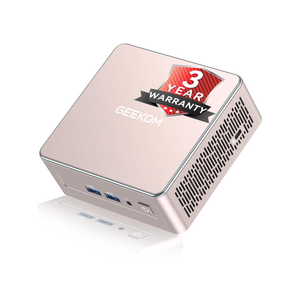
- Brand
-
GEEKOM
- Processor
-
AMD Ryzen 5 7430U
The Geekom A5 Mini PC is not a full-sized desktop computer and it doesn’t pretend to be one. But if you need a solid mini PC with a full understanding of the form factor, you’ll like what this one has to offer.


