Big-Nosed Herbivorous Dinosaur May Have Been Picky Eater


New research shows that the large ornithopod dinosaur Muttaburrasaurus langdoni from the Middle Cretaceous of Australia was no ordinary herbivore. Equipped with a toothed beak and a brain programmed for smell, this species probably combined selective feeding and agile behavior. The findings also hint at living near a vast inland sea, where it may have consumed salty plants – and perhaps even small animals – to survive.
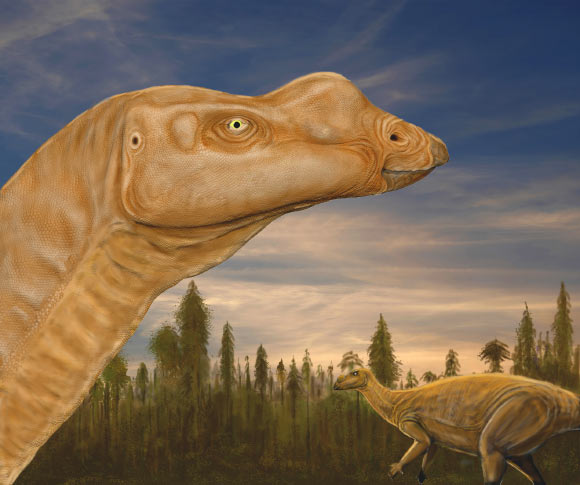
Muttaburrasaurus langdoni. Image credit: Matt Herne.
Muttaburrasaurus langdoni lived about 96 million years ago near the ancient Eromanga Inland Sea in what is now Australia.
The holotype specimen was discovered in 1963 near the township of Muttaburra in central-west Queensland by local breeder Doug Langdon.
It is one of the most complete ornithopod dinosaurs from the supercontinent Gondwana and is the fossil emblem of the state of Queensland.
In new research, paleontologist Matthew Herne of the University of New England and his colleagues examined different parts of the Muttaburrasaurus langdoniThe skull of a new specimen.
“Our discovery redefines several assumptions made about the bump-nosed species, which is the fossil emblem of Queensland,” Dr Herne said.
“The first astonishing discovery was that Muttaburrasaurus langdoni had teeth at the end of its snout.
“This was unexpected, because the beak (front part of the snout) of Muttaburrasaurus langdoni It was thought to be toothless, like many other well-known herbivorous species, such as Iguanodon of Europe and the “duck-billed” hadrosaurs, which are found mainly in the northern hemisphere.
“But ornithischian dinosaurs of this size normally had a beak-like snout without teeth, a good example being Triceratops.”
“Therefore, this Australian dinosaur’s beak was not toothless and was likely a pickier eater.”
With its narrow, toothy beak, Muttaburrasaurus langdoni would have looked for particular leaves and seeds and perhaps even invertebrates to vary their diet.
This also means that Muttaburrasaurus langdoni evolved from an earlier offshoot of the ornithopod dinosaurs of Camptosaurus And Iguanodonwhen earlier forms of small ornithischians all had toothed beaks.
This new discovery may help to locate Muttaburrasaurus langdoni more specifically on the dinosaur tree of life.
“The results were obtained by extracting the brain fingerprint on the skull and inner ears,” said Professor Vera Weisbecker from Flinders University.
“We realized that its inner ear was more like dinosaurs that walked on two legs, like Tyrannosaurus rexthan others who spent more time on all fours.
“It is therefore possible that Muttaburrasaurus langdoni was a large herbivore that walked and ran on its hind legs when needed and used its front arms for support to gather food closer to the ground.
The researchers also discovered that the characteristic “bulbous” shape of Muttaburrasaurus langdoniThe nose is made up of entirely new bones not found in other dinosaurs.
“The discovery of the new bones was exciting because they revealed two large, complex air chambers above the main inhaled airflow, which would have slowed down the air as it was inhaled,” Dr Herne said.
“So we suspect that they indicate a very acute sense of smell, perhaps to help the animal find food, detect predators or aid directional navigation.”
“This nose feature also corresponds to their very large olfactory bulbs – among the largest of all dinosaurs – which are the parts of the brain where smell is processed.”
“The use of advanced CT, neutron scattering and synchrotron technologies has provided detailed 3D digital models of the jaws and teeth,” added Australian Nuclear Science and Technology Organization (ANSTO) researcher Dr Joseph Bevitt.
The study was published online in the journal PeerJ.
_____
MC Herné and others. 2026. Cranial anatomy, paleoneurology, paleobiology and stratigraphic age of the large ornithopod, Muttaburrasaurus langdoni Bartholomai and Molnar, 1981, from the Middle Cretaceous of Australia. PeerJ 14:e20794; doi: 10.7717/peerj.20794


