Study finds that dangerous days when weather is prone to fire soaring around the world

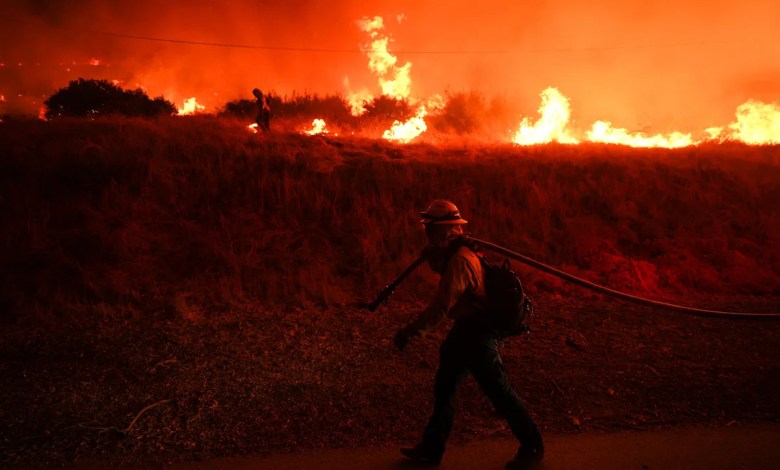
WASHINGTON (AP) — The number of days when weather turns hot, dry and windy — ideal for sparking extreme wildfires — has nearly tripled over the past 45 years across the world, with an even steeper upward trend in the Americas, a new study finds.
And more than half of that increase is caused by human-caused climate change, the researchers calculated.
This means that as the world warms, more and more places around the world are likely to catch fire at the same time due to increasingly synchronous fire conditions, that is, when several places have the ideal conditions to go up in smoke. Countries may not have enough resources to put out all the fires that break out and help will be less likely to come from neighbors busy with their own flames, according to the authors of a study published Wednesday in Science Advances.
In 1979 and over the next 15 years, the world experienced an average of 22 synchronous fire days per year for flames that remained in large regions of the world, the study found. In 2023 and 2024, it was up to more than 60 days per year.
“These kinds of changes that we’ve seen increase the likelihood in many areas of fires that will be very difficult to put out,” said John Abatzoglou, study co-author and fire specialist at the University of California, Merced.
Researchers didn’t look at actual fires, but at weather conditions: hot, with strong winds and dry air and ground.
“It increases the likelihood of widespread fires, but weather is only one-dimensional,” said the study’s lead author, Cong Yin, a fire researcher at the University of California, Merced. Other main ingredients of fires are oxygen, fuels such as trees and brush, and ignitions such as lightning, arson or human accidents.
The study is important because extreme fires are the main, but not the only, driver of increasing fire impacts around the world, said Mike Flannigan, a fire scientist at Thompson Rivers University in Canada, who was not involved in the study. And it’s also important because regions that once experienced fire seasons at different times and could share resources now overlap, he said.
Abatzoglou said: “And that’s where things start to break down. »
More than 60% of the global increase in synchronous fire days can be attributed to climate change from the burning of coal, oil and natural gas, Yin said. He and his colleagues know this because they used computer simulations to compare what happened over the past 45 years to a fictional world without the increase in greenhouse gases from burning fossil fuels.
From 1979 to 1988, the continental United States experienced an average of 7.7 synchronous fire days per year. But over the past ten years, that average has reached 38 days per year, according to Yin.
But that’s nothing compared to the southern half of South America. This region experienced an average of 5.5 synchronous fire days per year from 1979 to 1988; over the past decade, this figure has increased to 70.6 days per year, including 118 days in 2023.
Of 14 regions around the world, only Southeast Asia has seen a decrease in synchronous fires, likely because it is wetter there, Yin said.
___
Associated Press climate and environmental coverage receives financial support from several private foundations. AP is solely responsible for all content. Find AP’s standards for working with philanthropic organizations, a list of supporters, and funded coverage areas at AP.org.


