Supergiant star Betelgeuse is full of mysteries. New observations might solve the biggest one

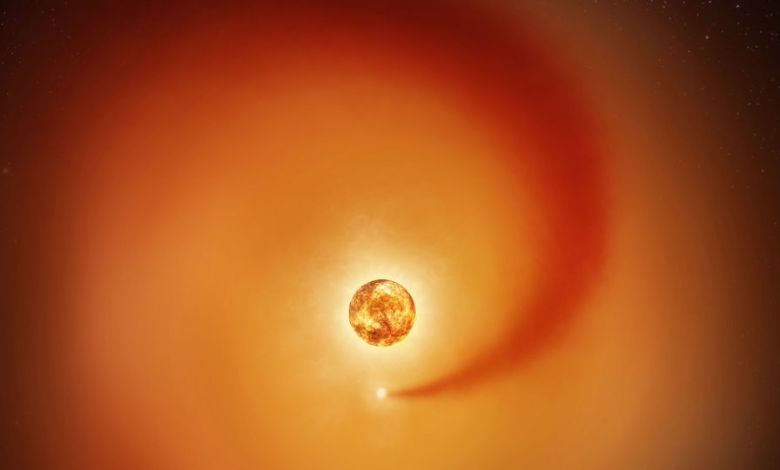
Astronomers have long searched for clues that a hidden companion star lies out of sight near the red supergiant star Betelgeuse. Today, they discovered a new piece of evidence: a wake-like trail behind a boat, crossing Betelgeuse’s upper atmosphere, likely forged by the invisible companion.
Betelgeuse’s reddish hue can be spotted in the constellation Orion, located about 650 light years from Earth.
The bright star is so big it could hold more than 400 million suns. Its relative proximity and brightness have made it one of the favorite stars of astronomers who observe and study the evolution of the giant star.
Yet despite being so well known, Betelgeuse has its share of secrets – one of the biggest being why its brightness appears to vary over a six-year cycle, and whether the invisible stellar companion, nicknamed “Betelbuddy”, is responsible for this variability.
Clues about the possible companion star were shared in research published last year, in which scientists suggested formally naming the object Siwarha, or “its bracelet,” an Arabic name befitting Betelgeuse’s companion, meaning “Hand of the Giant.” (“Elgeuse” is also the historical Arabic name for the constellation Orion.)
Siwarha would likely be too small and faint to see given its proximity to Betelgeuse, which grew by burning all the hydrogen in its core, bringing it near the end of its life.
Now, observations over the past eight years have revealed Siwarha’s effects on Betelgeuse: a never-before-seen dense trail of gas moving through the outer atmosphere of the larger star, where Siwarha orbits closely.
Siwarha’s trace appeared just after the star passed Betelgeuse from Earth’s perspective. Astronomers believe that Siwarha orbits Betelgeuse every six years, hence the larger star’s brightness changes every six years. The observations are included in a new study that has been accepted for publication in the Astrophysical Journal.
“It’s a bit like a boat moving on water. The companion star creates a ripple effect in Betelgeuse’s atmosphere that we can actually see in the data,” study lead author Andrea Dupree, an astronomer at the Harvard-Smithsonian Center for Astrophysics, said in a statement.
“For the first time, we observe direct signs of this wake, or gas trail, confirming that Betelgeuse actually has a hidden companion that shapes its appearance and behavior.”
Spotting the trail
Betelgeuse is about 15 times the mass of our sun and 1,400 times its diameter, Dupree said. Meanwhile, Siwarha is tiny and could be smaller than our sun.
“If you placed Betelgeuse at the center of our solar system, the surface would extend to Jupiter and the warm atmosphere above would extend at least 6 times farther,” Dupree said. “So the companion actually passes through the dense atmosphere of the supergiant star.”
Dupree’s team has been tracking changes in Betelgeuse’s light for years, using the Hubble Space Telescope as well as ground-based observatories like the Fred Lawrence Whipple Observatory and the Roque de Los Muchachos Observatory.
Patterns that emerged in the observations, captured both near the star and further away, suggested that a companion star was spinning in Betelgeuse’s extended atmosphere. The team recorded changes in the speed and direction of gases in the large star’s outer atmosphere due to a disturbance.

A plot of Hubble data shows the signature of the companion star orbiting Betelgeuse. -Elizabeth Wheatley/ESA/NASA
Hubble allowed the team to see how Betelgeuse’s deep atmosphere, or chromosphere, responded to Siwarha’s movement, while ground-based observations revealed changes in the broader atmosphere.
“What we learn from these latest results is that Siwarha appears to ‘stir up’ Betelgeuse’s extended atmosphere during its orbit, leaving a wake that impacts what we see from Betelgeuse itself,” said study co-author Morgan MacLeod, a postdoctoral researcher in theoretical astrophysics and a member of the Institute for Theory and Computation at the Harvard-Smithsonian Center for Astrophysics.
“This wake is evidence of the presence of Siwarha and it is also a trace of how such a small companion is able to affect what we see of Betelgeuse, by modulating the gas and dust around it,” he added.
The results support findings about Siwarha made by Steve Howell and his team in 2025. Howell is a senior research scientist at NASA’s Ames Research Center in California.
His team’s observations suggest that Siwarha’s detected size also included a larger region around it as it traveled through Betelgeuse’s atmosphere.
“The idea of an expanding plasma wake surrounding Siwarha would seem to be consistent with our discovery of a larger, larger source and not just a bare stellar photosphere,” Howell said. He was not involved in the new study.
Windows on giant stars
Tracking Betelgeuse’s behavior and variations can help astronomers better understand other faint and distant giant stars that are difficult to study, MacLeod said.
But in recent years, Betelgeuse has thrown astronomers with some puzzling problems that required some serious detective work to solve.
From late 2019 to early 2020, Betelgeuse dimmed so sharply that experts believed the star was about to explode as a supernova. Since this event, called the Great Dimming, teams of astronomers have determined that the star ejected a large cloud of dust, which temporarily blocked some of its light from Earth’s perspective.
Additionally, the star exhibited two regular variations in brightness: the six-year period, as well as a cycle that lasts just over a year.
Data collected over the years has shown that Betelgeuse’s brightness varies approximately every 416 days, becoming dimmer and then brighter. This pulsation, which occurs in Betelgeuse’s core, was found to be typical of red supergiant stars.
The longer period of 2,100 days was thought to be due to dust clouds, large convection cells on the star, magnetic activity, or an elusive companion star still beyond the optical range of telescopes.
Over the past year, evidence from several research teams indicated that the reason was the presence of Siwarha.
“With this new direct evidence, Betelgeuse gives us a front-row seat to observe how a giant star evolves over time,” Dupree said. “Finding the wake of its companion means we can now understand how stars like this evolve, lose material and eventually explode as supernovae.”
Other supergiant stars that also exhibit similar patterns of long and short variability may also have unseen companions, Dupree added.
Jared Goldberg, a researcher at the Flatiron Institute’s Center for Computational Astrophysics, says the new observations are an important piece of the puzzle in understanding what causes Betelgeuse’s six-year variability. Goldberg has previously written research on the companion star, but was not involved in this study.
If astronomers can conclude that the periodic variability is due to the presence of a second star, “we can make direct connections to the physics behind the formation and evolution of stars and planets,” Goldberg said.
The team is also working on hydrodynamic models to determine how the wake forms behind Siwarha and reconstruct how that affects Betelgeuse’s brightness, MacLeod said.
A hydrodynamic analysis would provide the vital information needed to interpret the new observations, such as what to expect from the motion of a solar-sized companion moving through the outer atmosphere of a massive red supergiant, said Edward Guinan, a professor of astronomy and astrophysics at Villanova University in Pennsylvania. Guinan studied Betelgeuse but was not involved in the new research.
Siwarha’s uncertain future
With Siwarha so close to Betelgeuse, what is the fate of the smaller star?
MacLeod believes Siwarha is moving ever closer to its enormous companion due to gravitational forces, which could lead to a merger within 9,000 years.
“We think stars could merge even before Betelgeuse goes supernova,” MacLeod said. “This would project gas, rotate Betelgeuse and potentially affect the properties of the possible supernova.”
According to astronomers’ calculations, Siwarha is now on the other side of Betelgeuse from terrestrial telescopes, but it is expected to appear in 2027.
“Additional detections will refine its orbit and thus give a better mass of Siwarha, helping to explain the evolution of the binary system, the rapid rotation of Betelgeuse and the future of the two stars,” Howell said.
Several teams hope to find a way to optically detect Siwarha.
“Seeing the companion will be the ultimate proof of its implied existence,” Guinan said. “I can’t wait.”
Sign up for CNN’s Wonder Theory science newsletter. Explore the universe with information on fascinating discoveries, scientific advances and much more.
For more CNN news and newsletters, create an account at CNN.com