Ozone Layer Recovery Continues under Montreal Protocol


September 16, 2025
3 Min read
The ozone hole is regularly shrinking due to global efforts
After almost 40 years of world efforts, the ozone hole on Antarctica continues to heal
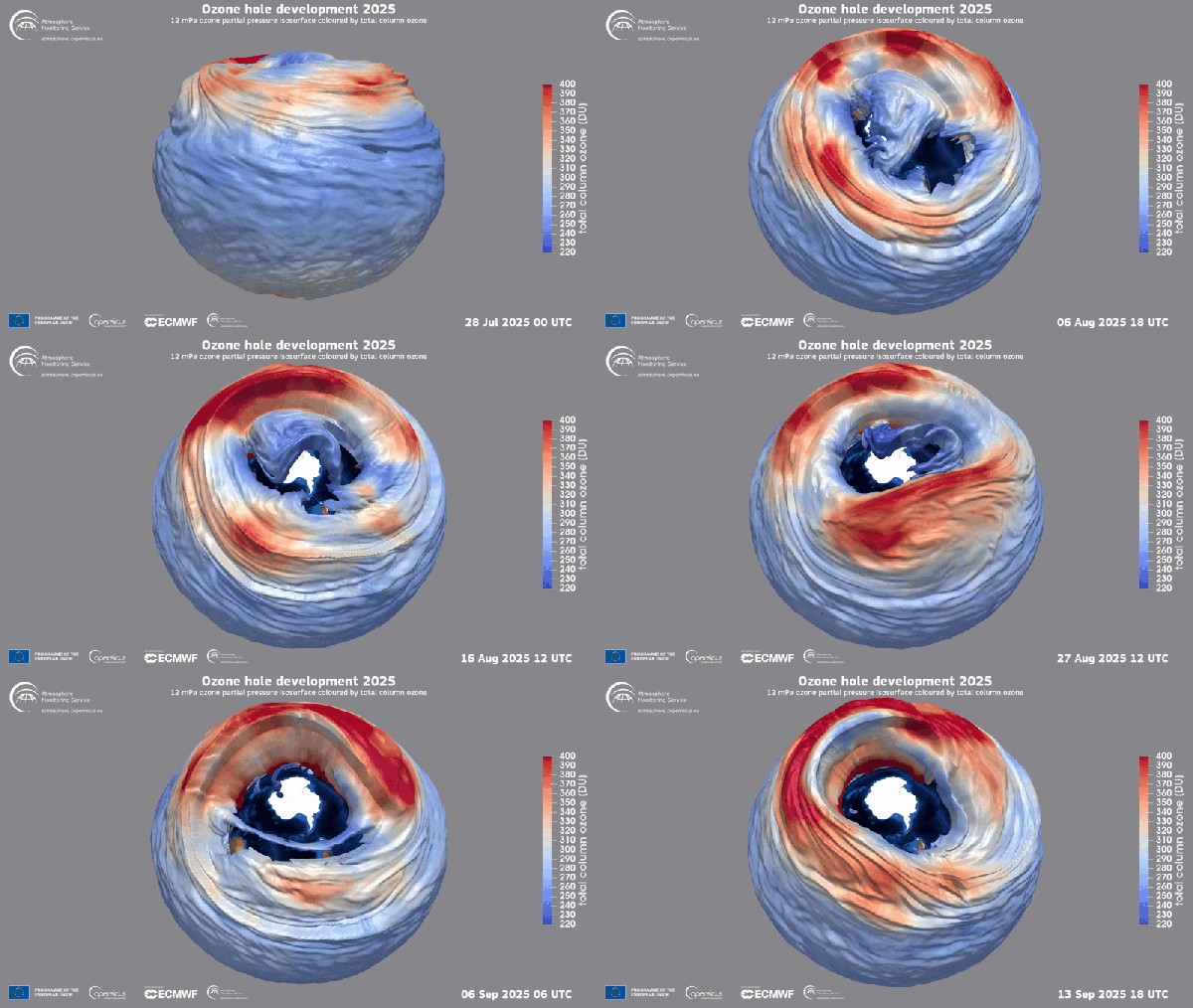
A 3D rendering of the evolution of the ozone hole in 2025.
Forty years after the world decision -makers have started to struggle with the crisis posed by a gaping hole in the protective ozone layer on the Antarctic, damage continues to heal, according to a new report by the world meteorological organization.
Found between about nine and 19 miles above the earth surface, the ozone layer is a large region of the stratosphere where the molecule, which contains three oxygen atoms, is particularly concentrated. Here, ozone plays a vital role in blocking the ultraviolet sun radiation – acting essentially as a planetary sunscreen in a way.
In the 1980s, scientists realized that a massive hole developed in the ozone layer above Antarctica at each spring in the south, then linked observation to previous research which discovered that a group of chemicals called chlorofluorocarbons (CFC) could be stored at the atmospheric ozone. The nations gathered to develop an agreement called the Montreal Protocol on substances that exhaust the ozone layer, adopted in 1987, to stop the production of these chemicals.
On the support of scientific journalism
If you appreciate this article, plan to support our award -winning journalism by subscription. By buying a subscription, you help to ensure the future of striking stories about discoveries and ideas that shape our world today.
“The Montreal Protocol is the best environmental agreement we have ever created,” said Durwood Zaelke, expert in environmental policy at the University of California, Santa Barbara, and founder and president of the Governance and Sustainable Development Institute, an organization focused on the fight against short -term but high -level climate pollutants. These include hydrofluorocarbons (HFC), which does not harm the ozone layer and have replaced many CFCs because they have been removed. The agreement has collected the world signatories, several successful cycles of modifications and the almost total elimination of chemicals that break down ozone. “It’s a big deal,” says Zaelke.
The result is a layer of ozone that scientists predict will recover the health it had in 1980 on the tropics and the average latitudes by 2040, on the Arctic by 2045 and on the Antarctic for 2066. “It takes a long time to cure the stratospheric ozone”, says Zaelke.
The new 2024 report of the World Meteorological Organization proves that the slow process continues as scientists expected it, explains Ar Ravishankara, atmospheric chemist of Colorado State University. The report shows that, on 2024, the total ozone levels in the atmosphere were higher than the 2003-2022 average for most of the planet – just a strip near the equator and a small plot of Antarctic coast in southern Africa was lower than this marker.
A particularly notable change came to Antarctica, where the exhaustion of ozone was notably lower than those of the years between 2020 and 2023. The ozone hole of 2024 also formed relatively slowly and recovered relatively quickly – a good sign for the future of the ozone layer, according to the report.
Ravishankara notes that on the long way to recovery, scientists expect to see better years and worse years. “A year does not tend,” he says. Ravishankara adds that the new report and other ozone observations in the atmosphere show a slow but regular ozone replenishment.
Ozone is produced mainly at latitudes closer to the equator. And from there, he must disperse towards the poles, where production is much slower due to reduced sunlight, says Ravishankara. The production and transport of ozone can be influenced by more important events in atmospheric phenomena, including the natural climate phenomenon called El Niño, the level of activity of the sun, the large -scale movement of the atmosphere and of course climate change.
An additional complication is that ozone in the lowest part of the atmosphere, called troposphere, always blocks sunlight but also acts as a harmful pollutant for human health. “You should know not only the total quantity of ozone above your head, but also where it is and how it changes in different parts of the atmosphere,” explains Ravishankara.
This is why the different forms of surveillance – both by satellites and soil – are so essential to understanding the state of the ozone layer. “This is what I call the responsibility phase of the Montreal Protocol, where you want to make sure that the results you want are obtained,” explains Ravishankara. “It will improve unless we jostle something else.”
Zaelke is concerned that the Montreal Protocol, such as international agreements in general, will not do well under President Donald Trump – however, at the request of industrial groups, he signed American legislation that joined the nation to the last amendment to the protocol, Zaelke said. However, he thinks that the global infrastructure dedicated to ozone recovery should be sufficient to resist the trend of administration far from world partnerships. “While the world will miss American leaders,” says Zaelke, “that will survive.”
It’s time to defend science
If you enjoyed this article, I would like to ask for your support. American scientist has been a defender of science and industry for 180 years, and at the moment can be the most critical moment of this two -centuries story.
I was a American scientist The subscriber since the age of 12, and that helped shape my way of looking at the world. Sciam Educates me and always delights me, and inspires a feeling of fear for our vast and magnificent universe. I hope that does this for you too.
If you subscribe to American scientistYou help make sure that our cover is focused on significant research and discoveries; that we have the resources necessary to report the decisions that threaten laboratories in the United States; And that we support the budding scientists who work at a time when the value of science itself does not become often again.
In return, you get essential news, Captivating podcasts, brilliant infographics, Maybe not miss newsletters, videos to watch, Difficult games and the best writings and reports in the scientific world. You can even Give someone a subscription.
There has never been more time for us to get up and show why science counts. I hope you will support us in this mission.


:max_bytes(150000):strip_icc()/Health-GettyImages-1807778714-7fbbb5750fa04d3f8c2393b36ef7eba0.jpg?w=390&resize=390,220&ssl=1 "5 Juices That Can Help Lower Your Blood Pressure Naturally")


