‘Superheated’ stellar factory in the early cosmos is producing stars 180 times faster than the Milky Way

When you purchase through links on our articles, Future and its syndication partners may earn a commission.

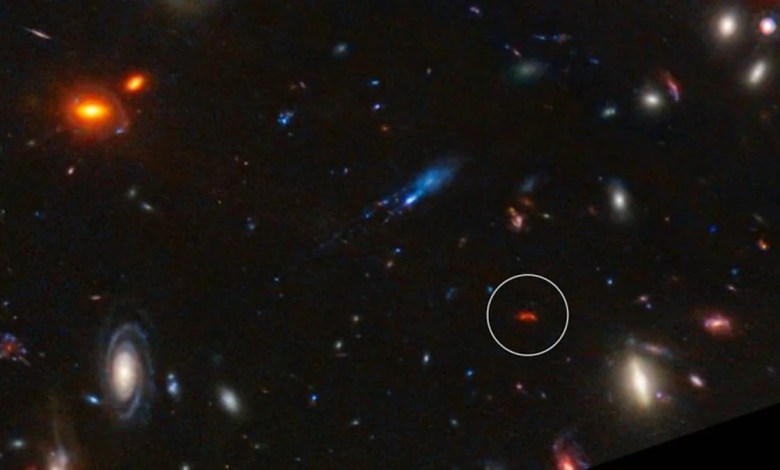
Galaxy Y1, the red rimmed speck, seen by the James Webb Space Telescope. | Credits: NASA, ESA, CSA, STScI, J. Diego (Instituto de Física de Cantabria, Spain), J. D’Silva (U. Western Australia), A. Koekemoer (STScI), J. Summers & R. Windhorst (ASU) and H. Yan (U. Missouri)
Astronomers have discovered a superheated “star factory” that existed just 800 million years after the Big Bang. The star factory, a galaxy known as Y1, gives birth to stars at a rate 180 times faster than the Milky Way. The discovery of a previously unknown extreme region of star birth could help scientists explain how galaxies grew so quickly in the early universe.
The team discovered the nature of Y1 by first measuring the temperature of its superheated cosmic dust. Using the Atacama Large Millimeter/submillimeter network (ALMA), the researchers were able to analyze the light emitted by the primordial galaxy, which travels towards Earth for 13 billion years.
Scientists say this has revealed a previously hidden epoch in cosmic history. “We’re going back to a time when the universe was producing stars much faster than it is today,” said team leader Tom Bakx, of Chalmers University of Technology in Sweden. said in a statement. “Previous observations revealed the presence of dust in this galaxy, making it the most distant where we have ever directly detected light from glowing dust. This made us suspect that this galaxy might be operating a different type of superheated star factory. To be sure, we decided to measure its temperature.”
The research is part of an ongoing effort by astronomers to understand the conditions under which the first generation of stars, known as “Population III (POP III)” stars, formed. These conditions are thought to be very different from those in which modern stars, or POP I, like the sun, were born.
Star factories on tour
Stars are forged in vast complexes of dense gas and dust like the Orion Nebula and the Carina Nebula in the local universe. These nebulae are bright because their star-forming gas and dust are illuminated by the light of the young, massive stars they contain. This illumination covers both light visible to the human eye and longer wavelengths in the infrared and radio regions of the electromagnetic spectrum.
“At wavelengths like this, the galaxy is illuminated by clouds of bright dust grains,” Bakx said. “When we saw how bright this galaxy glows compared to other wavelengths, we immediately knew we were dealing with something truly special.”
This revelation was possible thanks to the sensitivity of ALMA, made up of 66 radio antennas located in the Atacama desert region of northern Chile, and its Band 9 instrument which is tuned to a specific wavelength of light. ALMA allowed Bakx and his colleagues to determine that Y1’s dust glowed at a temperature of about minus 356 degrees Fahrenheit (minus 180 degrees Celsius).
“The temperature is certainly cold compared to house dust on Earth, but it is much warmer than in any other comparable galaxy we have seen,” said team member Yoichi Tamura from Nagoya University in Japan. “This confirmed that this is indeed an extreme star factory. Although this is the first time we have seen a galaxy like this, we think there could be many more. Star factories like Y1 could have been common in the early universe.”
While Y1 is producing stars and growing at an incredible rate of around 180 solar masses each year, as the team observed 13 billion years ago, this period of stellar explosion wouldn’t have lasted too long, at least not in cosmological terms. Scientists hypothesize, however, that these periods of intense star formation or star explosions might have been common in early galaxies, but are currently hidden from our view.
“We don’t know how common such phases might be in the early universe, which is why in the future we want to look for more examples of star factories like this,” Bakx said. “We also plan to use ALMA’s high-resolution capabilities to take a closer look at how this galaxy works.”

The Y1 galaxy and its surroundings as seen by the NIRCAM of the James Webb Space Telescope (blue and green) and by ALMA (red). | Credits: NASA, ESA, CSA (JWST), T. Bakx/ALMA (ESO/NRAO/NAOJ)
Further investigation of Y1 could help answer a lingering riddle about galaxies in the early universe. Previous studies have shown that primordial galaxies are filled with more dust than their older population of stars can create. The relatively high temperature of Y1 may provide an answer to this conundrum, suggesting that the high volume of dust is actually an illusion.
“The galaxies of the early universe appear too young for the amount of dust they contain. This is strange, because they don’t have enough old stars, around which most of the dust grains are created,” said team member Laura Sommovigo of the Flatiron Institute and Columbia University. “But a small amount of hot dust can be just as bright as a large amount of cold dust, and that’s exactly what we observe in the first year.
“Even though these galaxies are still young and don’t yet contain a lot of heavy elements or dust, what they do contain is both hot and bright.”
The team’s research was published Wednesday, November 12, in the journal Monthly Notices of the Royal Astronomical Society.


