Early Homo Reached Jordan Valley by at Least 1.9 Million Years Ago


New research recalibrates the age of the Ubeidiya Formation in the Jordan Valley to almost two million years, putting it on par with the famous Dmanisi site in Georgia. This could mark a pivotal moment in human evolution – evidence that early hominids with advanced tool-making techniques ventured into new environments much earlier than expected.

It is an artistic reconstruction of Homo erectus. Image credit: Yale University.
The Ubeidiya archaeological site is located in the Jordan Valley in Israel, between the village Menahemia and kibbutz Beit Zera.
First discovered in 1959, the site yielded distinctive Acheulean axes, but only a few hominid fossils.
“The Ubeidiya Formation has long been of interest to researchers because it preserves early evidence of the Acheulean culture, characterized by large bifacial stone tools found in association with rich faunal assemblages, including species of African and Asian origin, some of which are now extinct,” said Professor Ari Matmon of the Hebrew University of Jerusalem and colleagues.
“However, establishing the exact age of the site has remained a challenge for decades.”
“For many years, most researchers estimated that Ubeidiya was between 1.2 and 1.6 million years ago, but this age was based on relative chronology.”
To determine the precise age of the site, the researchers used three independent dating methods: magnetostratigraphy, uranium-lead (U-Pb) dating of mollusc shells, and dating of cosmogenic isotope burials.
“Cosmogenic isotope dating measures rare isotopes created when cosmic rays strike rocks on Earth’s surface,” they explained.
“Once these rocks are buried, the isotopes begin to decay at predictable rates, triggering a geological clock that reveals how long they have been underground.”
“We also examined traces of the Earth’s ancient magnetic field preserved in the site’s lake sediments,” they added.
“As sediments settle, they become stuck in the direction of the planet’s magnetic field at that time.”
“By matching these magnetic signatures to known reversals in Earth’s history, we determined that the layers formed during the Matuyama Chron, a period that began more than two million years ago.”
“Finally, we analyzed the fossils Melanopsis shells, freshwater snails embedded in sediments, using U-Pb dating to establish a minimum age for the layers in which the stone tools were discovered.
“Overall, the results converged at a much earlier date than expected.”
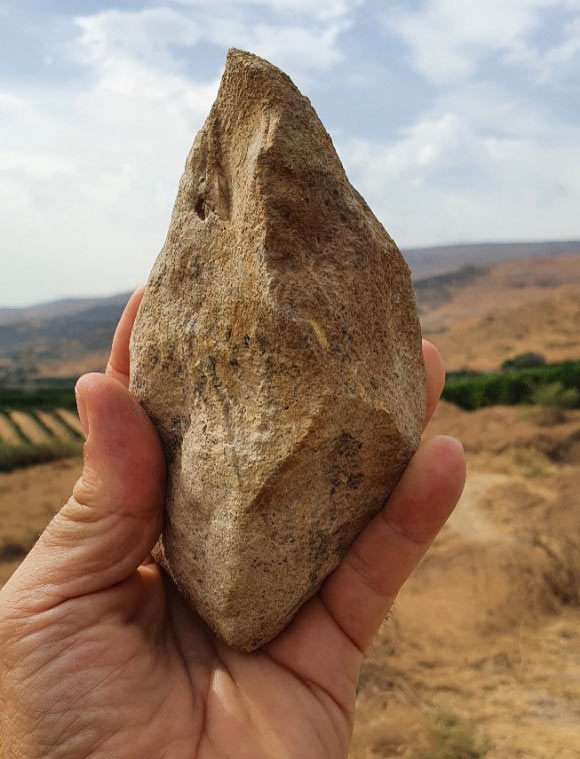
A bifaced stone tool from the Ubeidiya site in Israel. Image credit: Omry Barzilai.
The team’s results indicate that the Ubeidiya site is at least 1.9 million years old, significantly older than previous assessments.
“The new timeline suggests that Ubeidiya is about the same age as the well-known site of Dmanisi in Georgia, meaning that our ancestors spread to different regions at the same time,” the scientists said.
“It also suggests that two different stone tool-making technologies, the simpler Oldowian tradition and the more advanced Acheulean tradition, migrated at the same time from Africa by the different hominid groups as they moved into new territories.”
The study was published in the journal Scientific reviews of the Quaternary.
_____
A. Matmon and others. 2026. Complex history of exposure and burial and recycling of Pleistocene sediments in the Dead Sea Rift with implications for the age of the Acheulean site of ‘Ubeidiya. Scientific reviews of the Quaternary 378:109871; doi: 10.1016/j.quascirev.2026.109871


