Surgeon banned by private practice is working for NHS


Social Affairs Correspondent

 Bbc
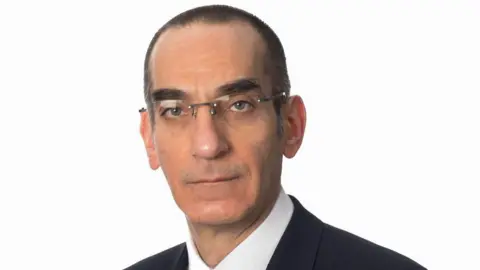
BbcA surgeon prohibits working for a private health care company, following an investigation into patient safety, continues to work in the NHS, the BBC learned.
Nuffield Health prevented Marc Lamah from working in their hospitals, but he still operates on patients for Sussex NHS Foundation Trust university hospitals.
An NHS patient left with a twisted intestine after an operation he made said he should never work again.
Mr. Lamah did not respond to the BBC comment request sent via his employer.
In January, the BBC revealed that the concerns had been raised concerning Mr. Lamah’s complications rate and that it no longer practiced at Nuffield Healthon hospital in Brighton pending an investigation.
A former hospital employee told the BBC that internal data showed that a third of Mr. Lamah’s patients had experienced a “moderate damage event”, where, for example, a patient had to be transferred to another hospital or reader, over a period of 12 months. The figure should be 5%, has been informed of the BBC.
In a statement to the BBC, Nuffield Health said that following an independent investigation, “we can confirm that Mr. Lamah’s practice of practice with Nuffield Health were removed.
“His conduct did not meet the standards of medical practice and governance that we expect. Patient safety is our absolute priority, and we hold all consultants according to the highest standards.”
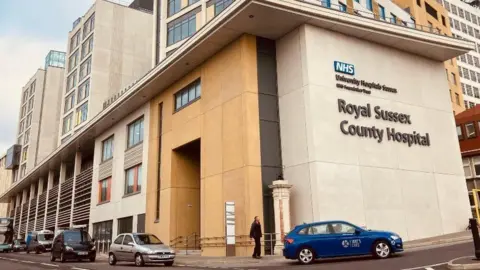
Mr. Lamah continues to operate as a colorectal surgeon at Royal Sussex County Hospital in Brighton.
Sussex NHS Trust university hospitals, which manages the hospital, told the BBC that it had audited the NHS data from Mr. Lamah, which showed that its results were in the expected national range. The trust added that Nuffield’s investigation had found “no concerns about technical capacities, surgical practice or patient safety”.
The trust is at the center of a large police investigation, the Brand operation, examining at least 200 cases of alleged medical neglect.
Sussex police examine concerns about preventable damage and concealation in neurosurgery and general trust services between 2015 and 2021.
The Trust manages seven hospitals in the east and western Sussex and is one of the largest NHS organizations, offering care to a population of nearly two million people.
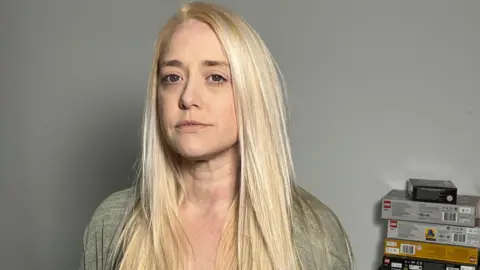
Sheryl Hunter says that she suffered “five years of hell” after an NHS operation carried out by Mr. Lamah. She must manually search her intestines and needed several emergency admissions.
After suffering from endometriosis for a number of years, doctors decided in 2019 that Ms. Hunter, a single mother, needed an operation to alleviate her pain.
Lamah decided that the best approach was to remove part of his large intestine, the colon, and connect it to his small intestine.
A few days after her release, said Ms. Hunter: “I felt something pop, and this very horrible fluid came from me”.
It was precipitated towards the Royal Sussex where they discovered that the articulation between the two intestines had torn, and “for 10 days, he had filled my abdomen with intestinal matter”.
This is a known complication of this type of surgery, includes the BBC.
Despite this problem solved, Ms. Hunter continued to suffer from extreme pain for several years, requiring repeated visits to her general practitioner and the Royal Sussex hospital.
She said, “I have very few good days. By that, I mean I am curled up in a ball crying.
“When I try to go to the toilet, I cry on the toilet in tears because it is so painful to go, to open my intestines. I have to do it manually, which means that I have to wear gloves.
“The pain is very severe – it’s in my stomach, it enters my spine, on my legs, my arms.”
Letters shared with the BBC by Mrs. Hunter show that her general practitioner wrote to Mr. Lamah asking him several times to see her again.
In January 2023, the GP wrote that “we wrote to you several times to review it and discuss its options”.
A few days later, Mr. Lamah replied to say that he had received no previous letter.
But almost 12 months later, in December 2023, the general practitioner wrote another letter urging Mr. Lamah to see her.
Ms. Hunter told the BBC that he had been “begged” by colleagues to see her but “he refused”.
Finally, in April 2024, she was seen by another consultant in another hospital led by the same trust – the Princess Royal Hospital of Haywards Heath – when she discovered what caused her pain.
“The main problem is a touch to 180 degrees on the small intestine causing an internal hernia and turning anastomosis [the surgical joint]”Said the exit sheet given to Ms. Hunter by the hospital after the procedure.
“When they reconnect [of the intestines]They put it back, “said Sheryl.
“That [creates] A risk of rupture. If you run up, it’s a two -hour window before death.
“If I hadn’t opened my intestines manually for five years, they said it would have happened.”
The trust said that the surgical error has only been presented as one of the possibilities.
The BBC has transmitted details to an independent medical expert who declared that torsion “is certainly a consequence of the 2019 operation”.
The trust indicates that only another operation would confirm whether Mr. Lamah had made an error or if the torsion had occurred naturally.
However, damage is now more extensive than it would have been if Ms. Hunter had been treated earlier.
She was told that she would need pelvic reconstruction surgery before he could have another operation to try to repair her intestines. She is on a waiting list for the first procedure and spoke to the Sussex police of her experience.
Former NHS colleagues have also raised concerns at the BBC about Mr. Lamah, but he continues to train at the County Hospital of Royal Sussex.
“I think it’s disgusting. This man should not be allowed to reach other patients,” said Ms. Hunter.
“I was told that Marc Lamah had a terrible way, but he is a fantastic surgeon.
“Marc Lamar has a terrible way, and he is a terrible surgeon. He should not be allowed to work, as far as I’m concerned.”
‘Robust systems’
In a press release, Professor Katie Urch, chief doctor of the University Hospitals Sussex NHS Foundation Trust, told the BBC: “We cannot publicly discuss the care of an individual, but we absolutely understand the distress and difficulty in anyone who lives with complex health problems in progress can be confronted.
“Our clinical teams are devoted to understanding the needs of their patients and providing the highest level of care.
“Although no medical procedure can guarantee a successful result, our teams are looking for the best possible results every day – and if we ever have reason to think that we could have done more for a patient, we have robust systems, including the routine use of independent experts, to help us learn and improve.”


