Symbols found carved into 40,000-year-old artifacts may be precursor to writing

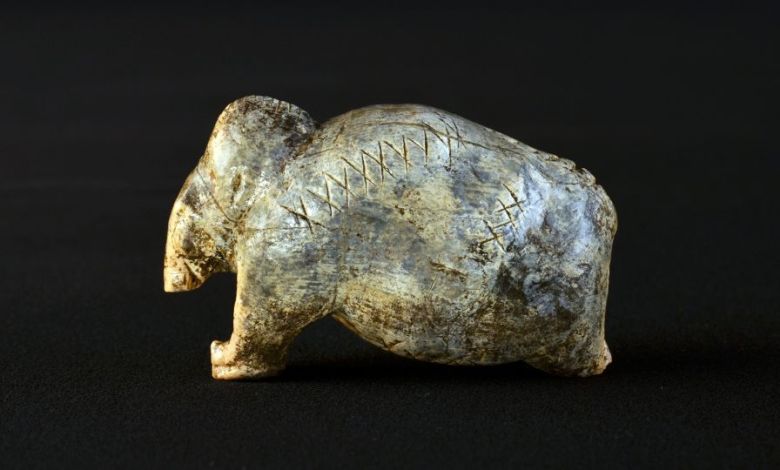
Symbols and inscriptions carved on tools and figurines by Stone Age humans more than 40,000 years ago may be an ancient precursor to writing, a new analysis suggests.
The markings, found on 260 German artifacts, are very different from modern writing systems, but show the same level of complexity and information density as proto-cuneiform writing, which appeared in Mesopotamia, or modern-day Iraq, around 5,300 years ago. The writing used abstract pictographic symbols and quickly developed into cuneiform writing, which researchers consider to be the first known writing system.
“They are very similar, in fact, indistinguishable from early proto-cuneiforms,” said Christian Bentz, an associate professor at Saarland University in Germany and co-author of a study of Stone Age sculptures, published Monday in the journal PNAS. “This really surprised us, because we expected that these sign sequences would not be close to either proto-writing or modern writing.”
The researchers used computer-assisted methods to analyze around 3,000 geometric signs, including crosses, dots, notches and lines. Carved on objects made of ivory, bone and antler, the marks often depicted animals common in the region at the time, such as woolly mammoths, lions, bears and horses. Some of the figurines, which had a higher information density than the tools, depicted human-lion hybrids, perhaps as a form of connection or appreciation for the earth’s top predator, according to the study authors.
The objects analyzed in the study come from a relatively small area of the Swabian Alps in southwestern Germany, but they are not the only ones to bear these types of markings, which are commonly found on tools and sculptures from the Paleolithic, or Early Stone Age, dating between 34,000 and 45,000 years ago. “That was more or less when anatomically modern humans entered the European continent from Africa and started living there,” said study co-author Ewa Dutkiewicz, an archaeologist and curator at the Museum of Prehistory and Ancient History in Berlin.

An ivory figurine features the shape of a human figure as well as multiple sequences of notches and dots, suggesting a scoring system. – Hendrik Zwietasch/Württemberg Regional Museum
“In addition to these inscriptions, they had figurative art. They had tools. They had personal ornaments. They had musical instruments,” Dutkiewicz added. “So they were quite modern in their behavior, and now we can say that the foundations of a signaling system were also present at that time.”
Meaning uncertain
The signs often appear in patterns — such as line, line, line or cross, cross, cross — that are not common in spoken language, researchers say. Some of these artifacts were discovered almost 100 years ago, but ongoing excavations are constantly revealing new ones. Over the years, scholars have interpreted these marks to mean many different things, including hunting counts, lunar calendars, fur patterns, or simply decoration.
“When I first saw the result on the screen, I couldn’t believe it,” Bentz recalled of the moment he first looked at the computer analysis and saw a match between older Stone Age inscriptions and the proto-cuneiform writing found on more modern tablets from ancient Mesopotamia. “I sent a screenshot to my colleague.”
According to Bentz, there appears to be a logic to the selection of symbols. “On animal figurines, like mammoths and horses, but also on tools, we have crosses,” he said, “but we never find crosses on human figurines, so somehow there must be some sort of taboo or convention not to put crosses on human figurines.” Other studies have suggested that the crosses could signify ritual killings, he added, which may be why they were not found on sculptures of people.

Researchers say the markings on the Stone Age figurines are similar to proto-cuneiform writing, seen here on a tablet from the Uruk IV period and approximately 3,350 to 3,200 years old. – Olaf M. Tesmer/Staatliche Museen zu Berlin/Vorderasiatisches Museum
However, it is still impossible to attribute a specific meaning to these signs. “These are very basic geometric figures, so even if I can be pretty sure of the meaning of one specific object, it might be completely different for another,” Dutkiewicz said, noting that the meaning of a symbol could also have changed over the thousands of years that the artifacts span.
These findings could prompt a rethinking of our concept of writing and its importance in human evolution, Dutkiewicz noted. “Usually when we talk about writing, it seems like some big monolithic achievement that humans finally manage to become civilized,” she said. “But when we look at the archaeological evidence, we see there’s a lot more going on than just written language.”
The ability to develop a written language already existed, as the markings show, but a written language is not a necessity, and many cultures around the world did not develop one, Dutkiewicz added. “However, the mental ability to transform information into codes is much older than we thought – that’s the sea change our study shows,” she said.
Just like us
The new study contains clear evidence that marking sequences convey something, according to Robert Kentridge, a professor in the psychology department at Durham University in England, who was not involved in the work. “We don’t know what they’re transmitting, but they’re transmitting information,” Kentridge said. “They’re not just random. They’re not just decorations.”
Kentridge co-authored a previous study on artifacts from the same period bearing similar marks, in which researchers attempted to decipher the meaning of the signs. His team found an association between a symbol that resembles the letter Y and the time the animals depicted on the object gave birth, as well as a link between an X and the time of year the animals were seen mating. “If you’re a Paleolithic hunter, these might be important things to know,” he said.
However, he added, Bentz and Dutkiewicz’s approach – refraining from assigning meaning to symbols – makes the most sense. Whatever their meaning, the marks should present these Stone Age human ancestors in a different light.
“Not so much in archaeology, but in the general public, there is still a tendency to think of these people as cavemen who fight with big sticks, and that seems completely wrong,” he concluded.
“There is a sophistication to the art and sculpture that they produced,” Kentridge added. “I’m pretty sure if we dressed them in a suit, or jeans and a t-shirt, they’d be like us.”
For more CNN news and newsletters, create an account at CNN.com


