New Species of Plant-Eating Dinosaur Unearthed in Korea


A new species of small herbivorous dinosaur has been identified from the partial skeleton of a juvenile individual discovered in the Republic of Korea.
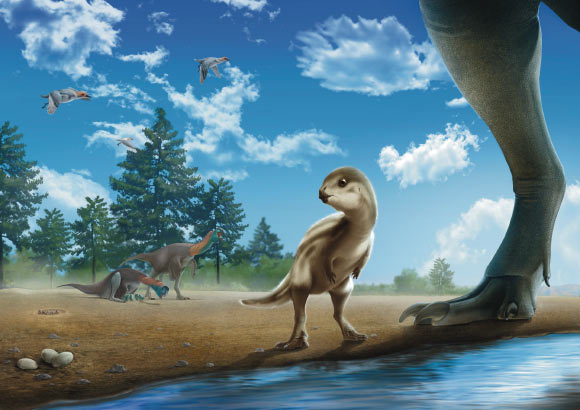
An artist’s interpretation of a miner Doolysaurus huhmini. Image credit: Jun Seong Yi.
Doolysaurus huhmini lived in what is now Korea between 113 and 94 million years ago, in the mid-Cretaceous period.
The ancient animal was a type of thescelosaurid, a group of bipedal neornithischian dinosaurs from the Cretaceous of East Asia and North America.
“The fossil record of dinosaur skeletons in Korea has long been limited in abundance and completeness,” said Dr. Jongyun Jung, a paleontologist at the University of Texas at Austin and Chonnam National University, and colleagues.
“To date, only two dinosaur species from the country are known from partial postcranial skeletons from the Late Cretaceous, the basal ceratopsian. Koreaceratops hwaseongensis and the early-diverging neornithischian Koreanosaurus boseongensis of the Seonso conglomerate.
The fossilized bones of Doolysaurus huhmini were recovered in 2023 from Middle Cretaceous rocks of the Ilseongsan Formation on Aphae Island, on the southwest coast of the Korean Peninsula.
The specimen consists of skull bones, vertebrae, hind limbs and numerous gastroliths – stones swallowed to aid digestion.
Advanced X-ray computed tomography (micro-CT) allowed researchers to reconstruct internal anatomical details of the dinosaur that would otherwise be hidden in the rock.
The animal may have had a fluffy coat and was about the size of a turkey, but an adult Doolysaurus huhmini may have reached twice this size.
Histological analysis indicates that the individual was very young, probably two years old.
“I think it would have been quite cute. It might have looked a bit like a little lamb,” said Professor Julia Clarke, a paleontologist at the University of Texas at Austin.
Doolysaurus huhmini is the first new dinosaur species discovered in Korea in 15 years and the first Korean dinosaur fossil discovered with parts of its skull.
“When we first found the specimen, we saw preserved leg bones and vertebrae,” Jung said.
“We didn’t expect pieces of skull and so many extra bones. We were very excited when we saw what was hidden inside the block.”
The presence of a cluster of gastroliths, as well as their size and estimated mass, suggest that Doolysaurus huhmini may have had a more omnivorous diet than previously assumed for closely related dinosaurs.
“The morphology of gastroliths observed in Doolysaurus huhmini and other early-diverging neornithischians may indicate a widespread or omnivorous feeding strategy for this group,” the scientists said.
“However, living birds show considerable variation in stomach anatomy and gastrolith usage across clades, suggesting that caution should be used when using these data to infer the diet of non-avian dinosaurs.”
The discovery highlights the potential for additional skeletal discoveries in Korea, particularly at paleontological sites like Aphaedo, where preservation conditions differ from those that produced the country’s abundant trace fossils.
“Doolysaurus huhmini is consistent with a richer dinosaur diversity in the Cretaceous of Korea than that represented in its rich fossil record,” the authors concluded.
Their paper was published online today in the journal Fossil record.
_____
J.Jung and others. 2026. A new dinosaur species from Korea and its implications for early-diverging neornithischian diversity. Fossil record 29 (1): 87-113; doi: 10.3897/fr.29.178152


