
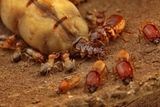
When termites aren’t busy eating your nice wood flooring, they are likely busy building their social structure, one of the most complex in the insect world. Termites live in vast colonies — one “super-colony” found in Brazil included 200 million termite mounds, according to the University of Buffalo.
Within these colonies, there are many worker insects, which don’t reproduce, and a lone pair that monogamously churn out offspring — the king and queen.
A new study, published in Science, shows how termites developed their complex social structures, including vast groups and regimented monogamy, over millions of years of evolution.
Read More: Humans May Be More Monogamous Than Meerkats, But Beavers Have Us Beat
How Termites Evolved from Cockroaches
Termites are a type of cockroach, and their ancestors likely had a simple and non-monogamous social structure. How termites’ colony structures evolved has remained unknown to science, but a new genetic analysis of the insects has provided important insights into complex social structures and monogamy.
“Termites evolved from cockroach ancestors that started living inside and eating wood,” said Nathan Lo, an evolutionary biologist from the University of Sydney and study co-author, in a statement. Lo and his team charted how these ancient bugs evolved by analyzing the genomes of cockroaches, termites, and woodroaches, a closely related species that eschews large colonies in favor of small family groups.
“Our study shows how their DNA changed first as they specialized on this poor-quality diet and then changed again as they became social insects,” said Lo.
Lo’s analysis showed that over the many years during which cockroaches evolved into termites, the insects’ genomes thinned, shedding genes involved in reproduction, digestion, and metabolism. As termites developed complex, multilayered societies, the evolutionary pressure for individual termites to maintain these genes withered.
“The surprising result is that termites increased their social complexity by losing genetic complexity,” said Lo. The findings contradict the assumption that more complex animal societies require more complex genomes to sustain them.
Losing Cockroach Genes and Becoming Monogamous
One genetic change during the evolutionary process was in the insects’ sperm. Cockroaches, like many animals, are polygamous, and females mate with multiple males. Evolutionary pressure has turned cockroach’s sperm into a reproductive Ferrari, streamlined and equipped with a powerful tail motor to help it beat rival sperm to target eggs. But as cockroaches became monogamous termites, this competition ended, and genes coding for the sperm tail motors disappeared. Termites’ sperm have no tails and are immotile.
“Our results indicate that the ancestors of termites were strictly monogamous,” said Lo. “Once monogamy was locked in, there was no longer any evolutionary pressure to maintain genes involved in sperm motility.”
How Termite Colonies Retain Their Structure
The analysis also showed the genetic adaptations that drive termites to become workers or kings and queens. Whether a bug retained the ability to reproduce or became a sterile worker depended on what it ate early in development. Some larvae are given large amounts of food by their older siblings, which fires up a high-energy metabolism and puts them on a worker developmental path. If a termite receives less food early in life, it will grow more slowly, but retain the ability to become a reproductive king or queen later on.
This, said Lo, helps the colony maintain its rigid social structure, where a dying king or queen is often replaced by its own offspring — leading to a high level of inbreeding.
“From an evolutionary perspective, that reinforces relatedness even further,” said Lo. Whether or not high levels of relatedness are required for complex insect societies to form is a hotly debated topic in the field. Lo’s data suggests that, at least in termites, it is a prerequisite.
Read More: Ants Do Poop and They Even Use Toilets to Fertilize Their Own Gardens
Article Sources
Our writers at Discovermagazine.com use peer-reviewed studies and high-quality sources for our articles, and our editors review for scientific accuracy and editorial standards. Review the sources used below for this article:




:max_bytes(150000):strip_icc()/Health-GettyImages-1206887947-4af79b0dda634ecb86c109180ddc8940.jpg?w=390&resize=390,220&ssl=1 "What Happens to Your Body When You Eat Sweet Potatoes Regularly")
