Terrestrial Particles Travel to the Moon by Hitchhiking Along Earth’s Magnetic Field Lines


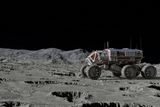
One of the main challenges of building and maintaining a permanent colony on the Moon, as in 2001: A Space Odysseyit’s about finding a reliable and economical way to transport essential resources, like water and energy.
The good news is that although the Moon looks like a barren desert – and, according to NASA, is a hundred times drier than the Sahara – it is not as desolate as it first appears. Indeed, for billions of years, particles have traveled from our atmosphere to its surface via Earth’s geomagnetic field, scientists at the University of Rochester reported in the journal Earth and Environment Communications.
“By combining data from particles preserved in lunar soil with computer modeling of how the solar wind interacts with Earth’s atmosphere, we can trace the history of Earth’s atmosphere and its magnetic field,” Eric Blackman, professor in the Department of Physics and Astronomy and distinguished scientist at URochester’s Laser Energy Laboratory (LLE), said in a statement.
Learn more: Earth and the mysterious planet Theia were probably close neighbors before the formation of the Moon
Analyze the composition of lunar soil
It’s been more than 50 years since humans set foot on the Moon, but samples from previous missions made these discoveries possible.
Previous analysis of these soil samples revealed the presence of light volatile elements, such as hydrogen, helium, neon, argon and nitrogen. Importantly, these substances were found in lunar soil but not in moon rock, meaning they must have come from somewhere else. Although their presence can, in part, be attributed to the constant flow of particles emanating from the sun (solar wind), the volume of nitrogen in the soil suggests that there is at least one additional source.
A few theories have been put forward, notably those which suggest that the light volatile elements arrived on interplanetary dust, during asteroid collisions or from the gas of lunar volcanoes. However, a leading theory is that the particles have a terrestrial origin.
If this is indeed the case, the question is: when and how did they travel from Earth to the Moon? In 2005, another team of researchers argued that the particles made the journey before the formation of Earth’s magnetic field. Twenty years later, Blackman and his colleagues put this theory to the test.
Hitchhiking on Earth’s Magnetic Field Lines
To do this, the team used complex computer simulations to model two different scenarios: one involving an early Earth without a magnetic field and a stronger solar wind, and the other involving a modern Earth with a strong magnetic field and a weaker solar wind. Of the two, the latter scenario was the most suitable.
According to the results, ions present in the Earth’s atmosphere are moved by the solar wind and guided along the lines of the Earth’s magnetic field. This happens most effectively when the Moon falls into Earth’s magnetic tail, that is, the elongated section of Earth’s magnetic field, which falls on the side farthest from the sun.
The only element that could not be taken into account in either model is hydrogen. This, the researchers explain, suggests that it has a solar or extrasolar origin and not terrestrial.
Resourcing of lunar bases
The findings could have important resource implications for future expeditions to the Moon, with the particles providing a close source of essential substances like water and nitrogen.
“By examining planetary evolution as well as atmospheric escape at different times, we can better understand how these processes shape planetary habitability,” Shubhonkar Paramanick, a graduate student in the Department of Physics and Astronomy and a Horton Fellow at LLE, said in a statement.
Learn more: The Moon moves away from Earth every year, and the tides are the reason
Article sources
Our Discovermagazine.com editors use peer-reviewed research and high-quality sources for our articles, and our editors review the articles for scientific accuracy and editorial standards. See the sources used below for this article:


