TESS Observes Interstellar Comet 3I/ATLAS


During a special observing operation earlier this month, NASA’s TESS space telescope recorded the subtle glow and tail of the interstellar comet, adding to archived observations that could reveal clues about this rare visitor from beyond our solar system.
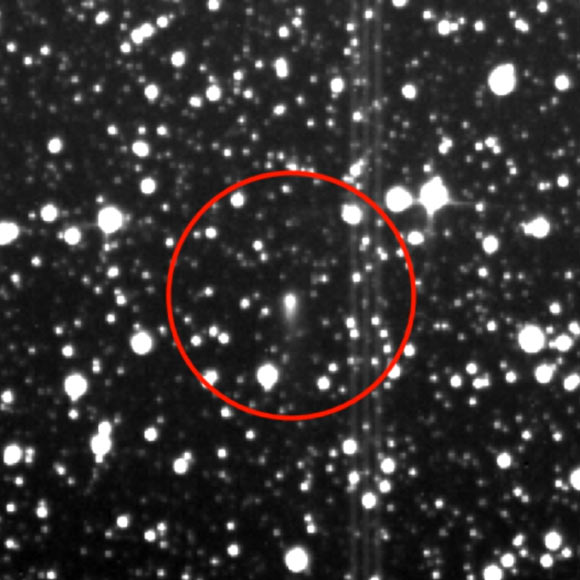
This 3I/ATLAS image was captured by NASA’s TESS satellite on January 15, 2026. Image credit: NASA / Daniel Muthukrishna, MIT.
3I/ATLAS was discovered by the NASA-funded ATLAS survey telescope in Rio Hurtado, Chile, on July 1, 2025.
Also known as C/2025 N1 (ATLAS) and A11pl3Z, the interstellar comet arrived from the constellation Sagittarius.
Its orbit is the most dynamically extreme of any object ever recorded in the solar system.
3I/ATLAS reached its closest approach to the Sun – known as perihelion – on October 30, 2025.
The interstellar visitor came within 1.4 AU or 210 million kilometers of our home star, just inside the orbit of Mars.
After emerging behind the Sun, the comet reappeared in the sky near Zaniah, a triple star system located in the constellation Virgo.
“The TESS spacecraft scans a wide swath of the sky for about a month at a time, looking for variations in light from distant stars to spot orbiting exoplanets or worlds beyond our solar system,” MIT astronomer Daniel Muthukrishna and colleagues said in a statement.
“This technique also allows TESS to identify and monitor comets and asteroids over large distances.”
“The mission’s wide field of view already made it possible to observe 3I/ATLAS in May 2025, almost two months before its discovery.”
From January 15 to 22, 2026, TESS reobserved the interstellar comet during a special observation campaign.
The object’s brightness was about 11.5 in apparent magnitude, about 100 times fainter than what humans can see with the naked eye.
All TESS data is publicly available on the Mikulski Archive for Space Telescopes.
“Looking at the TESS data, we were able to identify the faint comet by stacking multiple observations to track its movement,” the astronomers said.


