Testing Apple’s 2026 16-inch MacBook Pro, M5 Max, and its new “performance” cores


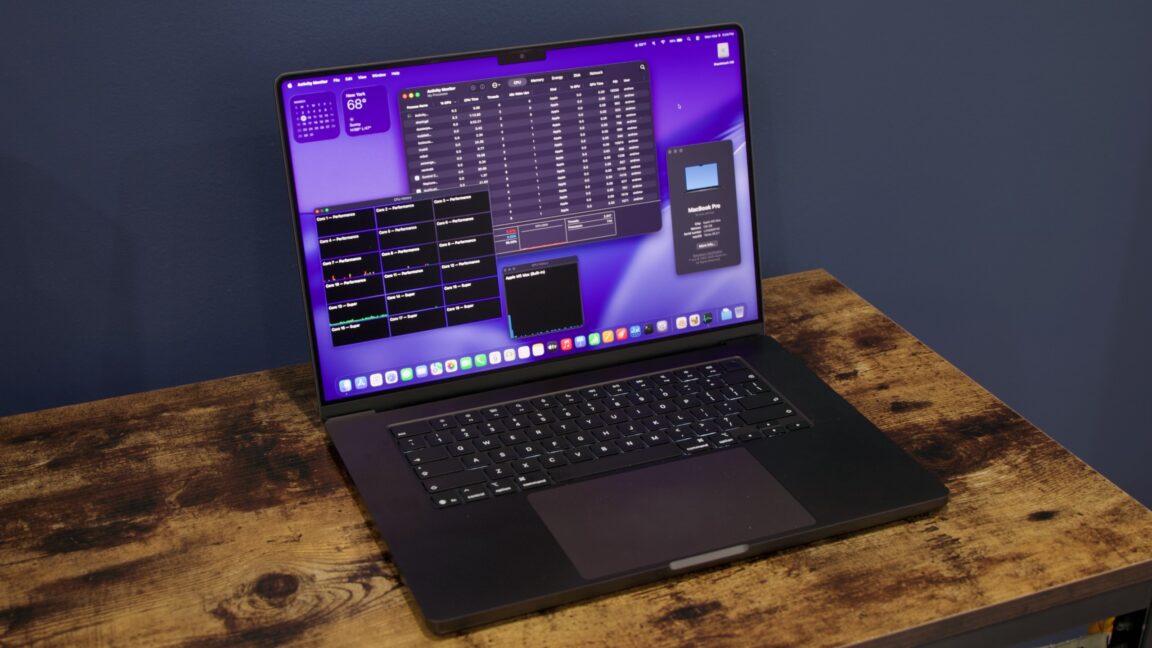
If you’re interested in a slightly broader review of the new MacBook Pros, I’ll direct you to reviews of the M1, M3, and M4 generation models, as well as the low-end 14-inch MacBook Pro with the standard M5 (now $100 more than before, but with 1TB of base storage instead of 512GB).
Apple uses the same external design for these laptops that it has been using since 2021: it ages quite well and we still mostly like it, especially compared to the MacBook Pros of the last Intel era. There’s simply not much else to say about the design that hasn’t been said.
M5 Max Marks
In our testing, the single-core performance of the fully enabled M5 Max is about 10% better than the fully enabled M4 Max version of last year’s 16-inch MacBook Pro. Multi-core performance improvements are more variable (Cinebench R23, which shows a 30 percent improvement, seems to be an outlier), but most tests also show a modest 10 or 12 percent improvement.
Graphics performance improvements are slightly more robust, measuring between 20 and 35 percent depending on the test. Apple suggests that you might see an increased increase in GPU compute workloads that can leverage the neural accelerator that Apple has built into every GPU core in the M5 family.
The jump from M4 Max to M5 Max isn’t as big, expressed as a percentage, as it has been over the last two generations; Both M3 Max and M4 Max were big advancements over what came before. But assuming you’re upgrading from an M1 or M2-based Pro, you’ll still be taking a big step forward. Fears that going from 12 of Apple’s highest-performing CPU cores (in M4 Max) to just six of the highest-performing cores are also a bit overblown, based on these results.
Compared to the base M5 in the 14-inch MacBook Pro, the M5 Max’s single-core performance is about the same, which is consistent with how Apple usually does things: upgrading to higher-end chips gets you better multi-core and graphics performance, but Apple doesn’t increase clock speeds on individual cores like Intel or AMD do with their high-end processors.


