Ocean Acidification Threshold Pushes Earth Past Another Planetary Boundary


Our planet is sick and its potentially deadly symptoms worsen, prevents a new report.
The earth has been pushed before several crucial physical and chemical limits to maintain the world a habitable place. Beyond the thresholds already exceeded by scientists for the increase in temperatures, loss of biodiversity and chemical pollution, we have also crossed the border on ocean acidification. The milestone is delivered with dark ramifications for marine ecosystems and human subsistence means.
“More than three -quarters of earth support systems are not in the security zone,” said Johan Rockström, director of the Potsdam Institute for Climate Impact Research (PIK) in Germany, announcing the evaluation in 2025 of the planetary borders. “Humanity grows beyond the limits of a safe operating space, increasing the risk of destabilizing the planet.”
On the support of scientific journalism
If you appreciate this article, plan to support our award -winning journalism by subscription. By buying a subscription, you help to ensure the future of striking stories about discoveries and ideas that shape our world today.
Humans and many other species have evolved to thrive in the Holocene climate, a period that started around 10,000 years ago. But while industrialized societies and started fossil fuels largely burning in the 19th century, greenhouse gases were built in the atmosphere, trapping heat and transforming the land and its climate in many ways in addition to increasing global temperatures.
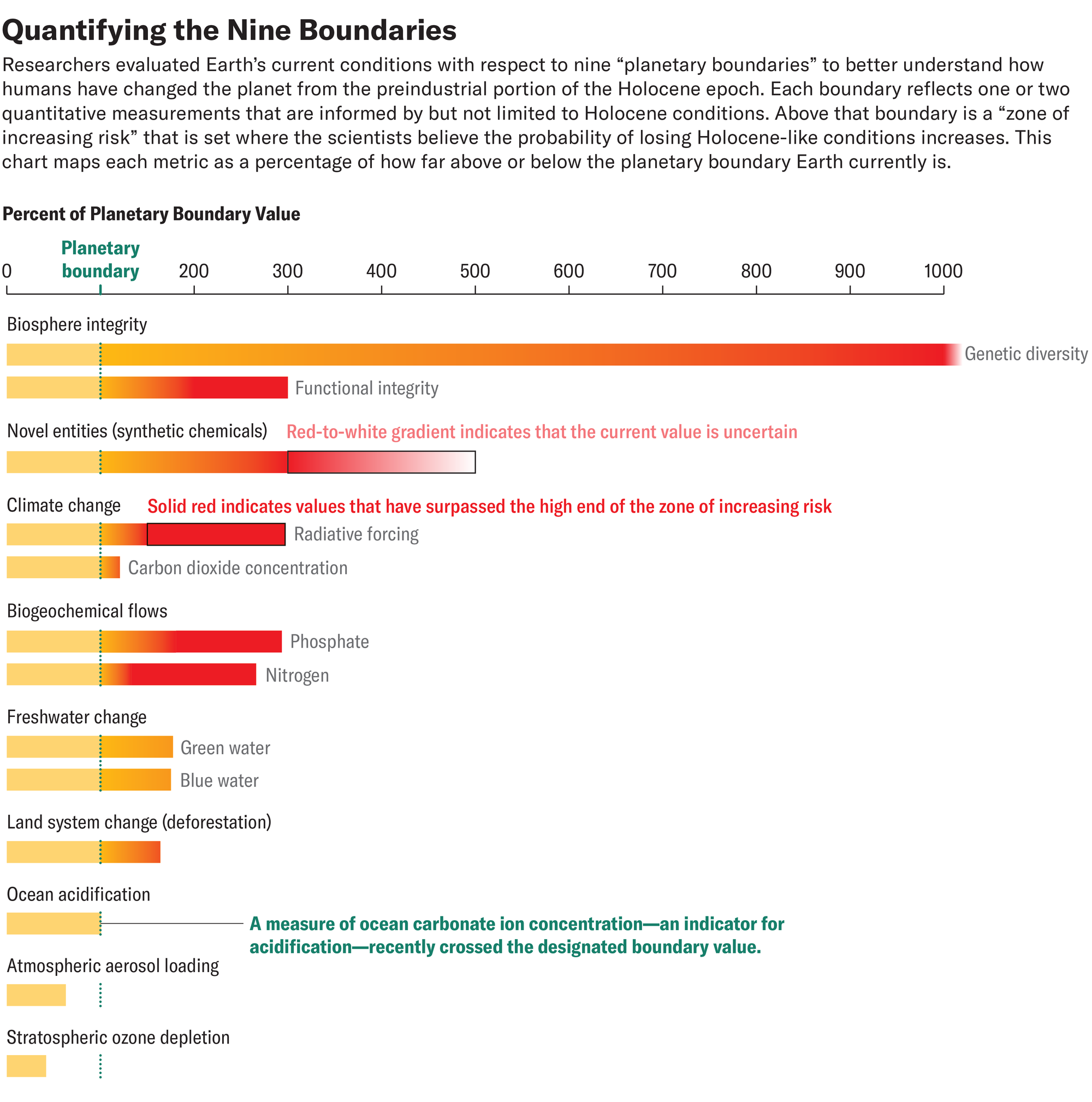
From 2009, Pik reported and hierarchical research on nine geophysical limits which constitute a kind of planetary survival system; Staying within these limits, they support, is the best hope of maintaining Clima’s climatic conditions that we and most of the other inhabitants of the Earth we have adapted. In 2023, the researchers published a study that quantified these limits and established where we are in relation to them. At the time, six of the limits had been exceeded, with many things in what scientists called a “increasing risk zone”.
“It’s like blood pressure,” said Katherine Richardson, a scientist of land systems at the University of Copenhagen, in an interview American scientist at the time. “If your blood pressure exceeds 120 out of 80, it is not a guarantee that you will have a heart attack, but it increases the risk, and therefore we do what we can make it fall.”
Among the nine limits, there is of course climate change, which is partly measured by the quantity of carbon dioxide of global warming in the atmosphere of the earth. The concentrations of carbon dioxide reached a record overall record of 422.7 parties per million (ppm) last year, against 280 ppm before the industrial revolution and the 350 ppm that many scientists consider a “safe” limit (which was exceeded in 1987). The burning of fossil fuels is the undeniable culprit.
Fossil fuels are also behind the new border offense – the ocean absorbs part of the excess carbon dioxide from the atmosphere, which makes it become more acidic of water. Since the industrial revolution, the pH of the surface of the ocean has dropped by 0.1; It may seem tiny, but because the pH scale is logarithmic, it reflects an increase of approximately 30% of acidity.
The acidification of the oceans can have deep impacts on marine ecosystems by exhausting the sea water from certain carbon compounds that corals and other animals for the construction of shells need to build their protective houses. At sufficiently low pH levels, corals and shells can even start dissolving. These effects could destabilize whole ecosystems and devastate many species of commercial value, such as oysters. A 2020 report from the National Oceanic and Atmospheric American Administration has revealed that ocean acidification would cost the country’s economy of billions of dollars.
“The movement we see is absolutely directed in the wrong direction. The ocean becomes more acidic, the oxygen levels drop and the marine heat waves increase. This increases the pressure on an essential system to stabilize the conditions on the planet Earth,” said Levke Caesar, co-cadré de Pik’s Planetary Boundaries Science Lab, in the press state.
The not so short list of other borders that we have blown is thinking. The excess of phosphorus and nitrogen from the generalized use of fertilizers flows into rivers and seas to trigger proliferations of toxic algae. Artificial chemicals, such as plastics, dichlorodiphenyloroethane (DDT) and perfluoroalkyle and polyfluoroalkyle (PFA) substances, accumulate with known in food chains. Agriculture and other changes in the use of land stripping forests and decrease the available fresh water. And as all these problems develop, more and more the biodiversity of the earth disappears.
According to the new report, only two of the nine limits remain intact: the exhaustion of ozone and aerosols in the atmosphere. Only the first shows clear progress far from the planetary border, due to the success of the Montreal Protocol, the international agreement through which countries suppress chemicals that erude the protective ozone layer of the earth. Aerosol emissions have decreased worldwide – in part for efforts to reduce pollution of global navigation, but in the absence of any unified political framework for reductions, levels could easily back down.
The global prognosis for the planet’s health is mediocre, given a certain number of countries, including the United States in particular, are moving away from significant action to tackle environmental problems.
“We are witnessing a general decrease in the health of our planet. But it is not an inevitable result. The decline in aerosol pollution and the healing of the ozone layer, shows that it is possible to turn the direction of global development. Even if the diagnosis is disastrous, the remedy window is still open,” said Rockström in the recourse to the press. “Failure is not inevitable; Failure is a choice. A choice that must and can be avoided. “
It’s time to defend science
If you enjoyed this article, I would like to ask for your support. American scientist has been a defender of science and industry for 180 years, and at the moment can be the most critical moment of this two -centuries story.
I was a American scientist The subscriber since the age of 12, and that helped shape my way of looking at the world. Sciam Educates me and always delights me, and inspires a feeling of fear for our vast and magnificent universe. I hope that does this for you too.
If you subscribe to American scientistYou help make sure that our cover is focused on significant research and discoveries; that we have the resources necessary to report the decisions that threaten laboratories in the United States; And that we support the budding scientists who work at a time when the value of science itself does not become often again.
In return, you get essential news, Captivating podcasts, brilliant infographics, Maybe not miss newsletters, videos to watch, Difficult games and the best writings and reports in the scientific world. You can even Give someone a subscription.
There has never been more time for us to get up and show why science counts. I hope you will support us in this mission.


