SpaceX launches second satellite to monitor sea level changes

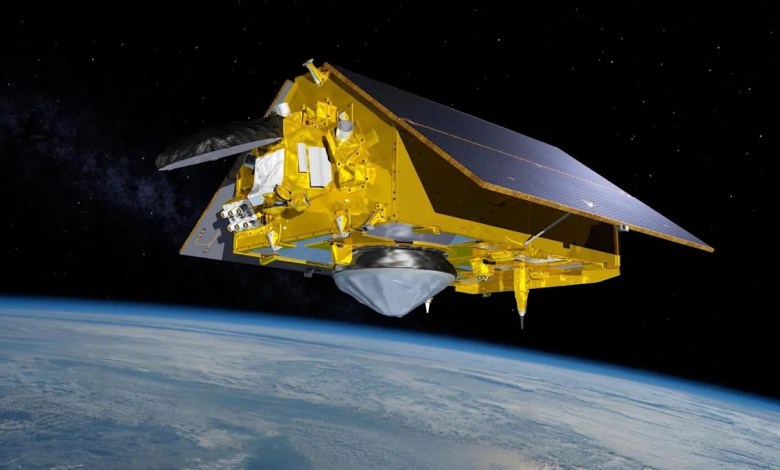
SpaceX launched a joint NASA-Europe environmental research satellite early Monday, the second in an ongoing $1 billion project to measure long-term changes in sea levels, a key indicator of changing sea levels. climate change.
The first satellite, known as Sentinel-6 and named for NASA climatologist Michael Freilich, was launched in November 2020. The latest spacecraft, Sentinel-6B, launched from California atop a Falcon 9 rocket at 12:21 a.m. EST.

A SpaceX Falcon 9 rocket hurtles into the night sky above Vandenberg Space Station in California, propelling a sophisticated environmental research satellite into orbit to monitor changes in sea levels around the world. / Credit: SpaceX webcast
Both satellites are equipped with sophisticated cloud-penetrating radar. By timing how long it takes the beams to bounce off the ocean 830 miles below, the Sentinel-6 satellites can track sea level with an accuracy of about an inch while also measuring wave height and wind speed.
The project builds on previous missions dating back to the early 1990s, which provided an uninterrupted stream of sea level data.
These data indicate that sea levels are slowly but surely rising, which is widely interpreted as evidence of global warming caused largely by human industrial activity.
But consistent with recent Trump administration policies aimed at reducing climate research and interpretation of that data, NASA did not directly refer to “climate change” or “global warming” during a pre-launch briefing for Sentinel-6B on Saturday.
In the press kit released by NASA for the first Sentinel 6 mission in 2020, the first item on a “must-know list” stated that the satellite would “provide information that will help researchers understand how climate change is reshaping Earth’s coastlines – and how quickly it is happening.” »
In the press kit for the Sentinel 6B mission launched Monday, NASA’s first “must know” item simply said that “Sentinel-6B will contribute to a multi-decade data set that is…critical to helping improve public safety, urban planning, and the protection of commercial and defense interests.” »
Karen St. Germain, director of NASA’s Earth Sciences Division, did not directly mention climate change during Saturday’s briefing, focusing instead on the practical importance of sea level monitoring.

A camera mounted on the second stage of the Falcon 9 captured a spectacular view of the Sentinel-6B satellite flying alone as the two vehicles cruised more than 800 miles above Madagascar. / Credit: SpaceX
“Sentinel 6B is the latest in a series of missions spanning three decades, uninterruptedly monitoring the height of our planet’s sea surface, finding patterns and advancing our understanding of planet Earth,” she said.
She said data provided by Sentinel-6 satellites “supports navigation, search and rescue, and industries like commercial fishing and shipping.” These measurements form the basis of U.S. flood forecasts for coastal infrastructure, real estate, energy storage sites, and other assets along our coastline.
The data, she continued, will help scientists “understand and predict coastal erosion and saltwater encroachment on inland water supplies used for agriculture, irrigation as well as municipal drinking water.”
Regardless of interpretation, the Sentinel-6B launch went off without a hitch.
After lifting off from Vandenberg Space Station’s Launch Complex 4E, the Falcon 9 rocket’s first stage propelled the vehicle out of the dense lower atmosphere, separated and returned to a landing pad at the California launch site.
The upper stage then performed two firings of its single engine before releasing the 2,600-pound Sentinel-6B into an 830-mile-high orbit inclined 66 degrees to the equator, the same orbit used by Sentinel-6A and previous sea-level monitoring spacecraft.
Taking 112 minutes to complete one orbit, the solar-powered satellite will fly over locations between 66 degrees north and south latitude, covering 90% of the planet’s oceans.

Artist’s impression of the Sentinel-6B satellite in normal operation. / Credit: NASA
In addition to measuring sea level, the new satellite will monitor temperature and humidity in the lower atmosphere as well as the high-altitude stratosphere using an instrument that measures atmospheric effects on signals broadcast by navigation satellites.
But the main mission is to monitor changes in sea levels on Earth.
“The dynamic balance that persisted before the industrial revolution has been upended by the almost instantaneous burning of enormous carbon reserves as our society has developed,” European Space Agency project scientist Craig Donlon said ahead of Sentinel-6’s first launch in 2020.
“We see evidence of this dramatic change in many different measurements… but they all point in the same direction: The Earth is warming. And the biggest indicator of this Earth system imbalance is sea level rise.”
The Sentinel-6 satellites are the result of a collaboration between NASA, the European Space Agency, the European Organization for the Exploitation of Meteorological Satellites (EUMETSAT) and the National Oceanic and Atmospheric Administration (NOAA).
St. Germain said NASA’s share of the cost of the two Sentinel-6 satellites was about $500 million. Europeans contributed a similar amount.
When employees are pushed to the streets
President Trump’s pardon of crypto billionaire raises concerns over his use of pardons
Louisiana father says ‘it’s disturbing’ after allegedly sharing fake images of his daughter


