
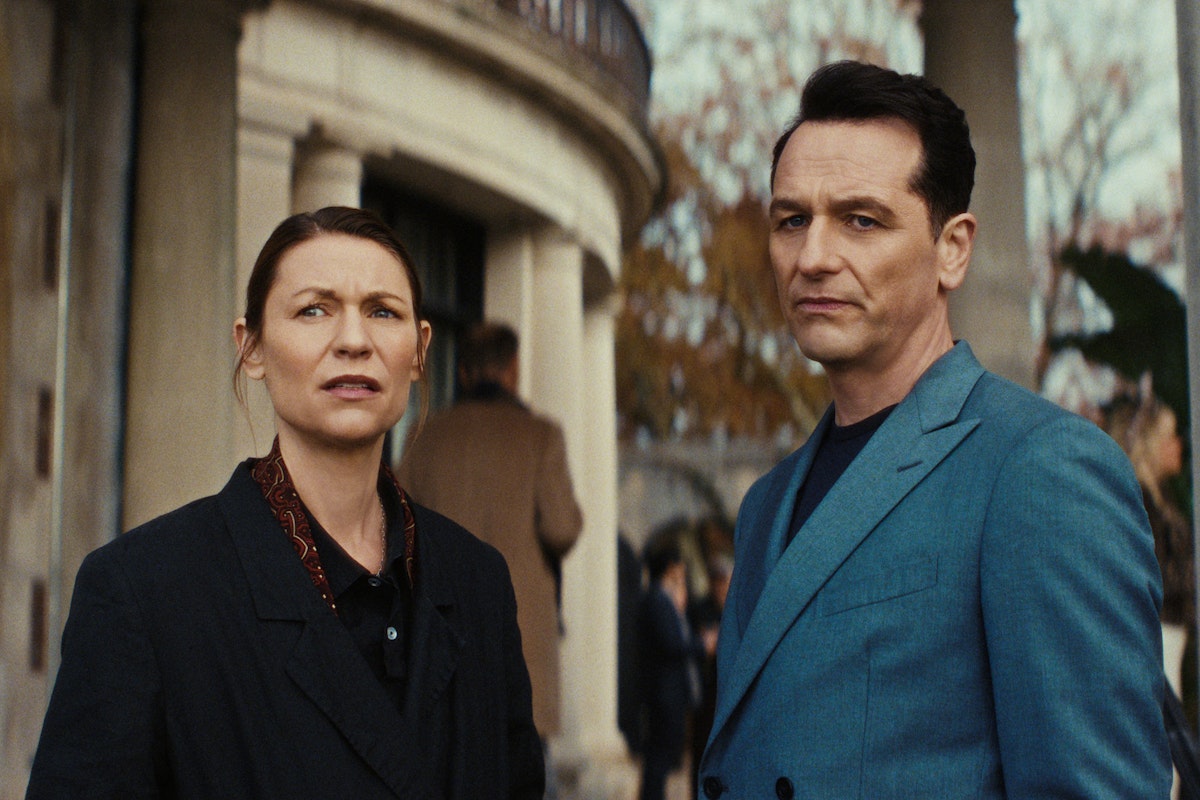
Danes, for her part, returns fitfully to the Homeland well. Her chin near-constantly aquiver, Wiggs is always on the verge of tears, a woman deep, deep in the midst of a nervous breakdown. But, in her scenes with Jarvis, she comes alive, activating the lethal attentiveness and brazen disregard for danger that made her the prize-winning journalist we’re told she was. In their early interviews, it’s enthralling to watch Wiggs shed her sadness and go in for the kill. But Danes, likewise, portrays Wiggs as someone who’s not fully in control of how and when her grief or her guts take over. Jarvis is, in fits and starts, disarmed by her. Theirs, finally, is a fair fight. Soon after his arrival to town, a townie mysteriously disappears. Partially because she suspects Jarvis, and partially because their tête-à-têtes have reinvigorated her, Wiggs sells her neighbor on the idea of a biography, a chance to set the record straight. Her editor is over the moon, and so Wiggs descends into the world of Nile Jarvis.
All of this early setup is quite promising. The sparring sessions between Rhys and Danes remain the highlights of the series—including an obligatory night of drinking and dancing and spontaneous personal revelation later in the season. But, once the stage is set, that old “network brawn” easily overpowers any of the show’s artful aspirations. In particular, what we begin to notice is how thinly the world outside these two is constructed and, conversely, how much time the show seems to want us to spend in it. There’s the pair of compromised FBI agents hissing warnings at Aggie, there’s Jarvis’s imposing father (Jonathan Banks, another silver age stalwart) grumbling disapproval, there’s the aforementioned Councilwoman Benitez (Aleyse Shannon) shouting clichés through a megaphone—The Beast in Me easily could have leaned into the psychological brinkmanship of Jarvis and Wiggs, but, instead, it insists on becoming a paint-by-numbers political thriller too.
Benitez, in particular, is ill served by the show’s treatment of her plotline. A clear AOC stand-in, the show treats her with the same texture as a “ripped-from-the-headlines” Law and Order case of the week. The show doesn’t so much characterize her as allow us to recognize her Ocasio-Cortez-iness and then fill in the characterization for ourselves. It’s hard to tell whether this caricature of an ambitious progressive activist whose bold leftist politics might be more opportunistic than sincere is the result of lazy or scurrilous writing. On paper, The Beast in Me presents itself as a kind of alternate-universe, celebrity death match, in which present-day AOC squares off against a young hybrid of Robert Durst and Donald Trump in their prime, while a writer for The New Yorker chronicles it all. But in order for that to happen, this show would need to take any of those institutions—the New York left, the New York oligarchs, or the New York press—seriously enough to render them with specificity and nuance. It doesn’t.


