All products featured on Condé Nast Traveler are independently selected by Condé Nast Traveler editors. However, when you buy something through our retail links, Condé Nast may earn an affiliate commission.

Photography by Michael Graydon & Nikole Herriott
The “best” meatballs do not exist, at least according to Elvira, who is not technically a nonna. Though she did fit a particular American idea of the “nonna” with her stern rebukes about the tiny departures I took from her meatball recipe. She had hurried over to her daughter’s friend’s home on a Thursday night with short notice when she learned that a journalist would be in Rome trying to find the absolute best way to make Roman-style meatballs.
Elvira used to run a restaurant, and according to Debora Lanini, who teaches cooking classes from her home—which is incidentally filled with more than 370 pieces of frog-themed decor—Elvira was known around the city for her meatball prowess. I had arrived in Rome during the hottest week of the summer to gorge on salty meat. I forgot to check the weather before planning my visit, which spanned a number of appointments to learn the art of the Italian meatball and then an extended visit to the Festival del Prosciutto di Parma in the Langhirano Valley of Emilia Romagna. Anyway, the Langhirano Valley sounded windy, and didn’t Rome have all of those fountains? I spent the ten minutes I had to spare between landing and arriving at Debora’s home in Trastevere eating a plate of thinly sliced cured jowl and, amid a city built on 2,776 years of culture, scrolling through the online marketing materials for the upcoming prosciutto fest.

A kitchen in Italy
Photography by Michael Graydon & Nikole Herriott

Cookbook author Ella Quittner
Photography by Michael Graydon & Nikole Herriott
By the time I made it to the top of two large hills and one steep staircase that Google Maps had innocently obscured and I came face-to-face with the large metal frog-shaped mailbox affixed to the grand double doors of Debora’s home (me: red and glistening and grinning, it: chilly and unbothered), I was nearly indistinguishable from the cheerful sow used as the mascot for the Festival del Prosciutto di Parma. A second frog, dressed in miniature gingham pants, glanced accusingly at me from a glass case. Already at Debora’s was a married couple who had plans to head to Italy’s other meatball capital (Naples) the next day, as well as a friend of Debora’s who renounced all meatballs shortly after I showed up, citing a wedding diet. There was the bride’s fiancé—a local magistrate who was introduced to me only as “The Judge”—and the bride’s mother, Elvira. Debora had kindly welcomed me for dinner with her friends on one of her few nights off, after I’d sent a desperate inquiry about wanting to learn the best way to make meatballs. She was the first person of many to tell me that there was no such thing as a “best” meatball, because a meatball was a humble thing, born of leftovers. It would be like flying to an asphalt factory and asking about the most iconic way to make highway pavement.
The meatball’s historic roots as a use for leftovers is especially evident in one Roman version, called the polpette di bollito: a juicy blimp of days-old stewed beef as tender as short rib, held together by a fried casing like a croquette. (Two great versions can be found at the Mordi e Vai booth at the Testaccio market and the restaurant Trattoria Da Cesare al Casaletto near the Villa Doria Pamphili.) Debora and Elvira demonstrated how to “ammolare” (pre-soak) the stale bread with milk just until it stopped sucking up the liquid, then to pour no more. Debora added a parsimonious pinch of salt and grated just a bit of lemon zest into the mix but abandoned the citrus well before she hit the bitter white pith. Elvira added more salt while Debora was turned away, then got to mixing with a black latex glove. We each ate a spoonful of it raw and Debora pronounced it slightly too salty. They demonstrated various sizes and explained potential use cases; one, sized like a newborn’s eyeball, could be put in a lasagna. But each time I tried to prod about the best way to chop the parsley, or the best ratio of grated pecorino to meat, Elvira gently corrected me: Meatballs were a matter of personal taste and routine. Meatballs were so personal, she told me, that you can work out which grandchild (or son-in-law; she winked at The Judge) a nonna prefers by the corresponding tweaks she makes to her meatballs. Still, that doesn’t make them the best; they’re still just meatballs. The idea that the best did not reign supreme the same way it did in America was a sentiment I heard a lot in my travels.

Fresh pasta in Italy
Photography by Michael Graydon & Nikole Herriott
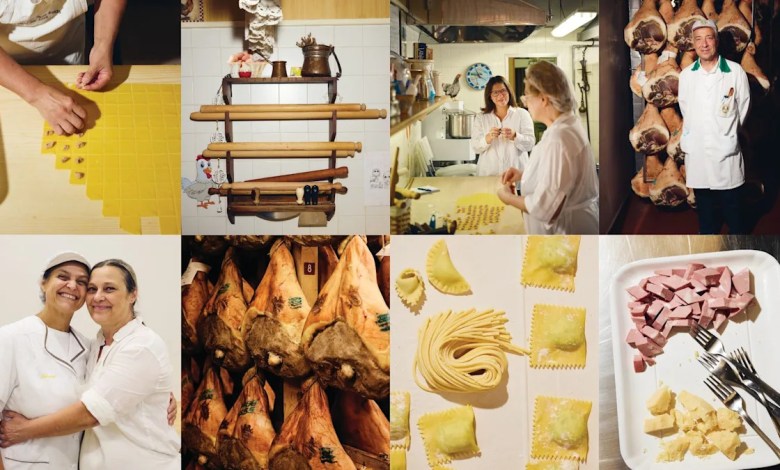
A few days after I left Debora and Elvira in Rome for Emilia Romagna, I watched with a shvitz-ing Aperol spritz—the Langhirano Valley was not windy that week—as a handful of butchers wearing special mesh gloves competed with one another to hand-carve Parma hams. Their long spindly knives cruised through thick layers of fat and cured pork like violinists’ bows for hours, but even when the competition ended, it was unclear who had won.
There were pronouncements made about whose slices had been arranged the most artfully on dozens of paper plates, and about who had managed to retain the most yield from each leg of prosciutto, and about whose slices were the thinnest, but it wasn’t obvious to an onlooker with a poor grasp of the language who exactly would be going home with the big win.
I might have chalked up this as a social distaste toward the ways in which American capitalism has created constant, granular hierarchies—if not for what happened that first night in Rome, after I went to Debora’s bathroom to wash my hands and dry them on a frog-printed towel.
When I emerged, Elvira was standing at the hot plate, quietly crying. No one but me and a stuffed frog peeking out from a potted plant had seemed to notice. The Judge was gesticulating from a love seat as he explained something about local politics, Elvira’s daughter was eating a peach, and Debora was refilling the salt dish. But Elvira, prodding at the contents of one of the two pans, was wordlessly wiping tears as they collected in the corners of her eyes. I approached her at the hot plate; I didn’t have to ask what was wrong. One of the skillets looked like it held the contents of an exploded hamster cage. There was no best way to make a meatball, but apparently she thought there was a worst way. Debora ushered me to the side, so Elvira could have a moment with her disappointment while I pretended not to study her. Within five minutes, Elvira was back to chiding me again, this time for flipping the next batch of meatballs a single second too soon. Still, the whole incident got me thinking about relativity.

Parma ham in Emilia-Romagna, Italy
Photography by Michael Graydon & Nikole Herriott
Even in a culture (or subculture) skeptical of any one “best,” the members of that culture still invent ways—sometimes subtle ones—to call things good or bad. In Emilia Romagna, at the hand-carving competition, contestant Fausto’s 215-gram plate of leaf-thin prosciutto slices generated a gasp from the crowd, while contestant Flaminio’s, arranged like a school of fish, got only gruff headshakes. And after much inquiry, at the end of a long night that included for some reason a drive-by visit from a local Italian chapter of the Hells Angels, I finally learned who won the carving competition: a butcher named Chantal, who would receive a “winner” sticker to display in her shop for the coming year.
Even where there was resistance to the idea of“the best,” where it needn’t be invoked in quite the same way to stoke competition, there was still ranking. There was still relativism, at least as a point of organization. No one person, place, or thing needed necessarily to be publicly proclaimed as the best as a matter of mass consensus, but it was important that each individual had an idea of what “the best” meant to them. The titration of garlic in a meatball. The arrangement of prosciutto slices on a plate. These things mattered in that they said something about the person they mattered to.

Obsessed with the Best: Optimized Recipes and Techniques from Rigorous Head-to-Head Cooking Tests
$29.98.00, Amazon
These “bests” had little to do with the status anxiety of America, where any sticker one could win in a meat carving contest would no doubt be large and loud, adorned with flashing lights and its own social media handle. And so they dissolved seamlessly into the narrative when I did indeed find my personal “best” meatball on the Aventine Hill, the southernmost mound of Rome, a mythical site of an ancient competition to be “the best,” in a mostly local way. The legend goes something like: Romulus and Remus decided to hold a contest of augury (basically, birdwatching to guess at the will of the gods), to decide whose name was slapped across the city. Remus set up camp on the Aventine Hill and Romulus, the Palatine. It’s fairly obvious what happened next, and it’s also fairly obvious why anyone who now owns real estate near the Aventine Hill might dismiss talk of said competition as culturally irrelevant. Still, on one morning of my trip, in an apartment on that Aventine hilltop, I broke into a meatball so tender that it seemed held together by sheer will. A meatball that was juicy and plush, and which percolated fat when sliced in two. I’d watched its creator, a chef and food writer named Daniela Del Balzo, make the mix and fry it, and I asked a million questions. Then I came home and tried to recreate it again and again. Eventually I wrote a recipe. Maybe they will be your ideal, too—or maybe you’ll dislike them. Either way, I’ve come to realize that the best meatballs do not exist.
Find the recipe in Obsessed with the Best: 100+ Methodically Perfected Recipes Based on 20+ Head-to-Head Tests.
Originally Appeared on Condé Nast Traveler