A 3D-Printed Rattlesnake Reveals How the Rattle Stirs Fear, Even in Animals Unfamiliar with the Sound


A rattlesnake’s distinct rattle is one of the best-known defensive sounds in nature. As humans, we know that the sound means “stay away,” even if we don’t live in areas where rattlesnakes are prevalent. This can be said of most animals that commonly interact with rattlesnakes, such as mountain lions.
But can we say the same about animals that do not cross paths with these snakes? That was the question of a group of researchers from the University of Texas at El Paso. Their conclusions, published in the journal PLOS Onedive into this question and find out why the rattle is such an important deterrent.
“This research is an effective demonstration of scientific creativity and interdisciplinary innovation,” Liz Walsh, interim dean of UTEP’s College of Science, said in a news release.
Learn more: Eastern Massasauga Rattlesnakes Are Resorting to Incest, and Humans May Be To blame
Custom 3D Printed Rattlesnakes
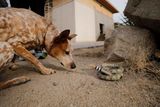
For this study, the El Paso research team, with help from Fab Lab El Paso, 3D printed a nearly lifelike robotic rattlesnake and tested how 38 different species from the El Paso Zoo would interact with it.
The 3D model featured the typical posture of a rattlesnake, with the rattles actually taken from deceased snakes found on the road near El Paso.
The snake models were then presented to zoo animals over three trials. For the first trial, the team placed a food reward in the animal’s enclosure, then released the animal to claim it. For the second trial, the team did the same thing, except they placed the snake model next to the food reward, but did not activate the rattle. On the third trial, the food reward was again placed next to the snake, but when the animal approached to get the reward, the rattle was turned on.
How Animals React to Rattlesnakes
The researchers found that when the rattle was turned on, all of the animals tested showed some form of adverse reaction. According to the research team, this demonstrates that the snake’s rattle is an effective deterrent, regardless of species.
However, what surprised the research team was that species that typically share their ecosystems with rattlesnakes, such as mountain lions and collared peccaries (javelinas), showed a much stronger fear response than animals that do not have these snakes in their natural ecosystems. What is even more surprising is that all the animals were born in captivity and therefore could not have learned this behavior in the wild.
“These results suggest that the rattlesnake rattle serves a dual purpose,” said Océane Da Cunha, lecturer and graduate student coordinator in UTEP’s College of Science, in a press release. “Animals without prior exposure to rattlesnakes still responded strongly, supporting the idea that rattling acts as a deimatic or startle signal. But the amplified response in species that share their current distribution with rattlesnakes indicates an evolved, innate sensitivity to the rattle.”
A Better Understanding of Rattlesnakes
The team also notes that the rattlesnake’s rattle is a rare example of a multimodal defensive display, because the snake combines body posture, sound, visual cues and tail vibrations. Using the team’s snake model, they can test this type of combined display in a controlled environment, which has been difficult to achieve with live snakes in the past.
“By combining engineering, behavioral ecology and evolutionary biology, Dr. Da Cunha and his team have advanced our understanding of how signaling systems evolve and why they persist,” Walsh said in the release. “Their findings not only shed light on rattlesnake behavior, but also contribute greatly to our knowledge of animal communication and predator-prey interactions.”
The findings add to a long-standing hypothesis that the rattle originated as a simple startle behavior and then evolved into a deeper warning. These findings also raise further questions about how animals develop innate fears and how these traits evolve.
Learn more: Rattlesnake venom evolves and adapts to climate change
Article sources
Our Discovermagazine.com editors use peer-reviewed research and high-quality sources for our articles, and our editors review the articles for scientific accuracy and editorial standards. See the sources used below for this article:


