The Colonial Takeover of Venezuela Begins with Corporate Investment


The spectacle of Nicolas Maduro’s capture has distracted attention from the more discreet imposition of the systems and networks of power that constitute colonial rule.
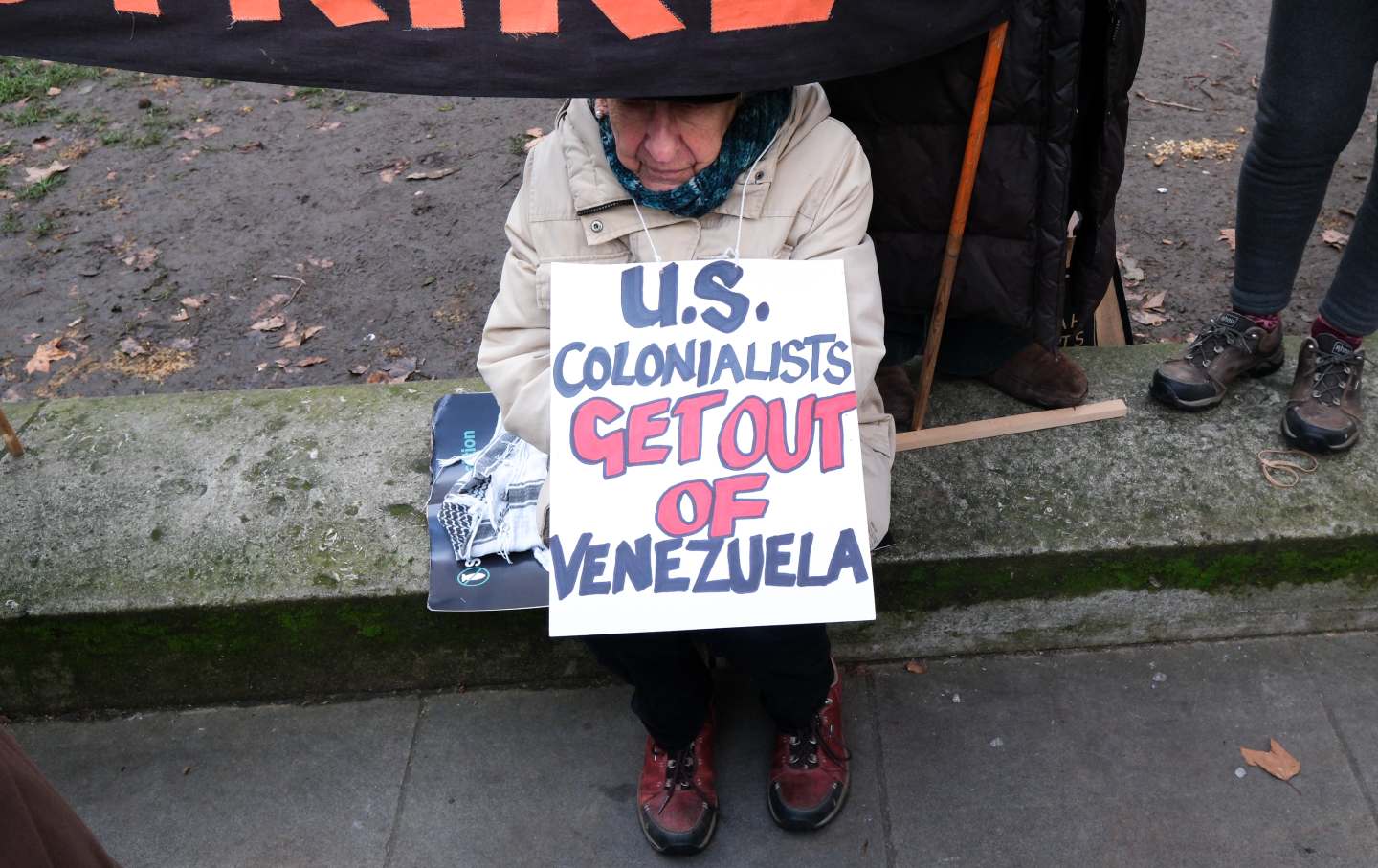
A woman demonstrates against US involvement in Venezuela, in London, January 10, 2026.
(Matthew Chattle/Future Publishing via Getty Images)
Accusations of neocolonialism against the United States following Operation Absolute Resolve in Venezuela are not false, but they focus on the wrong subject. The spectacle of Nicolas Maduro’s capture has distracted attention from the quieter installation of the power systems and grids that constitute colonial rule. If we ignore these systems now, Venezuela could descend into a colonial state that U.S. policymakers and citizens will find hard to see, let alone challenge.
Colonialism is not defined by spectacle but by the imposition of infrastructures of power, and history shows that private companies have been at the forefront in building this influence. The imperial 19th century offers a warning: some of the colonial world’s most exploitative power imbalances began not with conquest but with private business investment.
The kidnapping of Maduro constitutes a blatant violation of a globally recognized norm: territorial sovereignty. Governments around the world have condemned the operation as illegal. This condemnation, however, is largely rhetorical. There is no global defender of international law. International law relies on collective application, and Venezuela demonstrates how thin this protection can be in the face of overwhelming power.
The Trump administration is acting as if the post-war international order never existed. The actions in Venezuela, alongside Donald Trump’s broader hegemonic declarations on the Americas and Greenland, suggest a return to a world before international law – a world governed by imperial prerogatives. It’s not even neocolonialism; it is simply colonialism. The danger of the qualifier “neo” is that it risks distancing the present from a past which reaffirms itself with a disturbing familiarity.
The difference between war and colonialism is sustainability: the establishment of long-term control through governance structures. This control may appear limited or indirect. Colonialism is announced not only through occupation but also through legal, economic and administrative rules. At its height, the British Empire ruled a vast territory without general military occupation. Control was generally exercised indirectly through commercial monopolies, legal authorities, and administrative influence, with force deployed selectively rather than continuously.
Current number
Understanding colonialism in this way clarifies what to look for in Venezuela and, importantly, where our outrage should be directed.
History suggests several harbingers of lasting colonial control. The first is the injection of the colonizer’s legal systems. This can happen at a high level, through the enforcement of standards relating to human rights or transnational crime (such as the illicit drug trade), or at a lower level, through the restructuring of national legal regimes governing contracts, property or due process. Second, there is control of key economic sectors. In the 19th century, Britain repeatedly reshaped colonial economies by reorienting trade, reorganizing labor, and privileging extractive industries, which consolidated imperial authority while appearing commercially neutral. These economic transformations did more to stabilize the empire than any military campaign.
Third, the empire was also administered from within. British officials integrated themselves into local courts and political systems, exercising their authority through advisory roles and indirect oversight rather than through open annexation, echoing the advisory role the administration has hinted at for Venezuela.
While colonialism and empire are often seen as the purview of the state, chartered corporations have generally led the way. It wasn’t just because they were practical; for-profit institutions were structurally aligned with the economic logic of empire. Private companies, benefiting from a monopoly on trade, were often the first imperial actors on the ground. They signed treaties, raised military forces, and enforced their own law, first over their employees, then eventually over entire populations. For overextended empires, especially Britain during its near-constant wars with France, it was a profitable means of expansion.
The first warning sign of colonialism is therefore not invasion but the entry of businesses. The most important aspect of colonialism in Venezuela is not, for example, the location of warships but the decisions of oil companies. President Trump’s declaration that the U.S. oil industry will “rebuild” Venezuela’s oil infrastructure, as well as his support for Delcy Rodríguez – a longtime ally of the oil industry – as interim president, positions U.S. companies for a deep foray into not only Venezuela’s oil economy, but also its broader governance. This would place a dominant industry closely tied to political authority under the direction of American business.
Already, in response to Trump’s push for oil company investment in Venezuela, warning signs are emerging. While ExxonMobil CEO Darren Woods said Venezuela was “uninvestable,” he went on to say that “significant changes need to be made to these business frameworks, to the legal system, and there need to be lasting investment protections.” ExxonMobil’s involvement depends, among other factors, on the Trump administration’s ability to pressure Venezuela to rewrite the laws governing its oil industry. In terms of promises Trump can make to oil executives, changes in the legal governance of Venezuela’s industry are much less costly and easier than promising security or subsidizing infrastructure construction. The proposed leverage lies not in tanks or troops, but in the law.
For the left, this distinction matters. By focusing outrage on the spectacle of the intervention or the legality of Maduro’s removal, we risk missing the most enduring threat: the integration of private commercial actors into governance itself. Historically, it was these arrangements, and not spectacular power grabs, that stabilized colonial rule and made its overthrow difficult.
Popular
“Swipe left below to see more authors”Swipe →
The risk is compounded by the lack of transparency. Despite the long-standing relationship between the U.S. oil industry and U.S. grand strategy, the shift of Venezuelan diplomacy to private companies changes the information available to the public. The privatization of diplomacy makes intervention harder to perceive and harder to challenge. Even policymakers can find themselves excluded from decisions that shape long-term commitments.
History also shows where this path leads. Governance is expensive. Trade protection is costly if it is carried out independently or if it depends on state support. Chartered companies were often insolvent. One of the first business bailouts took place in the 17th century, when the British East India Company needed the support of Parliament to continue operations. Despite their ability to pursue profit, corporations could not finance the administrative and infrastructural burdens they shouldered on behalf of the empire.
Allowing companies like the US oil industry to lead the rebuilding of a strategically vital sector is therefore likely to fail in two ways. Either the state will provide substantial financial support or it will intervene directly to protect and administer business interests. Both outcomes reinforce colonial power and divert profit and agency from the Venezuelan people. Early indications suggest the administration is prepared to pursue the former, with reports circulating that Trump may be subsidizing oil companies’ efforts in Venezuela. However, the strong naval activity of recent weeks does not exclude this latter possibility either.
The stakes for the American public are enormous. Financially, the United States risks committing to a multibillion-dollar investment in another country’s industrial infrastructure. Politically, this risks intensifying competition. Morally, it risks resembling the empire he claimed to leave behind in 1776.
The danger is not that Americans will choose colonialism, but that it will be constructed quietly, through contracts and corporate governance, before anyone is asked to consent.


