The culture war is coming for your electricity


Relations between states are becoming so tense over their different approaches to fossil fuels and renewable energy that some politicians are calling for a “divorce.”
Utah Republicans celebrated last week’s announcement by PacifiCorp, one of the West’s largest utilities, that it would stop serving customers in Washington state. PacifiCorp operates primarily in Utah, but also in Wyoming and Idaho — and, to the chagrin of some Utah lawmakers, in blue states like California and Oregon. Utah lawmakers had previously pushed to sever their utility’s ties with states with more aggressive climate policies. Today, PacifiCorp is selling its 140,000 customers in Washington — along with two wind farms, a natural gas plant and other energy infrastructure — to Portland General Electric for $1.9 billion.
“We want a divorce from the three states that don’t look like Utah,” said Utah Republican House Speaker Mike Schultz. “This is the first step forward.”
In announcing the sale, PacifiCorp noted that “diverging policies” among the six states it serves had “created extraordinary pressure,” a challenge that had affected its financial stability. Utah still relies heavily on coal, while California, Oregon and Washington have adopted policies aimed at moving away from fossil fuels. Washington, for example, aims to cut its greenhouse gas emissions nearly in half by 2030, using 1990 levels as a benchmark. Since January, Washington has asked PacifiCorp to stop charging its customers for coal production, reducing costs to taxpayers by $68 million compared to the status quo – and potentially shifting coal costs onto states like Utah.
It’s not just money that widens the gap, but also identity. “Absolutely, it seems like a culture war,” said Matthew Burgess, an environmental economist at the University of Wyoming who studies political polarization. He sees Republican politicians exaggerating cultural tensions to appeal to their base, particularly in places where the long-term decline of coal has fueled economic anxiety and resentment. “Some of this rhetoric that maybe attributes what’s happening in the industry to coastal progressives and their climate histrionics — you can see how that kind of message could be resonant or cathartic for communities that have real problems,” Burgess said.
As the divide widens between blue states demanding clean energy and red states seeking to protect coal, oil and natural gas, the economic realities of grid sharing have become a point of contention. All of this is happening at a time when concerns about rising costs are gripping the country. Electricity prices have been climbing, with the average energy bill for a U.S. household 30% higher in 2025 than it was in 2021 — a sharp rise, but still in line with overall inflation. While Republicans often blame rising electricity prices on environmental regulations, Democrats typically blame Trump’s attacks on clean energy or the rise of energy-guzzling data centers.
Bethany Baker / The Salt Lake Tribune
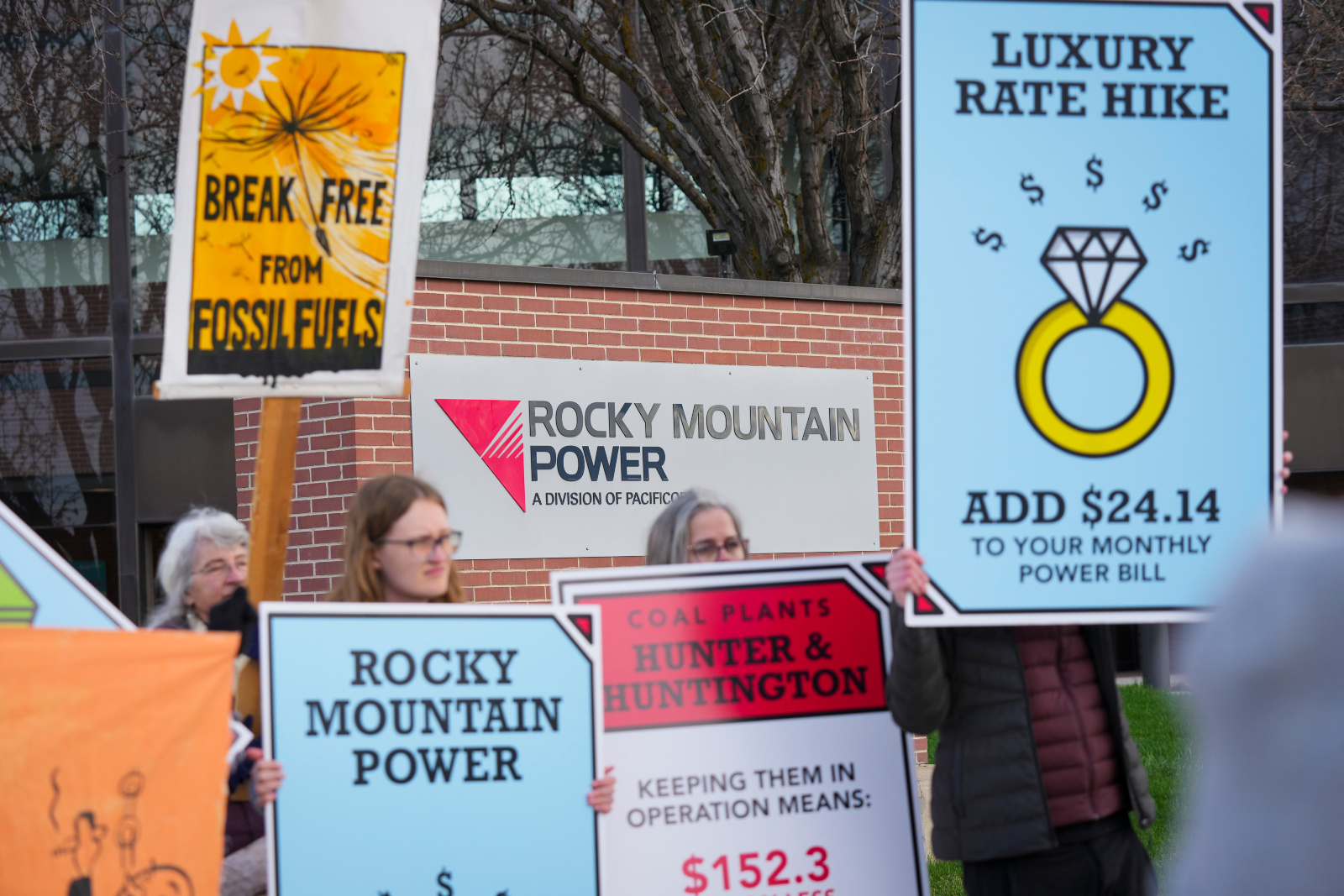
Tension over sharing energy costs with blue states grew in Utah in 2024, when Rocky Mountain Power, Utah’s largest electricity provider and part of PacifiCorp, proposed a 30% rate increase for most customers in the state. The utility said the increase was necessary to cover the costs of building new infrastructure and to comply with state regulations. Utah Republicans questioned Rocky Mountain Power and suggested the company could break away from PacifiCorp, its parent company, because of the progressive climate policies it was required to follow in California, Oregon and Washington. Last year, Utah Republican Gov. Spencer Cox signed a resolution encouraging an “interstate compact for regional energy collaboration” with Wyoming and Idaho.
“Unfortunately, we know Utahns are paying more for electricity because of decisions made in coastal states, like Oregon and Washington,” Cox said at the time. “But it’s much more than that.”
This theme has appeared in other parts of the country. Last September, five Republican-led states — Montana, North Dakota, Mississippi, Louisiana and Arkansas — asked federal regulators to stop a $22 billion transportation expansion project intended to connect cities in the Upper Midwest to the Great Plains. They argued that sharing the cost of the project would effectively force their ratepayers to subsidize wind and solar power to benefit Democratic states’ clean energy goals.
Yet while Republicans complain about the costs of building clean energy, Democrats blame the costs of keeping fossil fuels alive, noting that the Trump administration is forcing expensive coal plants to stay open beyond their retirement dates in Washington, Colorado, Indiana and Michigan. Michigan’s coal plant cost taxpayers $80 million in the first four months of operation beyond its scheduled retirement date, according to the chairman of the Michigan Public Service Commission.
“Clean energy is exactly where we’re moving forward,” said Meredith Connolly, director of policy and strategy at Climate Solutions, a nonprofit focused on clean energy in the Pacific Northwest. “It’s really about how quickly we get there, and are you creating these headwinds that slow the transition or are you trying to give an unfair advantage to fossil fuels? These are the stupid things we’re seeing that are actually driving up electricity costs.”

What’s behind your sky-high electricity bill? We analyzed it region by region.
There are many pressures on utilities: market forces, the rush to buy more electricity to power data centers, and even climate-related risks. In many states, particularly in the Southeast and Mid-Atlantic, replacing outdated equipment, protecting power lines and other measures to withstand more extreme weather are the biggest drivers of rising costs. In California, infrastructure upgrades to reduce wildfire risks (and therefore liability costs) are a key driver of soaring electricity bills. PacifiCorp, for example, faced numerous lawsuits accusing it of starting fires in Oregon and California with poorly maintained equipment and agreed to pay $2.2 billion as a settlement.
Some climate advocates worry what would happen if dividing the energy market along partisan lines becomes a trend. “Our destinies are tied to the energy market,” Connolly said. “And so those would be pretty artificial lines.”