The Endless Scoops of Seymour Hersh


Books and arts
/
January 14, 2026
Laura Poitras and Mark Obenhaus Cover and Seymour Hersh scoops
Laura Poitras and Mark Obenhaus Cover explores the life and times of one of America’s greatest investigative journalists.
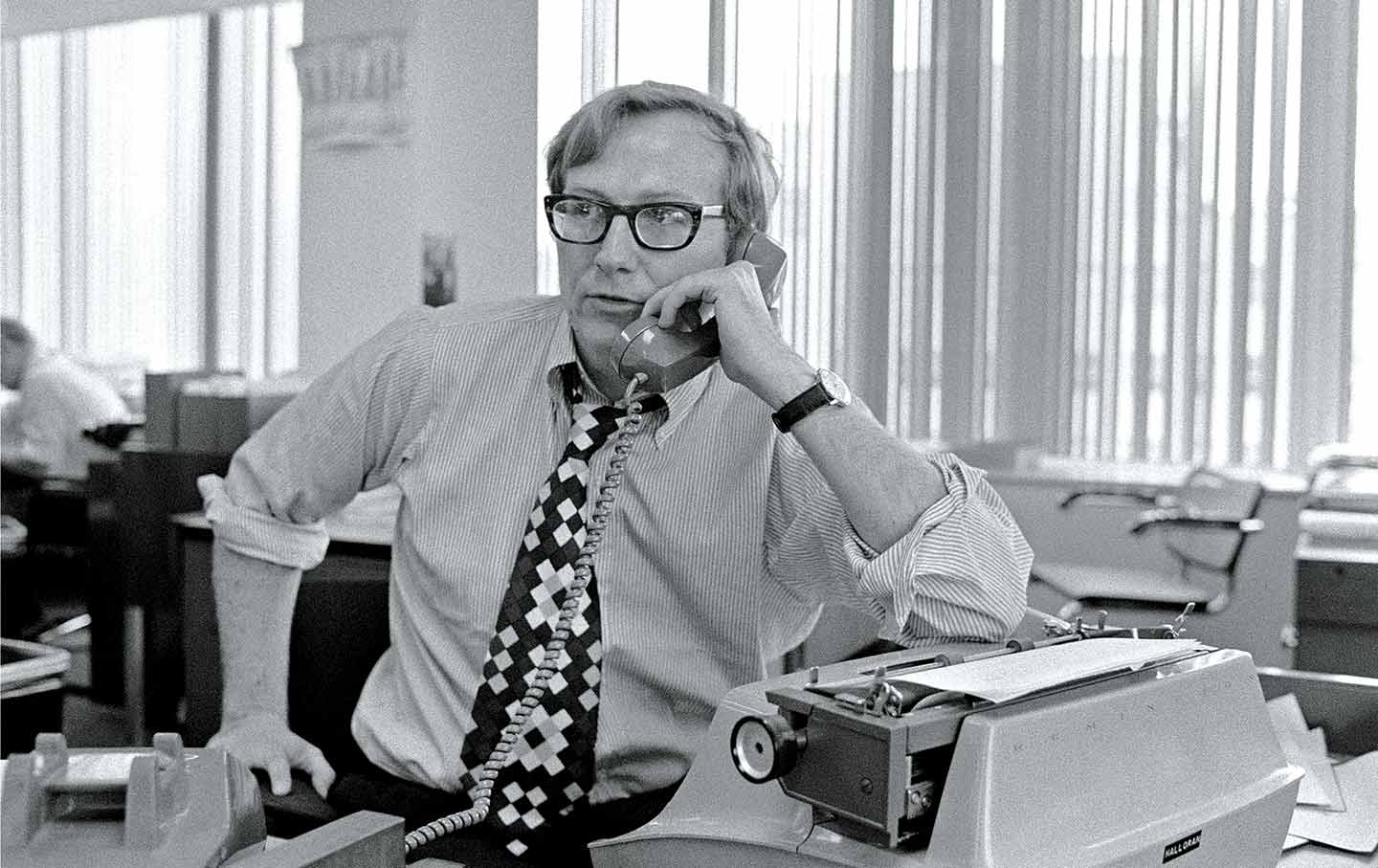
Seymour Hersh during his New York Times days.
(Wally McNamee/Getty)
Towards the beginning of Coverthe gripping new documentary from Laura Poitras and Mark Obenhaus, features a photo from a Pentagon press briefing during the Vietnam War. Cameras click, cameras roll, and the auditorium seats are filled with reporters. Everyone is focused on the man at the podium, Secretary of Defense Robert McNamara. This scene reminds us that most journalists practice herd behavior. You write down or broadcast what was said at the briefing, because if you don’t, your editor will scold you: “Hey, rival newspaper [or rival network] I just reported that McNamara said we were winning the war. Why haven’t we heard this from you? Whether covering City Hall, a state capitol or the White House, every reporter worries about receiving such a call. Yet, in the end, the briefing is rarely the story that matters.
If there has ever been a journalist who refused to practice herd behavior, that is the subject of a CoverSeymour Hersh. “When I was at the Pentagon for the AP,” he told Poitras and Obenhaus, recalling his early days reporting during the Vietnam War, “instead of going to lunch with my colleagues, I would go find some young officers. You know, I would talk a little bit about football, get to know them… Eventually the Army guys would start saying, ‘Well, it’s Murder, Incorporated'” over in Vietnam. Soon after, Hersh parted ways with the Associated Press (he would later do the same with The New York Times and would stop publishing in The New Yorker), but it was also about to tell the story of the My Lai Massacre, the deliberate massacre of several hundred Vietnamese civilians – men, women and children – in 1968 by American troops. This talk would be a huge boost to the anti-war movement. It would also launch Hersh’s career as one of the greatest investigative journalists this country has ever seen.
Cover gives a vivid picture of Hersh at work. We learn how he tracks down all the clues, whether it’s showing up at someone’s house unannounced, befriending an army officer or CIA agent with a guilty conscience, or taking notes on a document he’s looking at upside down on a lawyer’s desk, while the lawyer thinks Hersh is writing down what he says. Skilfully jumping back and forth through the decades, Cover brings together archival footage, interviews with an often reluctant Hersh, and shots of him in action, usually on the phone. We also hear about it from others, including President Richard Nixon. (“The son of a bitch is a son of a bitch,” Nixon said of him to Henry Kissinger. “But he’s usually right, isn’t he?”) Hersh resisted Poitras’s demands to make a film about him for almost 20 years before finally giving in — and in the film we even see him on camera trying to back out later. He comes across as extremely private, prickly, hyper-alert to lies, and relentless.
Cover touches lightly – perhaps too lightly – on the more recent work for which Hersh has been criticized. This includes going easy on former Syrian dictator Bashar al-Assad (“I never thought he was Mother Teresa,” Hersh admits to the filmmakers, “but I thought he was OK”) and several major stories that relied on one or two anonymous sources that could not be corroborated, such as Hersh’s claim that the United States blew up the Nord Stream pipelines that carried Russian gas to Germany. There were other questionable moments as well, but in a glittering career that spans more than 60 years, they can be forgiven.
Cover offers visual and aural pleasures to those of us old enough to remember the days when we journalists wrote on manual typewriters and sent our stories to newspaper typesetters in pneumatic tubes. But the film in no way romanticizes the news business; his eye is still fixed on Hersh’s resistance to the herd behavior presented in this first scene. “The biggest problem I had was running Sy at a newspaper that hated being beaten but didn’t really want to be first,” says Bill Kovach, the former New York Times Head of Washington Bureau. “THE Times I was scared to death that I would be the first to respond to a controversial story that called into question the credibility of the government.
It turned out the newspaper had other fears as well. “It was the beginning of the end for me The New York Times“, recalls Hersh, “when I started writing about business.” To give the Times some credit, he published some of these stories. But it’s impossible to imagine the stubbornly independent Hersh staying long with an established news organization that tried to rein him in.
Current number
After Hersh’s career, from the small Dispatch News Service (which broke the My Lai story) to The New York Times, The New Yorkerand the 11 books he wrote, Cover reveals how he obtained crucial evidence for a particularly important story from the 2000s: one that documented how U.S. troops horribly mistreated and tortured inmates at Iraq’s Abu Ghraib prison. Anyone who watched the media at the time will remember the shocking photographs of Iraqi prisoners – one with a leash around his neck; another, naked and cowering, threatened by an attack dog; another, hooded, standing on a box with electrical wires attached to his hands; another, bent over and chained to the door of a cell. “If there had been no photographs…no story,” Hersh remarks in the film.
How did he get them? On a radio show, Hersh urged people with information to contact him and then provided his phone number. A woman called. Her name was Camille Lo Sapio and she first went public in Cover. Lo Sapio says she lent her laptop to a former daughter-in-law deployed to Iraq. When the computer was returned to her, she found these photos on it.
One of the film’s final scenes is particularly haunting. Hersh is at home, looking at a table covered with photos of large rough diagrams, hand-drawn with thick marker, of houses and apartments in Gaza. Some diagrams appear to have been drawn on paper, others on walls and several on sheet metal pierced by bullets. Hersh is on the phone with the woman who sent him these images. We hear her voice, slightly accented, when she explains that it is “a record of massacres which can essentially be traced back to the units which committed the war crimes”. The woman is not named – is she Palestinian? Israeli? She asks to be identified in anything he writes as simply “a researcher recently returned from Gaza.”
At one point, Hersh asks him about the diagrams: “Is this all just background? Am I not allowed to write any of this down?” The woman replies, “For now. But you’ll be the one I go to when we’re ready.”
As admirable as Hersh and this expertly crafted film about him are, in a way Cover looks slightly old-fashioned, like those manual typewriters and pneumatic tubes we see on screen. At the time of Hersh’s greatest achievements—the revelations about My Lai and Abu Ghraib and a dozen other stories in between, such as Henry Kissinger’s support for Chile’s murderous 1973 coup—the revelation of the blatant violation of laws and ethical standards still had the power to shock us and spark outrage, protests in the streets, even investigations in Congress.
Is this still the case today? In the week of writing this, President Trump welcomed Saudi Crown Prince Mohammed bin Salman to the White House with trumpets and an F-35 flyover – the man who, according to U.S. intelligence, ordered the 2018 killing and dismemberment (with a bone saw) of critical journalist Jamal Khashoggi inside the Saudi consulate in Istanbul. When an ABC reporter at the White House asked Bin Salman about the brutal assassination, Trump attacked her for trying to “embarrass our guest.”
Popular
“Swipe left below to see more authors”Swipe →
The same week, it was reported that the US Coast Guard would view the display of the Nazi swastika or hangman’s noose as merely a “divisive risk” rather than a symbol of hatred. Under pressure from critics, officials later backtracked. Before backing down, President Trump also called for six Democratic members of Congress to be arrested and executed.
Each week brings similar examples. What could have shocked us deeply has become normal; Trump and the climate he fostered have hardened us. It is as if the value of the shock, of the revelation of evil, had been diminished by galloping inflation.
There is also another source of inflation. With the proliferation of smartphones and the photos they take, do images still have the power to shock us and incite us to action, like those of My Lai and Abu Ghraib? We have seen thousands of photos and video clips of the destruction of Gaza and the suffering of its people, in painfully graphic detail. Yet we allowed these massacres to continue with American weapons, under two presidents, for two years. And finally, today we all don’t know if the image or video we are watching is real or generated.
That’s not to say you shouldn’t take inspiration from the life of someone like Seymour Hersh. But it makes the kind of work he did more difficult than ever. This means not only revealing the injustice that those in power don’t want revealed, but also telling that story in a way that can break through the newly hardened shell that surrounds our hearts.
More than The nation
The “Big, Beautiful Bill” added additional taxes on a small group of universities. Today, budget cuts are hitting campuses in the Ivy League and beyond.
Student Nation
/
Zachary Clifton


