Webb Spots Four Distinct Dust Shells around Two Wolf-Rayet Stars


Using the NASA/ESA/CSA James Webb Space Telescope with data from ESO’s Very Large Telescope (VLT), two teams of astronomers captured a mid-infrared image of a system of four serpentine dust spirals around two aging Wolf-Rayet stars in a system known as Apep (2XMM J160050.7-514245).
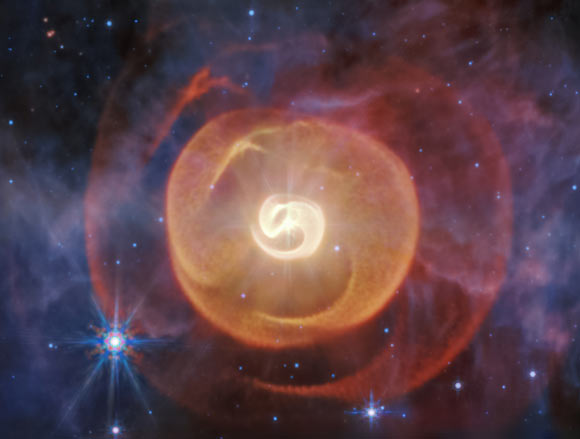
Webb’s mid-infrared image shows four dust shells wrapped around a pair of Wolf-Rayet stars known as Apep. Image credit: NASA / ESA / CSA / STScI / Yinuo Han, Caltech / Ryan White, Macquarie University / Alyssa Pagan, STScI.
Wolf-Rayet stars are a rare class of massive binary stars, where the first carbon in the Universe is forged.
It is estimated that there are only a thousand in our galaxy, the Milky Way, which contains hundreds of billions of stars in total.
Among the several hundred Wolf-Rayet binary stars observed to date, the Apep system is the only example containing two Wolf-Rayet stars of this type in our Milky Way.
In new research, Macquarie University astronomer Ryan White and colleagues sought to refine the orbit of Wolf-Rayet stars in the Apep system.
They combined precise measurements of the ring’s location from the Webb image with the shells’ expansion rate from observations taken by the VLT over eight years.
“This is a unique system with an extremely long orbital period,” White said.
“The next longest orbit for a dusty Wolf-Rayet binary is around 30 years. Most have orbits between two and ten years.”
The team’s paper was published simultaneously in the Astrophysics Journal with another paper, led by Caltech astronomer Yinuo Han.
“Looking at Webb’s new observations was like walking into a dark room and turning on the light – everything was visible,” Dr Han said.
“There is dust everywhere in the Webb image, and the telescope shows that most of it has been shed in repetitive, predictable structures.”
Webb’s observations provided a first of its kind: a sharp mid-infrared image of a system of four serpentine spirals of dust, one extending beyond the next in exactly the same pattern. Ground telescopes had detected only one shell before Webb revealed all four.
The Webb image, combined with several years of VLT data, reduced the frequency with which the two pairs intersect: once every 190 years.
In each incredibly long orbit, stars pass each other for 25 years and form dust.
Webb’s observations also confirmed that there are three stars gravitationally bound to each other in this system.
Dust ejected by the two Wolf-Rayet stars is cut off by a third star, a massive supergiant, which carves a hole in each expanding dust cloud from its wider orbit.
“Webb gave us compelling evidence that the third star is gravitationally bound to this system,” Dr. Han said.
Researchers have known about the third star since the VLT observed the brighter shell and stars in 2018, but Webb’s observations led to an updated geometric model, thus making the connection.
“We solved several mysteries with Webb,” Dr. Han said.
“The remaining mystery is the precise distance between the stars and Earth, which will require future observations.”
_____
Ryan MT White and others. 2025. The serpent eating its own tail: destruction of dust in the colliding wind nebula Apep. ApJ 994, 121; doi: 10.3847/1538-4357/adfbe1
Yinuo Han and others. 2025. The formation and evolution of dust in the colliding wind binary apep revealed by JWST. ApJ 994, 122; doi: 10.3847/1538-4357/ae12e5


