Hundreds of old EV batteries have new jobs in Texas: Stabilizing the grid


East of San Antonio in the county of Bexar, 500 batteries of electric vehicles at the end of their automotive life will soon be reused to provide energy storage to Texas’s Electric Grid, a Californian company, B2U Storage Solutions, announced on Tuesday.
The batteries, housed in 21 cabinets the size of shipping containers, create a second lifespan for technology made from critical minerals, including lithium,, nickel And cobaltFor another eight years, said Freeman Hall, co-founder and CEO.
Once the site is built and operational later this year, the batteries will take care of in the event of excess of renewable energy production on the network and that the cost of energy is inexpensive. The installation of Texas will have a total capacity of 24 megawatts.
B2U Storage Solutions, based in Los Angeles, plans to deploy three other grid storage projects in Texas throughout next year, totaling 100 megawatts across the State, said the company. Assuming that the average cleaning uses 30 kilowatt hours a day, it is enough energy to supply 3,330 houses for a day, said Hall.
The site near San Antonio will register with the CPS energy distribution system, one of the largest public service companies belonging to the city.

Texas finalizes $ 1.8 billion to build solar, battery and gaseous micro-metal
“We really help pioneer and demonstrate to the automotive industry that reuse has a lot of sense for a fairly healthy number of batteries before being really ready for the end of life and recycling,” said Hall in an interview.
Michael Stern, director of hall operations and in chief, began to build solar projects on an industrial scale almost 20 years ago in the cities of California in Palmdale, El Centro and Mojave, installing some 100 megawatts or enough electricity to supply more than 15,000 houses.
But soon, while more solar energy began to connect to the grid, their offers for public services were mined by a “duck curve” in development – a shortcut of industry for higher penetration of renewable energies on the grid depressed the prices of energy during sunny hours followed by an increase in cost in the evening because there is a loss of sun.
“This is what inspired us to realize that we had to add storage to our projects,” said Hall. “Along the way, we had a revelation.”
By seeking battery storage options for their solar projects, the two developers realized that the first wave of commercial EV batteries was starting to conclude their automotive life of around 10 years. Aware of the research that the state of health of these batteries, measuring the difference between a new battery and a used battery, surrounded up to 80%, Hall and Stern emitted the hypothesis that they could build a technology to use the batteries because they came from the vehicle, avoiding any cost of reuse.
The two solar developers therefore bought 300 Nissan Leaf batteries. The car manufacturer had encountered a problem of guarantee of the powertrain with the first public EV of the general public, because the range he promised in the lease with the customer has not succeeded.
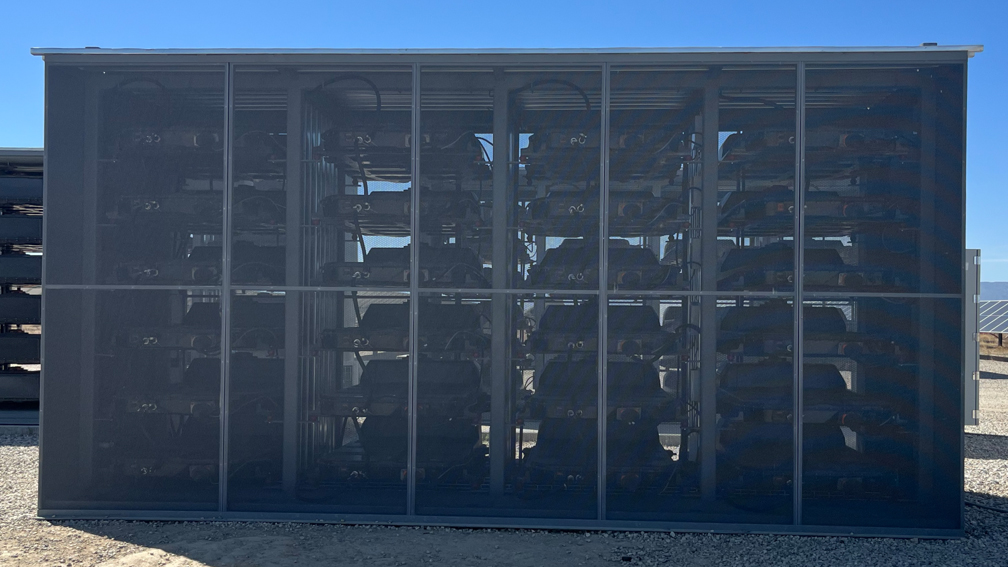
With the kind permission of B2U Storage Solutions
To repair the warranty and the warranty, Nissan exchanged the batteries and ended up with thousands of batteries that were still useful, said Hall, but not for driving. The batteries still had thousands of cycles in a less demanding scenario, such as stationary storage for renewable energies.
It was at this point that solar developers launched the EV storage technology for fundamental storage pack for B2U, which currently operates three facilities using electric vehicle retirement batteries, the Honda Clarity and Nissan Leaf in California.
B2U’s technology allows the company to buy Retired EV batteries without having to modify them, creating large -scale storage projects for less than if they installed new batteries.
The global fleet of electric cars has reached nearly 58 million by the end of 2024, or about 4% of all cars on the road, according to an international electric vehicle report from the 2025 energy agency. It is more than triple the quantity of electric cars in 2021.
Batteries in electric vehicles are generally replaced once they reach approximately 70 to 80% of their capacity as its reach begins to decrease. While more and more EV batteries are retiring in the next decade, the second -life EV battery market is expected to become an industry of $ 4.2 billion by 2035, according to a December Idtechex report, a technology market company.

Farmers make the bank harvest a new harvest: solar energy
As the emerging industry in the United States is advancing, the reuse of second-life batteries will become less expensive to use, depending on the report, as the new technology develops and accelerates the process. For example, quality insurance can currently take hours, but the report suggests that technology will soon reduce the process a few minutes. These cost savings will be particularly important, because loans and incentives for the inflation reduction law which supported an increasing interior recycling industry.
The opportunities on the competitive competitive market of the competitive GRID of Texas are what led Hall and his company to consider operating outside their headquarters in California, said Hall.
As a storage power generator, B2U is able to sell energy after invoice it at a lower cost and provide auxiliary services to the network, or be paid by network operators to help limit deviations and imbalances.
The batteries have made significant contributions to the capabilities of the Texas electricity network in recent years and have been credited to prevent summer failures by strengthening the reliability of the network. According to the Electric Reliabibility Council (ERCOT), nearly 4,000 of the 9,600 capacity megawatts added to the network (ERCOT).
The latest generation interconnection report shows that more than 700 autonomous battery storage projects and more than 300 more solar battery projects are online to connect to ERCOT.
Last year, another company based in California, Element Energy, began to store electricity using 900 batteries of second -life electric vehicles within the ERCOT. According to Element, the western Texas site totals 53 storage capacity megawatts, making it one of the largest retired EV battery projects in the country, depending on the element.
Trump’s second term is to create a “limbo moment” for us the battery recycles
B2U manages more than 2,000 retired batteries through its system, which coordinates the performance of the batteries, the cabinet and the overall power station. The data they collect in real time allow them to monitor the temperature of batteries and voltage levels. The company has 2,000 other end -of -automative life batteries at a certain deployment stage, said Hall, which will soon be ready to connect to the grid.
Whenever the company receives a batch of EV batteries, B2U performs its own diagnostic tests, with approximately 5 or 6% rejected due to lower quality health.
The tests, associated with the way they configure the batteries in their cabinets, allow retired batteries to operate despite the variance of their capacities. In terms of Profan, if a lower battery has loaded and reached its voltage limit, how B2U connects their batteries guarantee that the stronger batteries can continue to load until they are full.
“It’s a kind of key to solving the problem of second -life batteries,” said Hall.
The reused EV batteries are not something you hear a lot in Ercot, or in other grids in the United States as one of the first innovators, it took B2U for almost five years to obtain basic, distributed, profitable and ready to evolve technology, said Hall.
He said they had done their timing well. Since they started B2U in 2019, sales of EV cars in North America have almost tripled. This means a constant flow of ready -to -retirement batteries available for their next career stabilizing the grid and preventing early recycling of critical minerals. “You have not heard of it much to date,” said Hall about the use of the second -life EV battery. “But you will hear much more about it in the future.”