The heavy “portable” Toshiba T100 helped define early mobile business computing


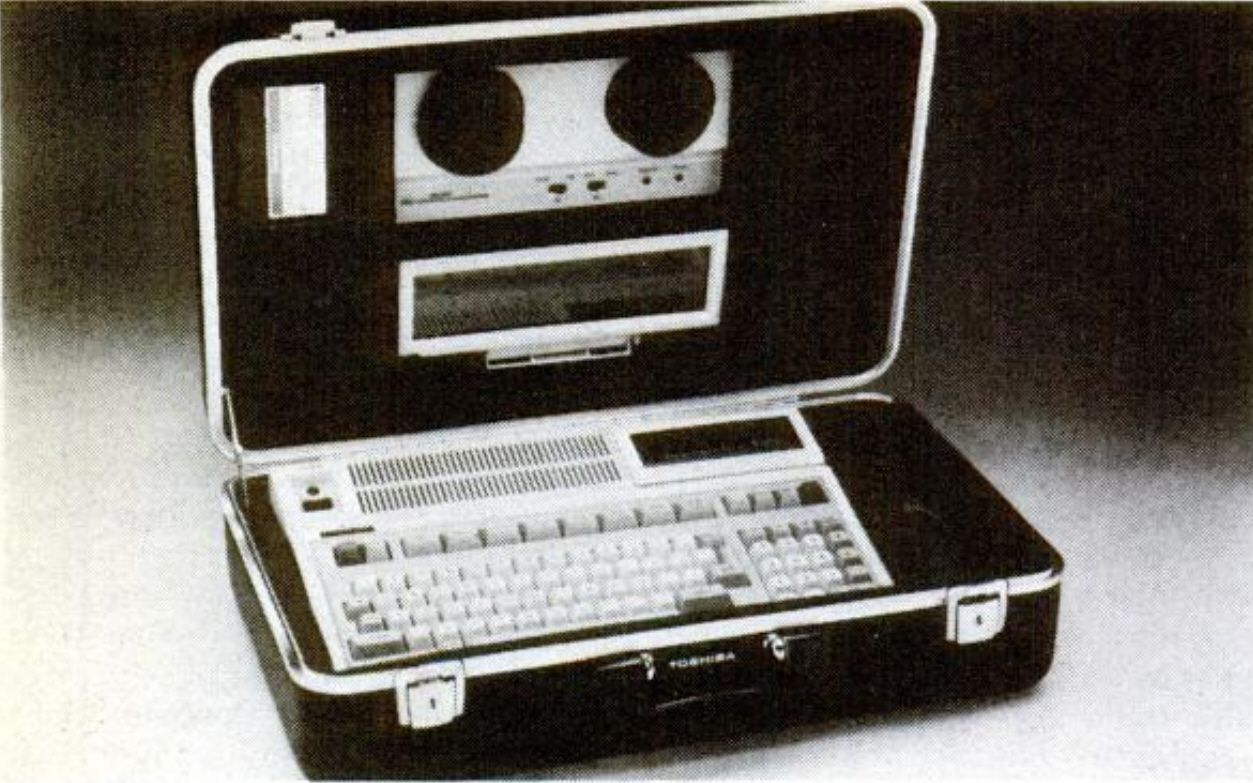
Long before laptops became thin slabs of metal that you could slip into a backpack, portable computing meant something very different: In the early 1980s, portability was measured less by weight than by the simple fact that a machine could be moved from one desk to another.
The T100 was different because it didn’t look or behave like the personal computers that dominated the first microcomputer boom. Although Toshiba described the T100 as being “the size of a typewriter”, a 1982 issue of InfoWorld observed that because “its LCD screen fits on top of the keyboard and processor, which are combined into a single unit”, it was actually smaller than that.
This was a big deal at a time when most enterprise systems still required several large components.
Designed for serious professional use
The concept was undoubtedly ambitious. The T100 could use either a traditional CRT or a liquid crystal display “the size of the palm of your hand”, a feature that seemed futuristic in 1982.
John Rehfeld, vice president and general manager of Toshiba America’s information systems division, said InfoWorld“This may be the first personal computer to offer liquid crystal display output.”
This small LCD screen, mounted on the device, hinted at modern portable thinking long before the term laptop became standard.
Beneath the compact body was hardware designed for serious professional use. The system ran on the CP/M operating system and included 64 KB of RAM – respectable specifications for its time. Rehfeld described the machine not only as a personal computer, but also as a network-enabled office tool.
“For not much more money [than a dumb terminal]you can have a computer on your desk that will be connected to a network, have email, have access to a corporate database and still do word processing,” he said. InfoWorld.
The T100 was seen as a productivity machine rather than a hobbyist’s toy.
Portable, sort of
The February 1983 issue of Popular science described the “coming tidal wave of new Japanese desktops”, including the T100. The magazine details the system’s internal hardware, including a Z-80A processor, 32 KB of ROM and expandable memory, as well as its impressive graphics capabilities.
Paired with Toshiba’s optional color monitor, the T100 offered “excellent eight-color resolution: 640 x 200 dots,” a level of capability aimed squarely at professional users.
The portability angle, however, was the real talking point. Popular Science noted that an optional compact LCD panel could present six or eight lines of text, providing a convenient, if rather limited, way to use the system without a full desktop display.
It was portability defined by a tradeoff: smaller screens and modular add-ons instead of built-in mobile convenience.
The July 18, 1983 issue of InfoWorld reported that the system was no longer the “T100 personal computer”, but rather the “Toshiba T100 portable machine”, explicitly pursuing the emerging laptop market.
The package seemed almost surreal by modern standards. A complete setup included “a seven-pound keyboard and typewriter computer, a 300 baud modem, a liquid crystal display (LCD), a RAM pack, cables, and a briefcase,” with a retail price of approximately $1,600.
Existing T100 owners could upgrade their machines by purchasing portability starter kits priced between $570 and $795 (the latter with the modem).
In total, the system weighed 25 pounds.
While today’s ultralight laptops can weigh as little as 1.5 pounds, in the context of 1983, this was cutting-edge mobility.
You could transport your computer, modem, and monitor to another location, which was a significant advancement when most office machines never left their desks.
Closer to office equipment
The inclusion of a modem made it even more forward-looking. Portable telecommunications was still new, and Toshiba clearly envisioned professionals connecting to business systems on the go.
The machine’s keyboard also played an important role in its identity. Unlike later membrane portable systems, the T100 used a fully mechanical typewriter-style layout with 89 keys, including cursor controls and programmable function keys.
It seemed closer to office equipment than to consumer electronics, thus reinforcing its primarily professional character.
However, the T100 was not perfect. InfoWorld pointed out that unlike competitors such as the AA battery-powered Radio Shack Model 100, the Toshiba relied entirely on AC power, limiting its true portability. In many ways it was a transportable desktop computer – powerful and modular but sector-dependent.
Nevertheless, the T100 represents an important evolutionary step in the history of computing. It combined desktop functionality, early LCD experimentation, communications hardware, and a compact mechanical keyboard into a system that challenged the era’s expectations of what a personal computer could look like.
It came before laptops had a defined form, before portability meant all-day battery life, and before mobile computing became ordinary.
Seen today, the idea of lugging around a 25-pound computer in a suitcase seems almost absurd. But in the early 1980s, Toshiba’s T100 offered something truly new: the possibility that your computer could travel with you.
Follow TechRadar on Google News And add us as your favorite source to get our news, reviews and expert opinions in your feeds. Make sure to click the Follow button!
And of course you can too follow TechRadar on TikTok for news, reviews, unboxings in video form and receive regular updates from us on WhatsApp Also.


