Estados limitan la cobertura de una terapia de referencia para el autismo. Y las familias reaccionan


ALEXANDER, N.C. – Aubreigh Osborne is a new friend.
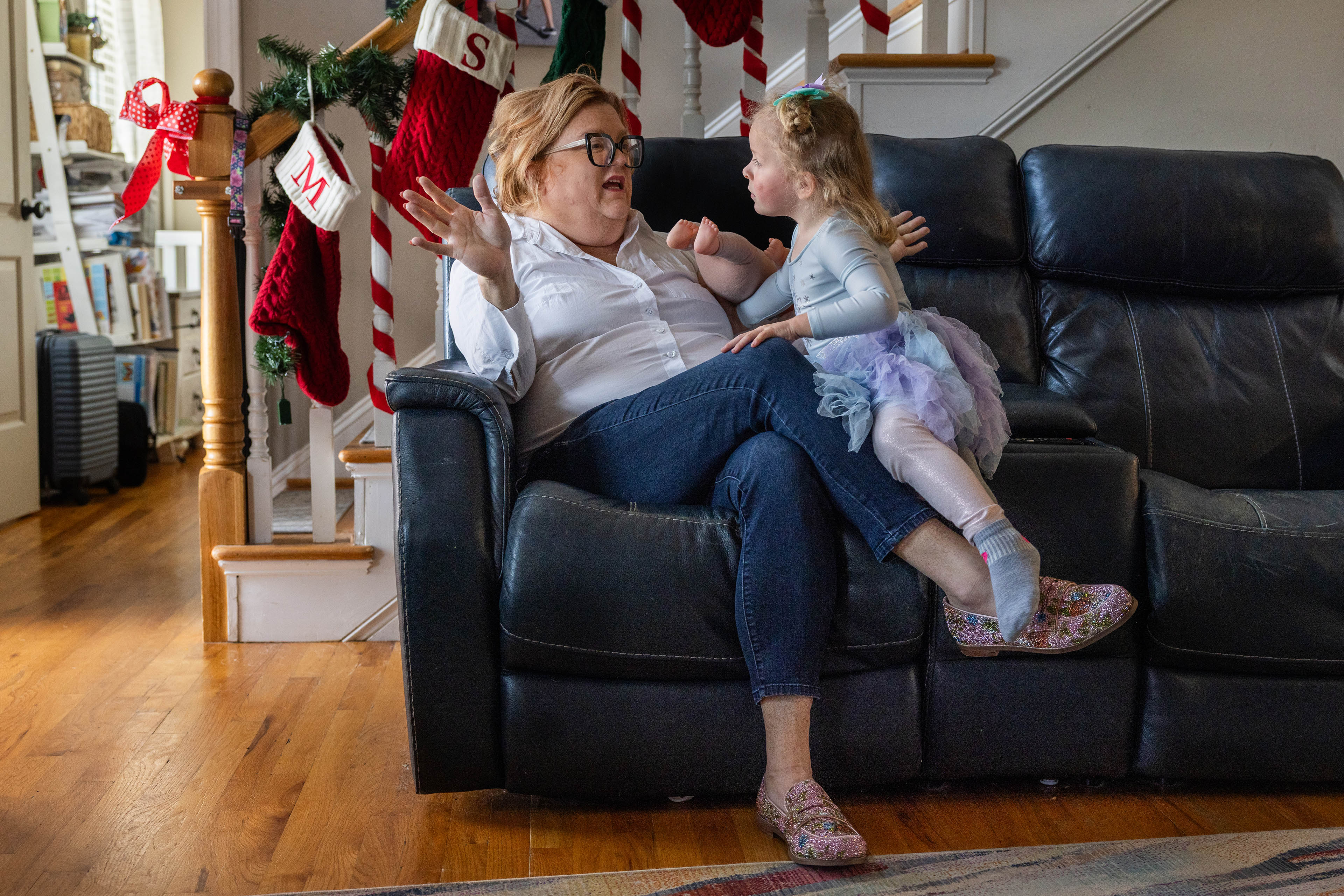
Blue dress and with a big month in his rizos rubios, the 3-year-old girl felt in the regazo of her mother pronouncing with him the number of a classmate after listening to the words “mejor amiga”. For the past month, Gaile Osborne has not hoped that her adopted daughter will make friends at school.
Diagnosed with autism 14 months ago, Aubreigh Osborne began this year tenfold with difficulty controlling his actions and, on some occasions, harming himself. It is difficult to interact socially so your family will avoid going out in public. But he actually received a therapy called applied behavior analysis, known as ABA, which should be used to help autistic people improve their social and communication skills.
Since then, the pre-schooler has worked with great regularity, but he left the sign, accompanying his mother to the supermarket without incident and knowing that someone is his best friend. All this, for the first time in your daily life.
“That’s what ABA tells us: moments of normalcy,” Osborne said.
But in October, Aubreigh’s therapy hours were abruptly reduced from 30 to 15 per week, part of an initiative to save Medicaid money.
Other families across the country also have a limited view on their access to this therapy as state officials enforce important concerns about the program: the public health safety that people with low incomes and disabilities receive. Carolina del Norte received 10% of payments from ABA suppliers. Nebraska is reducing payments by 50% for some of these services. In Colorado and Indiana, among other states, we are also considering reductions.
These recordings were made when the Medicaid patient in this therapy disappeared in recent years. ABA payments in North Carolina reached $122 million in fiscal year 2022 and are projected to reach $639 million in 2026, a 423% increase. In Nebraska, waste has increased by 1,700% in recent years. In Indiana, the increment was 2,800%.
Improved diagnosis and awareness of autism has meant that most families are involved in their children’s treatment, which can take place between 10 and 40 hours of service per week, according to Mariel Fernandez, vice president of government services for the Autism Service Providers Council.
Additionally, Medicaid coverage of this treatment is relatively recent. The federal government ordered states to prepare treatments for autism in 2014, but not all, including ABA, considered by Fernandez to be the “gold standard,” until 2022.
State presupposed challenges and $1 trillion cases in Medicaid planned cases, derived from President Donald Trump’s Gran and Hermosa Ley (One Big Beautiful Bill Act), have pushed states to cut spending on ABA and other growing areas in the program.
He also influenced a series of state and federal audiences who worked on pages produced by some ABA vendors.
The federal Medicaid program in Indiana estimated compensation for less than $56 million in 2019 and 2020 showed that some providers were coworking for excessive hours, including during nap time.
A similar hearing in Wisconsin calculated awards worth less than $18.5 million between 2021 and 2022. In Minnesota, state authorities conducted 85 open investigations into autism service providers in Lifetime, after the FBI launched two centers at the end of the year as part of a Medicaid fraud investigation.
Families present a battle
But the effects of reducing waste in this therapy have also generated a rechazo between families who depend on the treatment.
In North Carolina, the families of 21 children with autism filed a legal challenge against the 10 percent increase in provider payments. In Colorado, a group of providers and parents called on the state to move toward requiring prior authorizations and reducing therapy fees.
And in Nebraska, family and advocates are making sure cases — those in the 28% to 79%, depending on the type of service — can meet access to treatment.
“Your children have made very significant progress and now they are in office,” said Cathy Martinez, president of the Autism Family Network, a nonprofit organization headquartered in Lincoln, Nebraska, that serves autistic people for her family.
Martinez spent years giving up for Nebraska to apply for coverage for ABA therapy, while your family banked to pay for your bag for your son Jake.
Jake was diagnosed with autism at age 2, in 2005, and began receiving ABA in 2006. Martinez credited this therapy with helping Jake learn to read, write, use an assisted communication device and be in the bath alone.
To pay for the treatment, which cost $60,000 per year, the family had money lent to a friend, mortgaged their house for the second time and ended up in bancarrota.
“I think my Tuviera family declares itself in the bank to be able to cherish our child something that recommends all the doctors who live it,” Martinez said. “Ninguna familia debería tener que elegir entre la bancarrota y ayudar ayudar a su hijo”.
Nebraska mandated coverage of services for autism in 2014. Now, Martinez says recorts have been tasked with providing the service, limiting access to whoever performed.
We also confirmed the September fine, when Above and Beyond Therapy, one of Nebraska’s ABA providers, notified families who wanted to participate in the state’s Medicaid program, using records.
Above and Beyond’s website offers services to less than another state. At a state hearing, the company received more than $28.5 million from Nebraska’s privately administered Medicaid program in 2024. That’s about a third of the state’s total ABA time that year, and four times as much as the second-largest provider. Its chief executive, Matt Rokowsky, did not respond to interview requests.
A week after announcing its withdrawal, the company changed its mind and decided to continue offering services to Medicaid, citing “an enormous number of calls, emails and emotional messages” in a letter sent to the family.
Danielle Westman, mother of Caleb, a 15-year-old patient at Above and Beyond who received 10 hours of ABA at home, was released with the announcement. Caleb is semi-verbal and tends to annoy his bosses.
“No chance of looking like another company,” Westman said. “A lot of ABA companies want to go to their shift centers. My kid has a lot of experience, he has a lot of experience, because he’s at home, in his safe space, he’s amazing.”
Nebraska officials say that prior to the filings, the state had the highest Medicaid reimbursement rates for ABA in the nation and that the new pages are competitive compared to older states, but allow the service to be “accessible and sustainable into the future.”
Drew Gonshorowski, state Medicaid director, said his agency was handling the situation and was not aware of providers who had already made the condition in question on file. I confirmed that the largest suppliers began working in Nebraska after announcing the changes.
Uno also celebrated the records. Corey Cohrs, CEO of Radical Minds, which is centrally located in the Omaha area, criticized the tendency of some providers to offer 40 hours of services to children per week, with no difference in needs. Compared to the chemotherapy therapy received by all cancer patients, regardless of severity, it is only the most important treatment.
“So they make more money for patients and don’t make actual clinical decisions to determine the best path,” Cohrs expressed.
Nebraska established an ABA limit of 30 weekly hours without additional clinical review, and according to Cohrs, the new rates are sustainable for providers unless your business model depends exclusively on high Medicaid charges.
In North Carolina, Aubreigh Osborne’s ABA services were restored largely through the persistence of his mother, who called him again and again until the system was established.
And now, Gaile Osborne doesn’t tend to worry about legislative disputes that might affect her daughter’s attention span. In principle, in November, a ruling from the Superior Court of the State temporarily suspended the ABA’s cases while the request presented by the family was advanced.
Osborne is executive director of the Foster Family Alliance, a leading global advocacy organization in the state, and has been a maestra of special education for 20 years. With her experience, I don’t know how to help Aubreigh become better socially. In principle, he was skeptical about ABA, but today, this therapy is a point that contributes to his daughter’s well-being.
“It’s not perfect,” Osborne said. “But the progress that has taken place in at least a year is incredible.”
Do you have an experience related to services for people with autism that you would like to share? Click here to see your history on KFF Health News.


