The Infamy of the “Kavanaugh Stop”


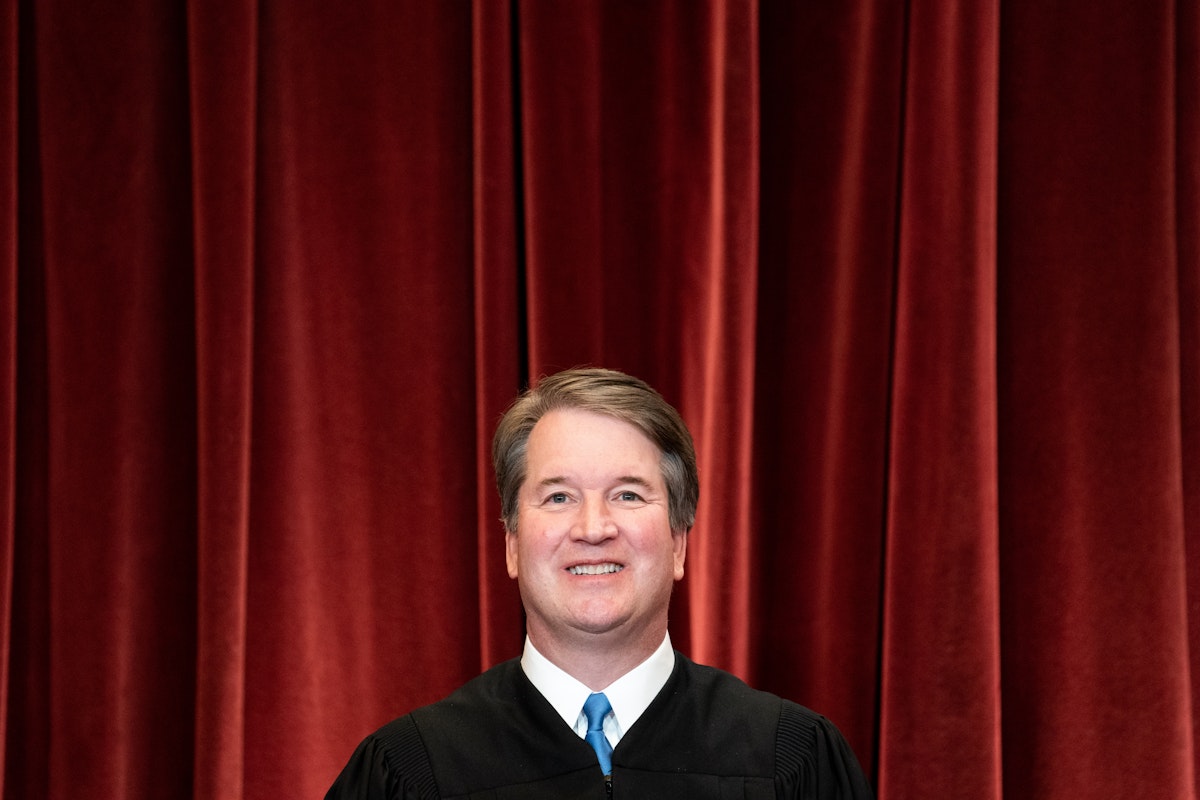
Believe it or not, there was a time when the Supreme Court’s emergency rulings did not routinely spark controversy; they were simply the means by which the court could consider urgent legal crises, such as motions related to capital punishment. But a key element of the Trump era is the transformation of the emergency docket into a “shadow docket”: unsigned decisions that have had a profound effect on the country. Beyond the fact that these decisions have a “heads, Trump wins, tails, the Democrats lose” tendency, they are, as Erwin Chemerinsky notes, often presented without much jurisprudential explanation while frequently bulldozing precedents. The judges themselves may not like the term “shadow docket,” but they still seem to enjoy operating in the shadows.
But there is one case in which a judge tried to explain himself in a recent phantom decision, but his reasoning exploded almost immediately after his first encounter with the real world: Brett Kavanaugh’s concurring opinion In Noem v. Vasquez Perdomo, in which the Supremes stayed a lower court ruling that specifically blocked the Department of Homeland Security from racially profiling people for immigration enforcement purposes. The larger court, as usual, did not issue a decision. But Kavanaugh still chose to intervene. His reward is a huge dose of infamy in the form of a specific secret police tactic that many have taken to calling “the Kavanaugh decision.”
Here’s the essential context. As The New RepublicMatt Ford reported After the Noem decision was handed down, Kavanaugh’s surprise deal went to great lengths to “minimize the impact” of an encounter with law enforcement: “It is important to note that reasonable suspicion only means that immigration officers may briefly stop the individual and inquire about their immigration status,” Kavanaugh wrote. “If the person is a U.S. citizen or is in the United States legally, he or she will be free to leave after the brief encounter. Only if the person is in the United States illegally could their check result in further immigration proceedings.”
As Ford pointed out, the encounters with law enforcement that formed the basis of the case itself could hardly be described as “brief.” One of the plaintiffs in Noème testified that his attempt to show valid proof of U.S. citizenship did not shorten the encounter, because the officers “refused to believe the validity of his California driver’s license.” As Justice Sonia Sotomayor recalled in her dissent: “The officer said the ID was insufficient, seized [his] arm,” escorted him to a vehicle and took him to a “warehouse area” for further questioning. None of this at all resembles the rapid-fire interaction that Kavanaugh suggested was the theoretical norm. And in practice, Kavanaugh’s ruling also failed to take into account his brief imagined encounter.
The essential elements of a Kavanaugh stop involve a person being detained specifically for immigration reasons, with race being a definite or likely factor in the decision behind the stop — Fourth Amendment protections against illegal searches and seizures be damned. Sotomayor sees a bleak future in the court’s decision: “We should not have to live in a country where the government can arrest anyone who looks Latino, speaks Spanish, and appears to be working a low-wage job.” »
If current events can serve as a guide, that of Sotomayor fears are now reality. Like the Chicago Tribune recently reportedChicago resident Rueben Antonio Cruz, a 60-year-old man from El Salvador, was sitting with a friend in Rogers Park when “immigration agents stopped their truck and went straight after them.” What followed was a classic Kavanaugh stop: Cruz and his friend were asked for “papers” proving their citizenship. Cruz, who was not carrying any such papers, was then placed in the officers’ vehicle and questioned. Cruz was eventually released, but not before officers fined him $130 for “no papers.” The ordeal made Cruz angry: “It’s not fair because I said, let’s go to my house and I’ll show you my papers. I’m a resident.”
THE Tribune notes that while federal law requires registered foreign nationals to carry proof of registration at all times, “prior to a second Trump administration, it was rarely enforced.” This detention drew criticism from Ed Yohnka of the ACLU: “America has never been a place where people have to ‘show their papers.’ It is unnecessary and cruel to ticket a legal permanent resident – and force them to appear in court and pay a fine for not carrying their papers. Unfortunately, this risks becoming commonplace as Trump’s henchmen, freed from their legal obligations by the Supreme Court, arrest Kavanaugh as part of their daily operations.
The possibility that Trump’s ICE agents, who were effectively given carte blanche to abuse their authority, could simply reject their prey’s proof of valid citizenship does not appear to have occurred to Kavanaugh. But it certainly happened to the jabronis who kidnapped brown people in American cities. In a second Kavanaugh ruling detailed by the Tribune, a 44-year-old Latina named Maria Greeley was jogging when she was attacked by federal agents who tied her up and detained her despite the fact that she always carried her passport with her to prove she was born in the United States. According to the report, agents remarked that she didn’t “look like a Greeley,” rejected her documents and repeatedly accused her of lying.
One of the most blatantly questionable things about the Supreme Court is that it is so often disconnected from the real world — a perhaps inevitable condition for giving nine people special robes and lifelong job security, then locking them in a sepulchral building to stew in their own partisan juices with no one to answer to. Kavanaugh’s flawed reasoning may simply be the product of deep naivety. But since all of this happened in a phantom case in which the Trump administration sought emergency relief in the form of permission to racially profile people, I think it’s hardly unbelievable to think that Kavanaugh felt compelled to try to put a good spin on a reprehensible decision.
The fact that Kavanaugh must own the Kavanaugh decision is little comfort. Who knows if it’s even possible to shame or humiliate Brett Kavanaugh anyway? It is very possible that the transformation of the United States into a country more reminiscent of Nazi Germany “My bitten paper“The era is precisely the legacy Kavanaugh sought for himself. It is we who are grappling with the consequences.
This article first appeared in Power Mad, a weekly TNR newsletter written by Associate Editor Jason Linkins. Register here.


