
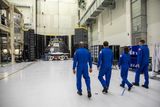
The launch date of Artemis II has been pushed back again, this time due to an issue with the helium, according to a recent NASA announcement.
The team of four astronauts, who had hoped to lift off this month in March 2026, will now prepare for launch opportunities in April 2026, provided all goes to plan.
Soon after this postponement was announced, NASA revealed plans to shake up its Artemis program by increasing the number of launches to one per year after 2028 and delaying its lunar landing. This means Artemis III will no longer be sending an astronaut to the moon.
An Issue with the Helium Flow for Artemis II
The Artemis II rocket completed a wet dress rehearsal on Feb. 19, 2026. This is essentially a test run of the launch without the actual take-off, and according to NASA, it was successful.
However, an update released the following day revealed engineers had encountered an issue concerning the flow of helium to the spacecraft’s interim cryogenic propulsion stage. Crew members Victor Glover, Jeremy Hansen, Christina Koch, and Reid Wiseman were subsequently pulled out of quarantine, and take-off — which had been due to commence as early as March 6, 2026 — was postponed.
A statement published on Feb. 26, 2026, revealed technicians have now determined the component responsible for the fault is either a seal on the tubing’s quick connect or a check valve on the end of the tubing. The agency is now planning for a potential April 2026 launch date.
“Pending the outcome of data reviews, repair efforts, and how the schedule comes to fruition in the coming days and weeks, the Artemis II Moon rocket will roll back to Launch Pad 39B in time for April launch opportunities,” NASA said in a statement.
If the rocket launch does go ahead in April, it is likely to be on the 1, 3, 4, 5, 6, or 30 of the month, according to mission availability data.
Read More: Establishing a Moon Time Zone Could Benefit Future Missions to Mars
What to Know About Artemis II
Artemis II is the second stage of the Artemis program and comes off the back of Artemis I, which saw an uncrewed spacecraft orbit the moon before returning to Earth in 2022.
Artemis II will be the first crewed flight, taking NASA astronauts Victor Glover, Christina Koch, and Reid Wiseman and Canadian Space Agency (CSA) astronaut Jeremy Hansen on a 10-day trip. The spacecraft will orbit the Earth twice before completing a flyby of the moon. While the crew will not step foot on the lunar surface themselves, the mission will lay the groundwork for a future landing.
In making sure the spacecraft is safe for flight, there are also many factors that can influence the launch date. Astronomers must account for the complex orbital mechanics required to instigate a successful space flight and ensure the rocket sets off on a precise trajectory to the moon.
According to NASA, this means there is a pattern of roughly one week of launch opportunities per month, followed by three weeks of none. Weather and scheduling can also restrict timings.
In November 2025, NASA announced potential launch opportunities as early as February and stated, “no later than April 2026.”
Artemis III and Beyond
On Feb. 27, 2026, Jared Isaacman, NASA administrator, announced changes to the Artemis program, revealing the agency plans to add more missions and decrease the time between launches from once every three years to once every 10 months.
“This is the NASA that once changed the world,” Isaacman said in an update posted on X. “This is the NASA that will do it again.”
According to the update, Artemis III, which is now due to take off in 2027, will not send humans to the moon as originally planned, but will instead trial systems and operational capabilities in low Earth orbit as part of an ongoing mission to establish a human presence on the moon.
Read More: Apollo Rocks Reveal The Moon’s Magnetic Field Was Both Strong and Weak
Article Sources
Our writers at Discovermagazine.com use peer-reviewed studies and high-quality sources for our articles, and our editors review for scientific accuracy and editorial standards. Review the sources used below for this article:


