The lives on hold waiting for wheelchairs


Munaza RafiqDisability

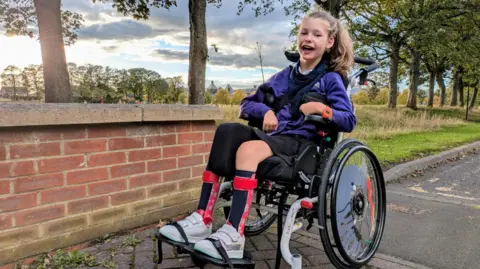 Family document
More than a thousand disabled children across the United Kingdom are waiting for wheelchairs and mobility equipment that could transform their lives, say Whiz Kidz.
The charitable organization, which helps users of wheelchairs up to 25 years old, was forced to close its specialized waiting list for wheelchairs for the first time in 35 years of history.
They say that the climbing of costs and the budgets of the tight NHS create a “huge demand” for their service, resulting in long delays.
The NHS England says that it is working with local health care providers to provide better services and that the NHS Scotland says that it is committed to ensuring that the vital services were protected.
The Ministry of Health in Northern Ireland said that at the end of August, the regional service had provided 87% of all wheelchair categories in the 13 weeks.
Whiz Kidz recorded a thousand children waiting for equipment when he decided to close the waiting list, but say that many others are missing.
BBC News spoke to two families of the impact that long expectations have on them.
‘She doesn’t get another childhood’
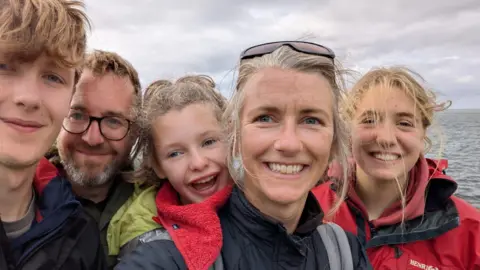 Family document
Wren is suffering from cerebral paralysis, affecting his speech, his four members and her posture, which means that she needs help for daily activities.
At home, the 11-year-old man uses a self-propelled NHS chair. It took more than a year to get this chair, of course the official objective of the 18 -week NHS.
While Wren’s mom, Anna, says that the arrival of her NHS chair has been greatly received – Wren will come out soon.
Anna also told the BBC that she was heavy and heavy, which means that Wren can only self-propeller a few meters before needing help.
The family turned to Whiz Kidz when they were told that Wren was not eligible for a wheelchair powered through the NHS.
Whiz Kidz provided him with a chair to use at school, but his family fears that Wren will soon exceed this chair.
The use of her wheelchair propelled to school is “a way for her to assert her independence,” says Anna. “She has fun.”
But the family is not sure when they have a new one when they develop, given the back-log to the charity.
“I don’t want Wren’s world to become smaller as it grows,” said Anna.
“She has no other childhood and we want to have the options open for her to everything she wants to do.”
Whiz Kidz highlighted a number of factors for increasing demand for their services.
The charitable organization indicates that the NHS in a wheelchair implemented more strict criteria while facing pressed budgets.
He also said costs increased in industry. The average specialized wheelchair costs £ 4,800, according to the charity, inflation continuing to increase the cost of the equipment.
Sarah Pugh, CEO of Whiz Kidz, described the situation as “national crisis”.
“Behind each statistic is a child who is missing school trips, lack of play with friends or living in pain,” she said.
“This cannot be acceptable in the United Kingdom in 2025. We have urgent public support to reopen the list – because childhood cannot wait.”
Whiz Kidz launched The Childhood did not expect a call, to collect £ 750,000 to reopen the waiting list and reduce waiting times.
‘I have no independence’
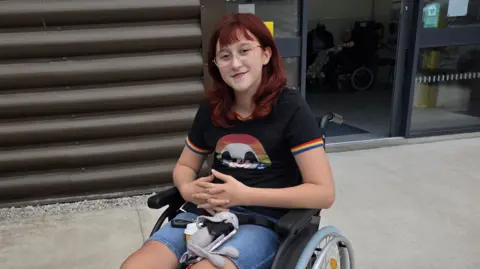 Family document
Like most teenagers her age, Ivy likes to spend days in the park with his friends, purchases and games.
But unlike most teenagers, she relies on her friends and family to help her.
Ivy has a single circulation of the ventricle, a heart disease limiting life, which means that one side of his heart works.
Ivy, is able to walk, but only very short distances. This means that it is not eligible for a propelled chair, but to a manual wheelchair of the NHS.
However, the exhaustion caused by her state means that she is unable to propel and rely on others to push it.
“I have to count on my mother to lead to school – and it’s only 15 minutes on foot,” explains Ivy.
“I have to make my friends push my manual wheelchair from the lesson to the lesson … It’s not fair.”
“I am excluded when I am in the wheelchair because, obviously, I cannot take myself.”
Ivy had hoped that the starting secondary in 2024 would provide him with more freedom, which is why his mother Emma applied to Whiz Kidz for an electrical attachment to the Ivy wheelchair to make life easier.
They applied in January of the same year and are still waiting.
Emma admits that they do not need, but says that the attachment “would improve it [Ivy’s] Life massively, not having to count on someone else all the time. “
There is also a mental and physical toll on the family.
“It becomes quite heavy by pushing a wheelchair for 12 hours at a time – your shoulders and your back hurts me,” explains Emma.
Emma’s ultimate goal for Ivy is to live life like any normal adolescent and enjoy his life without constraints.
“This would greatly improve our lives and give Ivy this independence … We had to make real big sacrifices to be able to allow us electrical attachment by ourselves,” explains Emma.
The BBC asked the NHS in each part of the United Kingdom for their response.
The Ministry of Health in Northern Ireland said that at the end of August, the regional service had provided 87% of all wheelchair categories in the 13 weeks.
The NHS in England told us that they offer personal wheelchair budgets so that people can choose a wheelchair that meets their individual needs, adding that it worked to provide “better services that improve access and experiences for wheelchair users”.
In Scotland, a spokesperson said that the government had committed to ensuring that the vital services were protected and that the eligibility criteria for the supply of wheelchairs for children have remained unchanged since 2014.
The Welsh government has not yet answered.


