The Loch Ness Monster’s body is a ‘zoological impossibility’


The first stories of a mysterious creature that hides in Loch Ness date back to the 7th century. But after 1,300 years and countless observations, there is still no substantial evidence supporting the existence of the beast. According to a recent historical journal published in the scientific journal EffortPart of the problem may be the fact that the most commonly recognizable appearance of Nessie is a “zoological impossibility”.
The generations of traditions, canopies and pop culture represent the stereotypical description of the monster of Loch Ness as a serpentin Animal whose body forms loops or arches when it moves in water. After examining the decades of archival equipment, the environmentalist of the University of St. Andrews Charles Paxton and Adrian Shine of Loch Ness Center noted that 25 to 32% of all the postcards linked to Nessie show a creature leaning into one or more “hoops” above the surface of the water.
He will then reason that these are based on the observations of most people, right? The “real” Nessie should at least look like nessia somewhat on postcards, t-shirts and other memories. This is what Paxton and Shine supported.
“If the banal imagery depicts sea snakes with several arcs and the witnesses are influenced by this imagery, then” archnuity “could be presumed to be commonly represented in the subsequent relationships of eyewitnesses of sea snakes,” they wrote.
It turns out that the hypothesis does not hold. In fact, in the midst of documented observations in the center of Loch Ness, Paxton and Shine estimate that 1.5 percent describe an incredible animal with hoops or bumps.
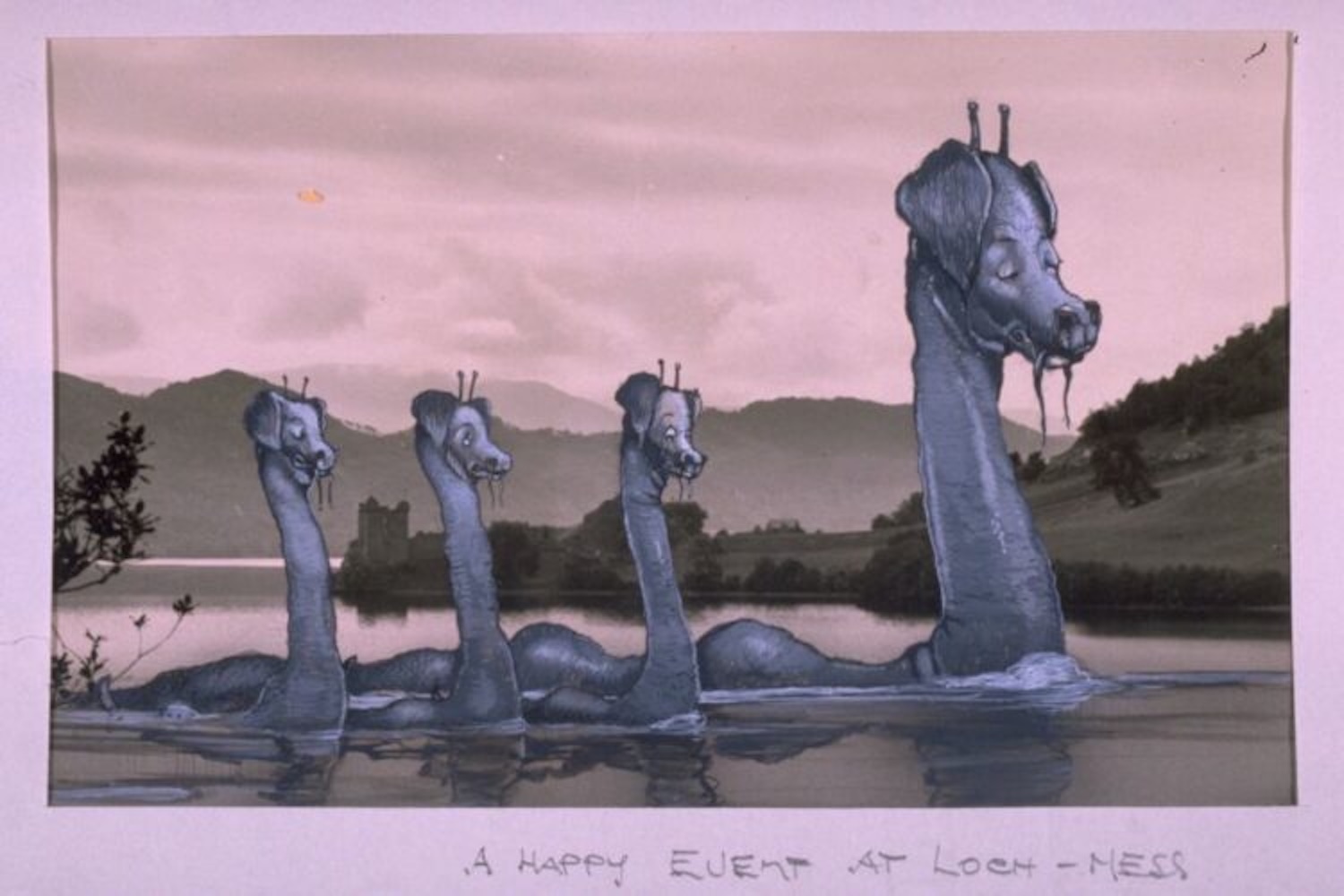
“The images of these serpentive animals have been common since the 16th century, but the real proportion of these relationships of eye witnesses, in particular at Loch Ness, has until recently been extremely weak,” wrote the co-authors of the study. “In this case, he seems really witness[es] Do not generally point out the impossible, even if the hoop monster is a common representation of Nessie. »»
Consider unidentified flying objects as a comparison. Before the 1947 Roswell incident and the cultural ascent that followed zone 51, UFO reports described all kinds of strange air vehicles – Zeppelin type devices with rationalized rockets. Once the public has learned supposed flying saucers, however, media representations quickly moved to plaque -shaped design as an extraterrestrial transport method. And while many observations involve whistling saucers in the heads of witnesses, most describe in place of orbs and lights defying physics.
Although the immediate reaction may be to further reduce Nessie’s observations, researchers actually support the opposite. If anything, the fact that most people don’t do it Describe a bizarre monster is something that deserves consideration. At the same time, researchers explicitly warn that their results do not validate the arguments in favor of an aquatic cryptide in Scotland.
“This insight supports the assertion that the majority of the relationships of eye witnesses are in fact based on an underlying physical reality, even if it does not represent a real encounter with an unknown species,” they wrote.
In this spirit, it is probably a good idea to stick to the revised maxim: if it looks like Nessie of pop culture and movements like Nessie of pop culture – the chances are they No real nessia.
… And even if the mystery figure has no bumps, it is always more likely to be a newspaper than a monster Loch Ness.

More offers, reviews and purchasing guides


