The Neoliberalism of Robert A.M. Stern


The death of the last living resistance to postmodern architecture marks the end of an era and reminds us that we are in a new, worse one.
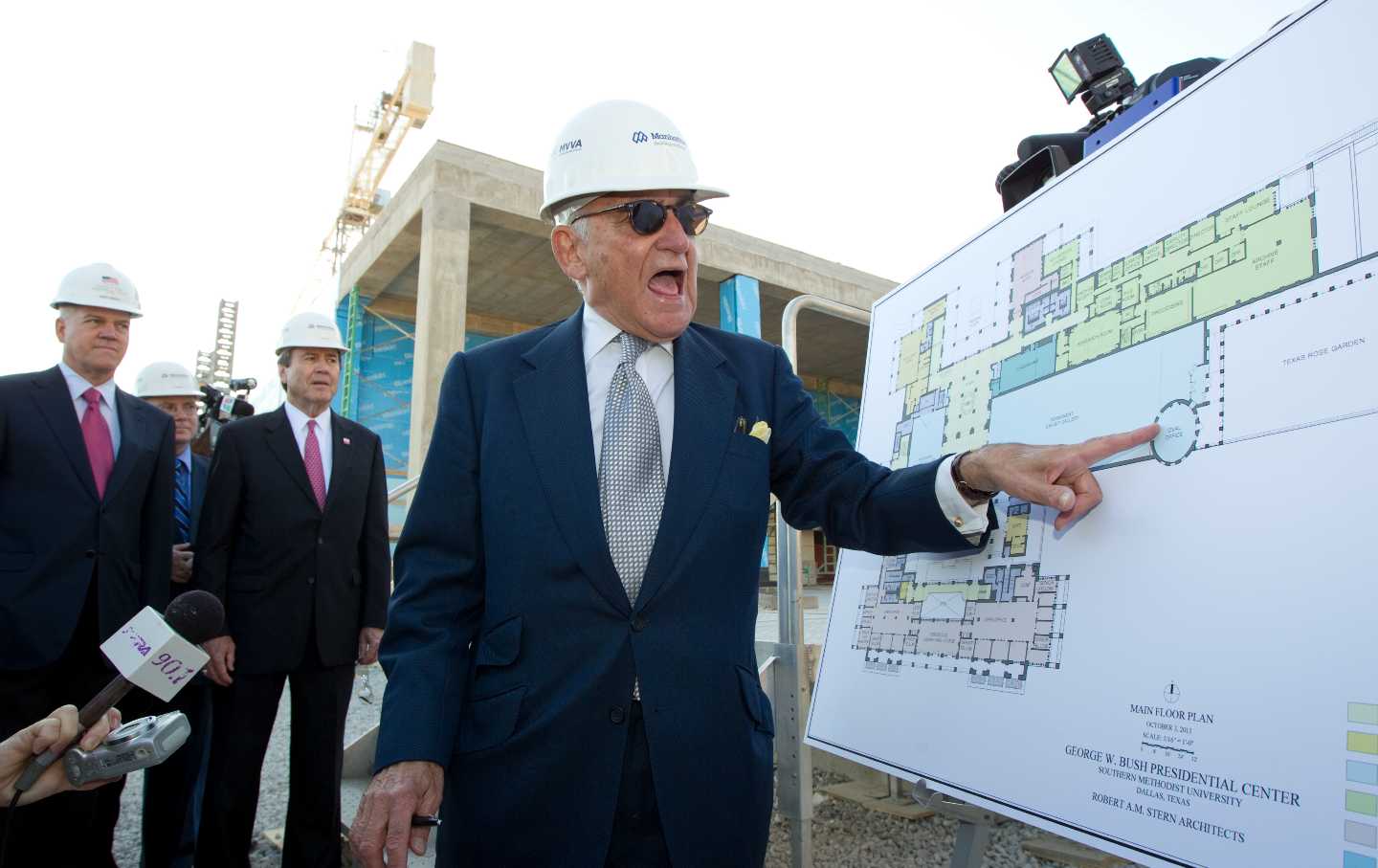
Robert AM Stern gives a guided tour of the construction work on the George W. Bush Presidential Center.
(Robert Daemmrich/Getty)
The term “neoliberal architecture” has come to encompass a number of different developments over the past four decades, from the glittering, anonymous office towers of the financialized economy to the “soft” tourist city of endless amenities and passive surveillance best seen through a phone camera or from the back of an Uber. But when I learned in November that architect Robert AM Stern – one of the last living resisters of postmodernism – had died at age 86, I couldn’t help but redirect my gaze to the original neoliberal architecture. It is rude to speak ill of the dead, but the times in which the dead lived and worked are a good thing. The architecture of Stern’s generation, which reached its peak in the 1980s and 1990s, was, despite its playful colors and cartoonish irony, architecture whose clientele was largely composed of the elite and the institutions that fostered their rise to power. Stern participated more happily than any of his peers.
Stern was conservative, one could even say neoconservative. This was true both architecturally and politically, although he tended to whitewash his political ideas and keep them close to his chest. Born in 1939 to a middle-class family and graduating with an MArch from Yale in 1965, he began designing Manhattan penthouses and summer homes for the well-heeled along New England’s windswept coasts. Coastal homes were often inspired by the shingle vernacular of the late 19th and early 20th centuries, so favored by peers like Robert Venturi and Charles Moore. (Stern would later establish a home construction office of his company RAMSA, devoted solely to replicating real historic homes.) This clientele and the project of neo-historic architecture would characterize his work for the rest of his life. The pinnacle of this way of working is one of his last but most famous buildings, 15 Central Park West, which towers over the eponymous park in imitation of the grand prewar apartment buildings, replete with majestic masonry and patient doormen.
Stern’s early work in the 1970s fit squarely into the emerging style known as postmodernism, which rejected the austere, unadorned forms of modern architecture as well as the directive, so valuable to the previous generation, to directly shape the way we live by shaping architecture. The form-follows-function philosophy that had propelled architecture forward for nearly 80 years gradually became entangled in mixed modes of expression, and previously bare technical elements, such as staircases and mechanical systems, became covertly ornamental elements. The answer to this dilemma was to ignore functionalism altogether and return to the languages of the past, which postmodernists revived through pastiche and often ironic forms. In Stern’s 1974 Lang residence in Connecticut, for example, a macaroni-colored stucco box on a green hillside is pierced with six windows like the front of a die, each of which is framed by a molding torn from a plinth and glued to the facade. The house displays the languages of the time: pastiche, irony and the play of history and new materials.
Beginning in the 1970s, the interrogative quality of postmodernism, including its celebration of the vernacular, from the Las Vegas Strip to the suburban home, faded while its historical gestures gradually became caricatured. This development would only accelerate in the 1990s, when almost all postmodern architects, including Stern, found themselves deeply enmeshed in the ersatz worlds of the Walt Disney Company. Stern’s architectural philosophy is on full display in a 1986 special he did with PBS called Pride of place (which was sponsored by Mobil). The exhibit, which also included a companion book, is a star-studded overview of American architecture, from the Shakers to the mall. This is not necessarily a bad overview of the subject, but like any truly patriotic work, it is not devoid of revanchism. Stern wholeheartedly accepted a version of history in which the United States is still a benevolent actor. He wholeheartedly believed in the American project and all the kitsch that came with it, evident in everything from his Norman Rockwell Museum (inspired by the Greek Revival style but featuring a strange floating pediment on the facade) to his preoccupation with theme parks. In his Pride of place bound book, he writes,
Just as the stations seem to liberate their clients from the restrictive conventions of the working world, their design also liberates their architects. Just as one can see normally buttoned-up men and women revealing all their physical and psychological nuances on a summer afternoon at the beach, one can see national architectural preferences, finally freed from so many economic and societal constraints, expressed intensely in seaside resort architecture.
This last line clearly reveals his vision of American architecture: an apolitical playground in which the architect, working in a distinctly national tradition, could be “liberated.” His work for Disney – at its peak Mousified in the animation studio building wearing the hat of The Sorcerer’s Apprentice and at its peak in the BoardWalk resort, a 1:1 replica of a late 19th century shingle hotel, showcases this fantasy. Architecture as entertainment, architecture as sign, architecture as theme and playground for the leisure class (and the city itself will soon follow). These ideas, as innocuous as they may seem at first glance, are partly responsible for the way we today perceive the built environment as a place of consumption.
Current number

Stern’s generation aspired to remake America in the image of the soda fountain and small town before integration. A new generation raised with mice but deprived of property and hope produces AI shadows of the same fantasies.
However, what is most distinctively neoliberal about Stern is his willingness to work with the (literal) architects of neoliberalism. There was not a single academic business school – so often historicized in neo-Georgian colonnaded brick – to which he refused to lend his name. When it came time to hire an architect for the George W. Bush Presidential Center, there was only one man for the job. These buildings, along with the Disney buildings, are perhaps Stern’s most public-oriented work. What is a resort if not an imaginary and commodified common good? It is one of the great ironies of postmodern architecture that Stern and his contemporaries were so invested in the revival of small-town urbanism in the form of planned communities like Seaside, Florida, and its Disney-owned sister, Celebration, but, in an overcorrection of modernism, remained singularly indifferent to real public space and real public goods, especially mass housing.
Stern’s decidedly elite projects ran the gamut from top universities to some of Manhattan’s most expensive residential properties. He believed in the architect as celebrity, and brought those values to Yale’s previously rather straightforward architecture program, where he served as dean from 1998 to 2016. A highly successful protégé of his recently regaled me with stories of Stern pioneering the after-class cocktail party, and how he often sent Manhattan students back to Yale in limousines.
But the man also represented an era, now in the rearview mirror, when the rich were trendsetters, when they helped organize rather than simply rule the world. Today, the architect has never been more relevant in elite culture. Since we are unfortunately stuck in an elite culture, it is for the worse. Increasingly replaced by the custom builder, the architect has lost control over the production of architectural culture. Gone are the heydays of Rizzoli table books and Architectural collection. Celebrities are now moving out of their McMansion basements and holed up in cruise ship-like fortresses crammed into the Hollywood Hills. In an era of academic austerity, his position as dean at Yale also feels like a relic from a distant past. Stern, for all his conservatism, was often an amusing architect, particularly in his early work and interiors. But it’s never been more clear that the fun is over. The world he helped create will never make him any different.
Even before February 28, the reasons for Donald Trump’s imploding popularity couldn’t have been clearer: rampant corruption and billions of dollars’ worth of personal enrichment during an affordability crisis, a foreign policy guided solely by his own abandoned sense of morality, and the deployment of a murderous campaign of occupation, detention, and deportation on American streets.
Today, an undeclared, unauthorized, unpopular and unconstitutional war of aggression against Iran has spread like wildfire across the region and Europe. A new “forever war” – with an ever-increasing likelihood of US troops on the ground – could very well be upon us.
As we have seen time and time again, this administration uses lies, misdirection, and attempts to flood the zone to justify its abuses of power at home and abroad. Just as Trump, Marco Rubio, and Pete Hegseth offer erratic and contradictory justifications for attacks on Iran, the administration is also spreading the lie that the upcoming midterm elections are threatened by non-citizens registered to vote. When these lies go unchecked, they become the basis for further authoritarian encroachment and war.
In these dark times, independent journalism is the only one that can uncover the lies that threaten our republic – and civilians around the world – and shine a light on the truth.
The nation‘s experienced team of writers, editors and fact-checkers understand the scale of what we face and the urgency with which we must act. That’s why we publish critical reporting and analysis on the war with Iran, ICE violence at home, new forms of voter suppression emerging in the courts, and much more.
But this journalism is only possible with your support.
This month of March, The nation must raise $50,000 to ensure we have the resources to produce reports and analysis that set the record straight and empower people of conscience to organize. Will you donate today?


