The next frontier in space is closer than you think – welcome to the world of very low Earth orbit satellites

When you purchase through links on our articles, Future and its syndication partners may earn a commission.

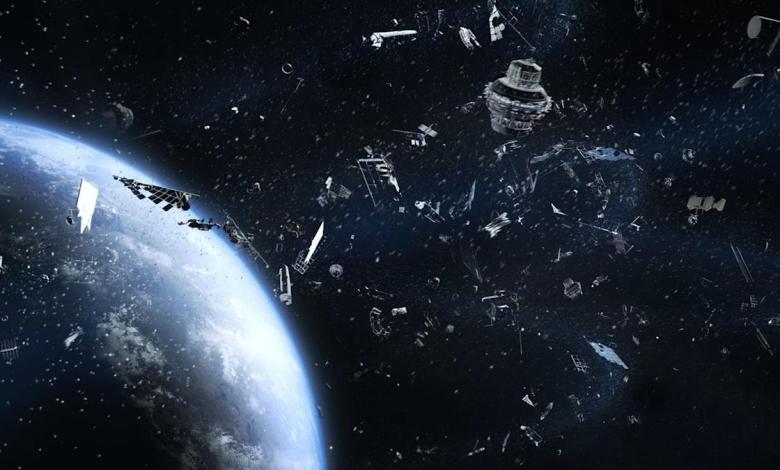
Illustration of debris orbiting Earth. | Credit: Getty Images
This article was originally published on The conversation. The publication contributed the article to Space.com Expert voices: opinion pieces and perspectives.
There are approximately 15,000 satellites orbiting the Earth. Most of them, like International Space Station and the Hubble Telescopereside in low earth orbit, or LEO, which rises about 1,200 miles (2,000 kilometers) above the Earth’s surface.
But as more satellites are launched in LEO – SpaceX Starlink Internet Constellation alone will end up send thousands more there – the region there are a few people.
That’s why it’s fortunate that there is another orbit, even closer to Earth, that promises to help reduce overpopulation. It’s called VLEO, or very low earth orbitand is only 60 to 250 miles (100 to 400 kilometers) above the Earth’s surface.
Inasmuch as engineer and professor which develops technologies to extend human presence beyond Earth, I can tell you that Very Low Earth Orbit, or VLEO, satellites offer advantages over higher altitude satellites. Among other benefits, VLEO satellites can provide higher resolution images, faster communications and better atmospheric science. Full disclosure: I am also a co-founder and co-owner of Victoria Defense, which seeks to commercialize VLEO and other space energy technologies.
Advantages of VLEO
Images from satellites in very low Earth orbit are sharper because they see the Earth more clearly than satellites located higher up, a bit as if moving closer to a painting helps you see it better. This results in higher resolution images for agriculture, climate sciencefor disaster response and military surveillance purposes.
End-to-end communication is faster, which is ideal for real-time communications, such as telephone and Internet services. Although the signals still travel the same speed, they don’t have to go as far, which reduces latency and conversations flow more smoothly.
A lot weather forecast relies on images of clouds above Earth, so taking these photos closer means higher resolution and more data to predict.
Due to these advantages, government agencies And industry are working on the development of satellites in very low Earth orbit.
The hold-up: atmospheric drag
You may be wondering why this region of space has so far been avoided for sustained satellite operations. This is for one major reason: atmospheric drag.
Space is often thought of as a void. So where exactly does space begin? Although approximately 62 miles (100 kilometers) away – known as the von Kármán lineage – is widely considered the starting point, there is no difficult transition where the space suddenly begins. Instead, as you move away from Earth, the the atmosphere dissipates.
In and below very low Earth orbit, the Earth’s atmosphere is still thick enough to slow down satellites, forcing those at lower altitudes to deorbit in a few weeks, even a few daysessentially burning as they fall back to Earth. To counteract this atmospheric drag and stay in orbit, the satellite must constantly propel itself forward – in the same way that riding a bicycle into the wind requires continuous pedaling.
For propulsion in space, satellites use different types of thrusterswhich provide the necessary thrust to avoid slowing down. But in VLEO, the thrusters must be on all or almost all the time. Thus, conventional thrusters would quickly run out of fuel.
Fortunately, Earth’s atmosphere in VLEO is still thick enough that the atmosphere itself can be used as fuel.
Innovative thruster technologies
This is where my research comes in. At Penn State, in collaboration with Georgia Tech and funded by the US Department of Defenseour team is developing a new propulsion system designed to operate between 43 and 55 miles (70 to 90 kilometers). Technically, these altitudes are even lower than very low Earth orbit, making combating drag even more difficult.
Our approach collects the atmosphere using a spoon, like opening your mouth wide when pedaling a bicycle, then uses high-power microwaves to heat the collected atmosphere. The heated gas is then expelled through a nozzle which pushes the satellite forward. Our team calls this concept the breathing microwave plasma thruster. We were able to present a prototype thruster in the laboratory inside a vacuum chamber that simulates the atmospheric pressure found at 80 km altitude.
This approach is relatively simple, but it has potential, particularly at low altitudes, where the atmosphere is thicker. Higher up, where the atmosphere is thinner, spacecraft could use different types of VLEO thrusters that others are developing to cover large altitude ranges.
Our team is not the only one working on thruster technology. Just one example: The US Department of Defense partnered with a defense contractor. Red thread develop Ottera VLEO satellite with its version of atmospheric breathing thruster technology.
Another option for keeping a satellite in VLEO, which leverages technology I have worked on throughout my career, is to attach a lower orbit satellite to a higher orbit satellite with a long tether. Although NASA has never flown such a system, the proposed follow-up mission to the satellite tether system Missions carried out in the 1990s involved dropping a satellite into a much lower orbit from the Space Shuttle, connected by a very long tether. We are currently re-examining this system to see if it could work for VLEO in a modified form.

A breathing thruster firing into a vacuum chamber at Penn State. | Credit: Ethan Kravet
Other complications
Overcoming drag, although it is the hardest, is not the only challenge. Satellites in very low Earth orbit are exposed to very high levels of atomic oxygenwhich is a highly reactive form of oxygen that quickly corrodes most substances, even plastics.
The satellite’s materials also must withstand extremely high temperatures, above 2,732 degrees Fahrenheit (1,500 degrees Celsius), because friction heats them as they move through the atmosphere, a phenomenon that occurs when all spacecraft reenter the atmosphere from orbit.
The potential of these satellites stimulates research and investment, and the proposed missions have become reality. Juniper Research estimates that $220 billion will be invested over the next three years alone. Soon your internet connection, weather forecast and security could be even better, powered by VLEO satellites.


