The planet is overheating. Why is the news looking away?


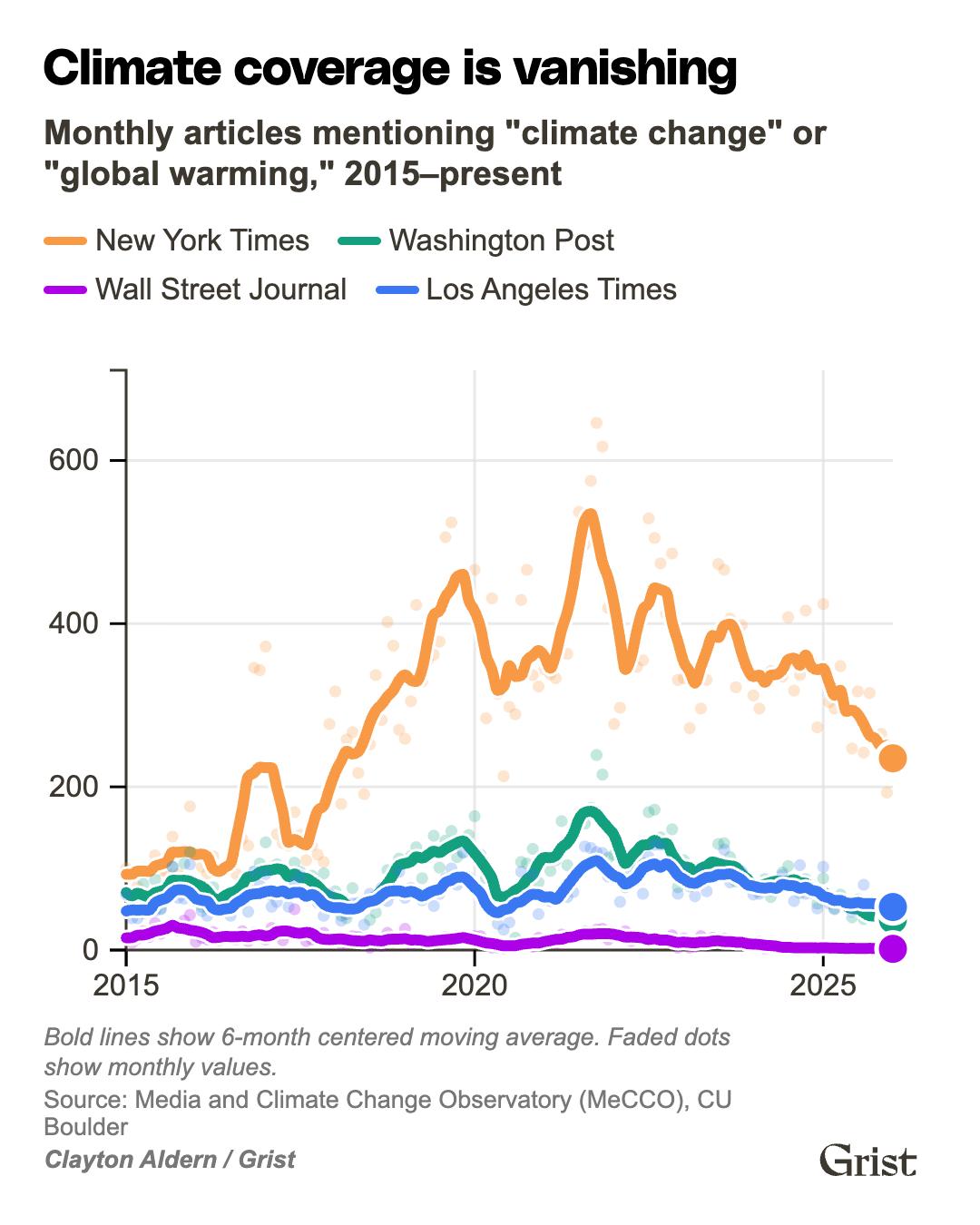
Scientists are pretty sure Earth is hotter than at any time in the last 125,000 years, but the media is evolving, trying to stay on top of pressing news — from the daily chaos of the Trump administration to the latest developments in the war against Iran. The shift in attention began during the COVID-19 pandemic and, despite a temporary rebound, has accelerated in recent years: Since its peak in 2021, global media coverage of climate change has fallen 38%, according to data from the Media and Climate Change Observatory at the University of Colorado Boulder.
Many journalists have been busy digging through 3 million pages of the Epstein files rather than the latest scientific report, although you can still find information on some of the most important recent findings, including that estimates of sea level rise have been significantly underestimated and that global warming has accelerated “significantly” over the past decade.
Last year, the first of Trump’s second term, major broadcast networks in the United States reduced their climate coverage by 35 percent from the previous year, according to a recent report from Media Matters, a watchdog organization. “The competition, the administration’s flood-the-zone strategy, makes it very difficult for anything that isn’t very urgent right now,” said Allison Fisher, director of the nonprofit’s climate and energy program.
The change in direction has concrete consequences. When media coverage of an issue wanes, it can be difficult to build enthusiasm for protests and policy change. It’s out of sight, out of mind, said Anthony Leiserowitz, director of the Yale Program on Climate Change Communication. Normal people don’t spend their time reading scientific articles or talking to a climate scientist over their backyard fence. “Literally billions of people know about climate change just because the media has reported on it,” Leiserowitz said.
When writers and editors prioritize – or deprioritize – a particular topic, it sends a signal to both policymakers and the public. “They’re using one of the most powerful tools in politics, which is defining what topics are covered and what topics aren’t covered, and within that, what range of opinions are expressed on those topics,” said Mark Hertsgaard, co-founder and executive director of Covering Climate Now, a nonprofit that advocates for more rigorous coverage of climate change. “So of course when we stop talking about climate change in the press, public figures say, ‘Oh, well, I guess it’s not that important anymore,’ or ‘Maybe they’ve figured it out,’ or whatever.”
You can see the recent decline in media coverage on climate in the United States by looking at some of the country’s largest newspapers: the New York Times, the Wall Street Journal, the Washington Post and the Los Angeles Times. While the New York Times has published a huge volume of articles on global warming, its coverage has plunged, declining 66% since its peak in October 2021, when it published 646 articles mentioning the subject, and this January, when it published 221.
People notice the decline. In 2022, 35% of Americans reported hearing about global warming in the media at least once a week, according to data from the Yale Program on Climate Change Communication. According to the most recent data from December, only 17 percent did so.
Looking at the long term, neglecting climate change is actually the norm in America’s mainstream media, Hertsgaard said. Around 2019, however, they started paying more attention to it. Young people around the world began skipping school on Friday to demand their governments take action on climate change, inspired by Swedish activist Greta Thunberg. As the 2020 US elections approach, progressives’ enthusiasm for the Green New Deal has pushed future President Joe Biden to embrace plans to combat climate change. At the same time, organizations like Hertsgaard’s Covering Climate Now, founded in 2019, pushed media outlets around the world to connect the dots on extreme weather, providing context for how greenhouse gas emissions had increased flooding, fueled wildfires and worsened drought.
“When you can bring these two things together – an increase in media coverage at the same time as an increase in popular opinion and mobilization, and 7 million people in the streets – that’s when you can break the climate silence,” Hertsgaard said.
The volume of information about climate change plummeted at the start of the COVID-19 pandemic, but quickly recovered as world leaders began adopting policies to combat rising greenhouse gas emissions. Biden has made tackling climate change a priority, and in 2022 he signed the nation’s first comprehensive climate law, packed with incentives aimed at incentivizing a faster shift to clean technologies. (It was largely repealed under President Donald Trump.)
Then, just like that, the media’s zeal for covering climate change began to fade again, and experts aren’t exactly sure why. Perhaps the passage of major climate legislation in the United States has led to a diminished sense of urgency. The decline in climate news continued to deepen in 2025, when global coverage fell another 14% from the previous year, and was particularly visible in the United States.
After Trump took office with a promise to “drill, baby, drill,” a widespread “climate silence” descended across the country. Companies suddenly stopped talking about the climate commitments they had proclaimed a few years earlier. Many congressional Democrats have avoided speaking directly about climate change, with the phrase disappearing from their speeches, social media accounts and podcast appearances. Then the Trump administration went after the media, withdrawing public broadcasting funding from NPR and PBS stations and threatening to revoke the broadcast licenses of major networks over coverage that Trump didn’t like.
“You have corporate media owners who are increasingly worried about running afoul of the Trump administration calling climate change a ‘hoax’ and climate action a ‘scam,’ right? Fisher said.
Fisher said she was alarmed by the lack of coverage on ABC, CBS and NBC of the Trump administration’s actions to cut climate research and environmental regulations, as well as the declining link between extreme weather and climate change.
CBS has long led climate coverage among broadcast networks, but that focus suddenly changed late last year, Media Matters found. Earlier this year, the Trump administration approved a merger between Paramount Global (which owns CBS) and Skydance Media. Brandon Carr, chairman of the Federal Communications Commission, suggested the merger would ensure “a diversity of viewpoints from across the political and ideological spectrum” within the network. Shortly after naming its new editor-in-chief, Bari Weiss, in October, CBS laid off most of its climate team, along with about 1,000 other employees. One of the network’s few remaining climate segments in the months since has focused on polar bear populations thriving in the Norwegian Arctic despite melting sea ice, a common talking point among climate deniers. “Experts say the bears are still in trouble in the long term, but hey, the experts have been wrong before,” said Tony Dokoupil, anchor of Evening Newsto end the segment.
“We know what they say on Fox News — it’s almost exactly the same thing,” Fisher said. “Beyond the volume, I think this shift in the way the climate story is told is even more dangerous. »

Why Democrats don’t talk much about climate change anymore
Layoffs have swept the news industry, with The Washington Post last month laying off the majority of its climate team, more than a dozen reporters and editors, in deep reductions. Max Boykoff, a professor of environmental studies at the University of Colorado at Boulder who tracks media coverage, suggested that newsrooms’ decisions to shift their attention away from climate change could be driven by a sense of “climate fatigue” among the public — a weariness with a long-running crisis without easy solutions. “Publishers may be evaluating this and putting people on different beats,” he said. The media’s waning enthusiasm for highlighting climate stories has frustrated some journalists: Chase Cain, NBC’s longtime climate reporter, recently resigned from his position, saying he was exhausted from fighting to get his stories on the air.
Leiserowitz, of the Yale Program on Climate Change Communication, noted that the number of Americans concerned about climate change and wanting action to reduce emissions hasn’t really changed. Even though climate change is no longer a priority for voters — number 24 out of 25, according to data from the Yale program — that’s mainly because other issues have increased in importance. For liberal Democrats in particular, this includes protecting democracy, treating immigrants, and disrupting government services. “It’s just that all these other issues have now overtaken climate change as a voting priority,” Leiserowitz said.
Hertsgaard says there is a large audience waiting for more stories about life on a warming planet. According to surveys, between 80 and 89 percent of the world’s population – and 74 percent in the United States – want their governments to take stronger action on climate change. Media outlets around the world are turning to climate coverage, gaining audiences and making money from it, he argued, citing The Guardian and France Télévisions, the French public broadcaster, which saw its ratings improve after incorporating climate change into its weather forecasts. “If you are a smart newsroom, you will recognize that this is a business opportunity, not just a journalistic duty,” Hertsgaard said.
Still, experts say it will be difficult to reverse the megatrends driving declining climate coverage in the near future, even as extreme weather continues to draw attention to the consequences of global warming. As long as Trump is in office, there will likely be intimidation of the media, silences on climate and a constant stream of chaos in the news, crowding out climate stories, Fisher said.
Leiserowitz hopes, however, that the public won’t forget what it learned when mainstream media began reporting seriously on the crisis. “Just because the media isn’t talking about it,” he said, “doesn’t mean it’s suddenly gone or erased from their memory.”


