The Pleasure of Repetition in Art


Explore
MAde to the highest point of Kline, Kooning and Pollock, Andy Warhol’s Campbell’s Soup Cans was a blow in the eye of abstract expressionism. Not only was he obviously mimetic, but he was mimetically mimetic with a banal commercial product found in each supermarket and corner grocery in America. When people think of rehearsal in painting, they probably think of these emblematic soup cans first.
But all rehearsals are not as opposite or as disturbing as Campbell’s Soup Cans. A painting of the impressionist period is particularly relevant. I think of Paris Street; Rain day by Gustave Caillebotte. Currently hosted at the Art Institute in Chicago, he was initially exposed to the third Impressionist exhibition in Paris in 1877. It is probably the best known work in Caillebotte. I consider him a masterpiece and I regret having never seen the real thing. Even so, that keeps lower me. Discussions on this subject generally focus on the incredible likelihood of painting, the feeling that he is photographic in his lively capture of an ordinary moment.
Thus, the art critic Sebastian SMEE observes in an article in The Washington Post Dated January 20, 2021:
Caillebotte compressed different sensations of time and movement in the same image. A walk to the most distant visible point could chew half an hour. But this current situation – a potential pedestrian collision – will take place in a few seconds. Are we going to the left or right? Our instinctive hesitation is complicated by the man who enters the right. The space is simply too tight. And all these umbrellas do not help!
ADVERTISEMENT
Nautilus members benefit from experience without advertising. Connect or join now.
SMEE’s comments are not directed to the form of the masterpiece of Caillebotte, but on its content. That is to say, of course, not unusual. This recalls criticism of poetry recording their personal evocations for public consumption. But is it useful? Well, in some cases, when a scene in history or mythology is represented, it is pleasant to know what is going on. Think about Judith with Holoferne’s head By Botticelli, his head without rope was holding by her hair with the left hand of Judith, a sword on the right. Explain what is happening is iconography, but it does not help to shed much light on the reasons why painting is considered a masterpiece.
Human beings find the rehearsal pleasant.
When the French painter Paul Delaroche saw a daguerreotype for the first time in 1839, he would have said: “From today, painting is dead.” He had to come from the idea that the image was everything. From this starting point, it is not unreasonable to ask, what is the point of going to all problems to make an image on canvas when a camera can do it much more precisely and much more effectively? Obviously, the delaroche of five words for painting was, as the relationships of the disappearance of Mark Twain, prematurely. But why? What about the painting that prevented photography from killing it?
ADVERTISEMENT
Nautilus members benefit from experience without advertising. Connect or join now.
I will try to shed light on it. I start by asking, where does the pleasure come from? The description of SMEE implies that he finds the painting a source of pleasure. I do it too. But describing the scene is not a lot of help. Everyone can do it, but perhaps not as eloquently as SMEE.
The first thing to observe about this table is that it is entirely faces, places and body – three categories that our brains are specially wired to recognize. The area of the fusiform face is dedicated to the recognition of the face. His neurons shoot if the subject looks at a face. But if the subject is shown a tree, a car, or something other than a face, the area of the fusiform face remains silent. The nearby parahippocampal square area, on the other hand, responds to environmental scenes such as landscapes. Damage to the parahippocampal place area (for example, due to a stroke) often lead to a syndrome in which patients cannot visually recognize scenes even if they can recognize individual objects in scenes (such as people, furniture, etc.). A third domain is also relevant: the area of the extras, which selectively responds to images of human bodies and parts of the body (to the exclusion of faces).
As you can imagine, the three areas will light up like the sky on July 4 in the brain of anyone was standing in front Rain day. In this regard, it is precisely like the eight centuries of Western painting that preceded it, of Cimabue Crucifix (1288) through Meissonier French campaign (1864) and CAILLEBOTTE.
ADVERTISEMENT
Nautilus members benefit from experience without advertising. Connect or join now.
But that does not bring us closer to the reason why Caillebotte painting is so pleasant to look at. Or is it? Art critics regularly bring a history of painting, culture, painting schools, etc. But what is often left out is the way in which the act of vision shapes mental structures in the brain – how certain arrangements of forms can trigger deep perceptual satisfaction.
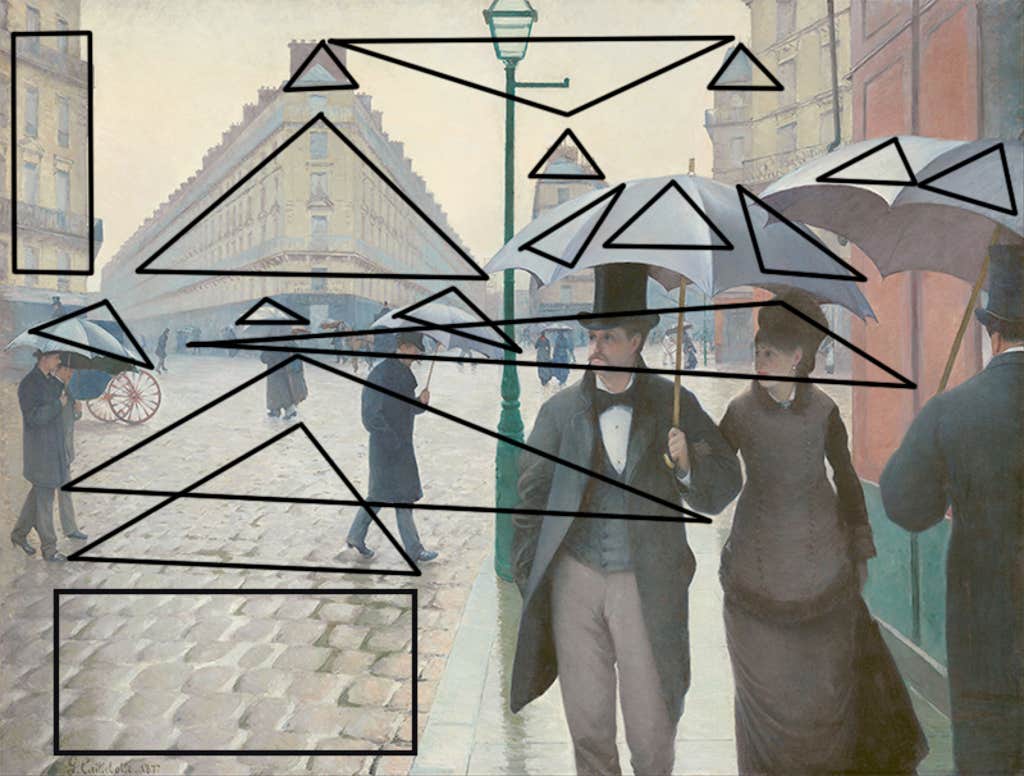
So let’s look at, at Caillebotte Paris Street; Rain day Not as a recognizable street scene but as an arrangement of geometric objects as illustrated in the image above. The first thing that appears is the extent to which the triangles dominate the canvas. The foreground and the middle contain five umbrellas. The umbrellas are themselves rounded distortions of a triangle. But note that the umbrellas consist of smaller triangles in a triangle. Here is a painting that bask in the representations which highlight the resemblance between two similar forms while retaining their differences. It is full of visual rhymes. The pattern of the triangle does not end in the umbrellas. Notice the three numbers on the left. They constitute the points of a triangle.
The pattern of the triangle is also picked up by buildings. The building on the left of the dominant couple is triangular. Inside the building contours are more triangles defined by the long rows of balconies that run along the facades. Now look at the domes on the two buildings on the right. They are each triangular, and taken together, they form three points from another triangle.
The repetition of the same variety / except appears elsewhere, especially in the cobblestones. By “the same / except”, I mean a visual relationship in which the forms are clearly similar, but slightly varied, so that the brain perceives both the similarity and the difference. In other words, objects share a recognizable model but are never exactly identical. This interaction between repetition and variation is at the heart of how we perceive the structure, rhythm and depth between mediums. With the cobblestones, for example, the closer they get closer to the lower left of the painting, the more they are lying down, thus lending a ramp effect to this part of the painting, inviting the spectator to intervene and improve the feeling of depth that painting gives off. But the rehearsal also appears elsewhere. Notice the facades of visible buildings. Their windows, parapets and balconies are repeated over and over again. This is obvious in the original image.
ADVERTISEMENT
Nautilus members benefit from experience without advertising. Connect or join now.
There is another triangle, more subtle than those we have just seen, but just as real. In the original painting, the wall on the right is brown reddish. This color is repeated through the boulevard – seven major avenues meet at the place of Dublin – and if you draw a line to connect the two reddish brown walls, you have a side of a triangle. If you connect the two ends of this furthest single line, on the left, you have another triangle that encloses the heads of the two main figures on the right, thus focusing on their line of view. We are not finished. There is another triangle composed of the three figures on the right on the point of hitting each other. And this triangle is parallel by the triangle noted earlier figures walking in the street.
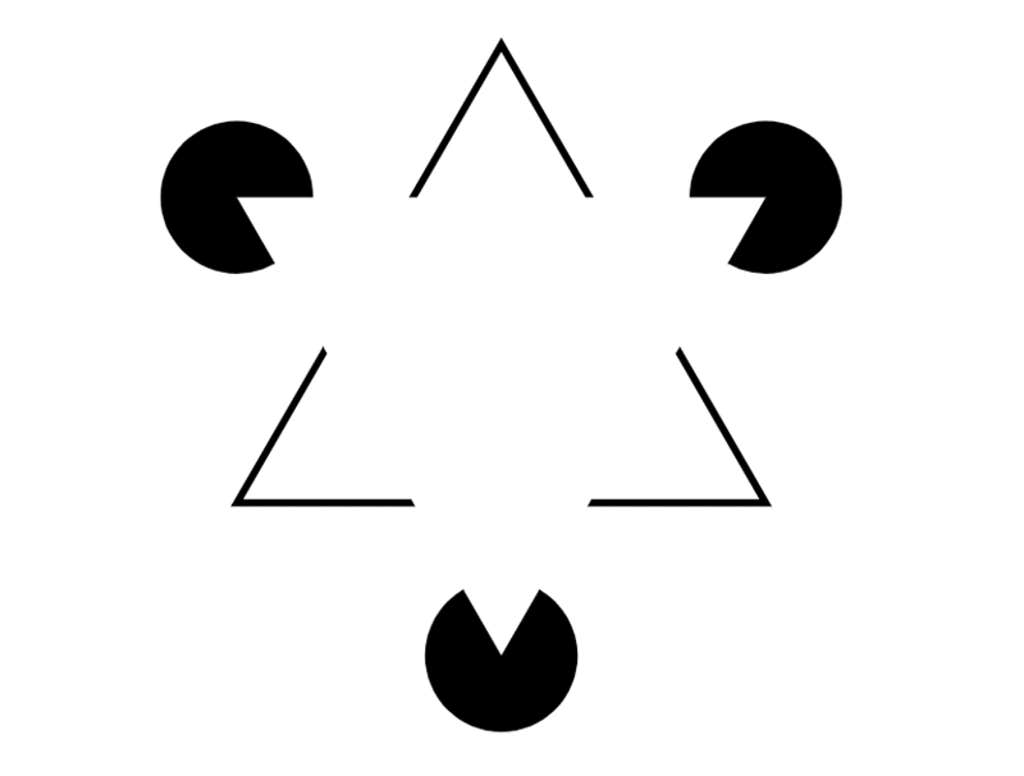
And now we can conjecture. Psychologist Elizabeth Margulis has shown us that human beings find a pleasant rehearsal. Caillebotte painting is filled with objects that offer the spectator the opportunity to build triangles. The fact that humans can do so is demonstrated by the famous Kanizsa triangle illustrated above. Looking at this figure, you cannot help but build a triangle and interpret the illusion as a white triangle seated above three black discs. In reality, there is no triangle. There are simply three PAC-Man type objects placed in such a way that you see a triangle. Caillebotte did roughly the same thing. He painted objects that induce the spectator to build triangles and he made the triangles in the pairs of the same / except. The discovery of this visual relationship of the same / except is the source of the pleasure of painting no less than rhyme is a source of pleasure in a poem. Indeed, Caillebotte Paris Street; Rain day is designed to provoke a visual rhyme as a source of pleasure. The same goes for the rectangular and square patterns of the paint.
It should be noted that, as a photographic, familiar, dramatic – that you have – that painting is that a source of its pleasure has nothing to do with the content of the image but its shape, a form that forces the spectator to find rhymes.
ADVERTISEMENT
Nautilus members benefit from experience without advertising. Connect or join now.
This article is adapted from a press reader extract Samuel Jay Keyser’s book Play again, Sam. An edition in free access to the book is available here.
Main image: Andy Warhol’s Campbell’s Soup Cans / Wikimedia Commons


