The record-breaking cocaine boom — and its deadly fallout : Planet Money : NPR

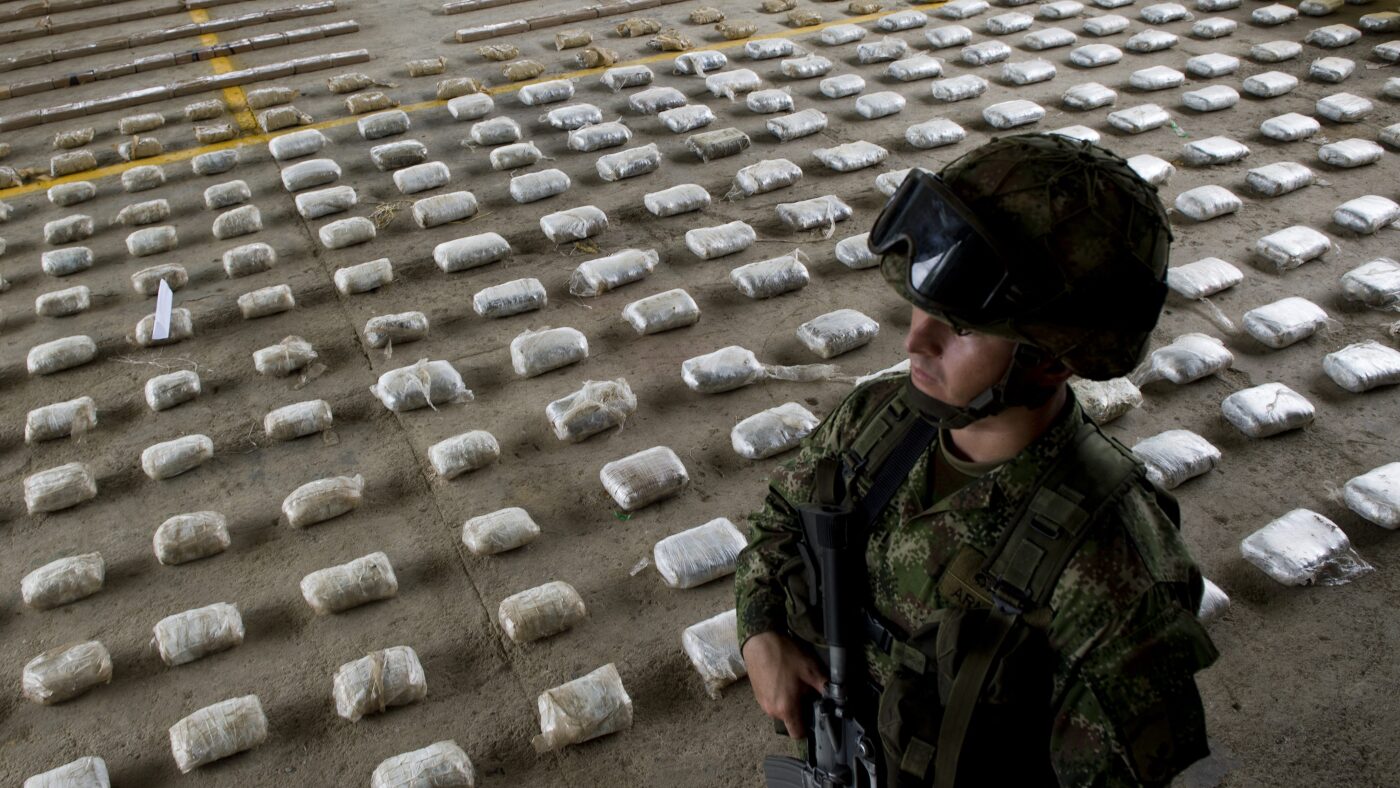

A Colombian army soldier stands next to packages of seized cocaine during a press conference at a military base in Bahia Solano, Choco department, Colombia, March 14, 2015.
LUIS ROBAYO/AFP via Getty Images
hide caption
toggle caption
LUIS ROBAYO/AFP via Getty Images
A few weeks ago, a police officer made a routine traffic stop in Upland, California, just outside Los Angeles. The officer was accompanied by a police dog named Petey.
As they approached the car, Petey started barking. Something about this car was clearly strange. Sure enough, they discovered that the vehicle contained approximately 66 pounds of cocaine hidden in a hidden compartment.
“The drugs were taken off the street, the smuggler went to jail and our good boy got a steak,” the Upland Police Department posted about the drug seizure on social media.

Drug seizures like these are increasing across the country, but they represent only a small fraction of what is believed to be a record increase in the supply of cocaine. In its latest annual global report, the United Nations Office on Drugs and Crime found that after a decade of rapid growth, “global cocaine production has again reached a record level, accompanied by significant increases in cocaine seizures, cocaine users and – most tragically – cocaine-related deaths in many countries.” »
So what’s behind this surge? And how does this affect us in the United States? A new working paper by economists Xinming Du, Benjamin Hansen, Shan Zhang and Eric Zou — “The Return of Coke and the Fallout from the American Overdose” — provides some answers.
Why the supply of cocaine is increasing
Ten years ago, it seemed like the heyday of the cocaine market was largely behind us. The drug was still popular in some places, but it was also something of a relic, more associated with nightclubs in the 1970s and Wall Street in the 1980s.
Du and other economists suggest that at least part of cocaine’s decline was the result of fierce supply-side interventions in Colombia. With significant U.S. involvement, Colombia “led an aggressive campaign against the plantation of coca, the raw plant used to make cocaine,” they write. As a result, “coca fields in Colombia declined from about 168,000 hectares in 2000 to just 48,000 in 2013, and cocaine became much less available in the United States.”

TOPSHOT – A Colombian police officer kisses a dog during an operation to eradicate illicit crops in Tumaco, Narino department, Colombia, December 30, 2020.
JUAN BARRETO/AFP via Getty Images
hide caption
toggle caption
JUAN BARRETO/AFP via Getty Images
But around 2015, the economists write, a few policy changes “created a perfect storm for coca’s resurgence.” First, the Colombian government ended its US-backed aerial fumigation program, citing public health concerns. Many feared that the chemical sprayed (glyphosate) was carcinogenic. Then, in late 2016, the Colombian government signed a historic peace agreement with the revolutionary Marxist guerrillas FARC. For decades, the FARC attempted to overthrow the Colombian government, and to finance their war, they became heavily involved in the cocaine trade.
“For years, the FARC tightly controlled and taxed coca production in the areas it dominated,” the economists write. “As the rebels demobilized, a power vacuum formed in remote coca-growing regions. Various other armed groups, ranging from FARC splinter factions to cartels, rushed to seize these territories. These new traffickers actively encouraged local farmers to plant more coca while consolidating their control.”
Furthermore, in a classic case of unintended consequences, the Colombian government introduced “a coca crop substitution program that promised stipends and development aid to farmers who were eradicating their coca crop,” but this plan backfired because farmers “quickly realized that they had to have coca plants in the ground to qualify for compensation, leading many of them to start new coca plots or expand existing ones in the hope of obtaining the promised subsidies. (Note: see a recent Planet Money episode about a U.S. effort to get Peruvian coca farmers to grow blueberries).
Because of these and other factors, the program to eradicate coca cultivation in Colombia failed and production exploded. “By 2022, Colombia’s cultivated area and potential cocaine production were more than three times their 2015 levels,” the economists write.
Much of this cocaine made its way to the United States (as well as Europe, which is also experiencing a historic cocaine boom). Drug Enforcement Administration (DEA) data shows that after 2015, “the average size of cocaine seizures increased significantly, while seizures of other drugs did not follow the same pattern.”
And, hello classic supply and demand, with an increase in the production and distribution of cocaine, prices have fallen, helping to fuel a boom in demand.
Ben Hansen, an economist at the University of Oregon and co-author of the study, says cocaine is a “positive experience,” meaning it’s a type of product that users should experience to drive demand. “Because cocaine is a good experience, if you have a large supply shock, that leads to more people potentially using it and therefore experiencing it and enjoying it,” says Hansen. “And then they want it again.” In this way, an influx of new supply generates an increase in new demand.
Cocaine has many negative side effects, but the scariest is overdose. After a long period of “stable cocaine-related mortality,” the economists write, cocaine-related overdose deaths began to increase in the United States in the late 2010s.
The consequences of the cocaine wave
Du, Hansen, Zhang, and Zou estimate what this increase in cocaine supply has meant for American overdoses. Economists estimate that if Colombia’s post-2015 cocaine boom never happened, there would be about 1,500 fewer overdose deaths in the United States each year.
As a reminder, in 2023, the last year for which data is complete, there were approximately 30,000 cocaine overdose deaths, according to the CDC. This represented approximately 28% of all overdose deaths.
That’s significantly fewer than overdose deaths from synthetic opioids (mainly fentanyl), which have been implicated in nearly 73,000 deaths, or about 69% of the total.
Hansen, who also studied the opioid market, says they were particularly sensitive to the fact that at the same time as this cocaine surge, there was also a fentanyl surge, and sometimes people overdosed after ingesting both drugs (sometimes unintentionally because the cocaine was cut with fentanyl). “And when we narrow it down to overdose deaths involving just cocaine, we continue to find this relationship, which suggests that it’s not just a correlation with fentanyl that we accidentally detected here,” says Hansen.
The United States, of course, is not the only country suffering the negative effects of the dramatic expansion of cocaine production and distribution. Another new working paper by economists Gianmarco Daniele, Adam Soliman and Juan Vargas, “Cocaine Goes Bananas: Global Spillovers from an Illicit Supply Shock,” documents that this post-2015 cocaine surge “coincided with a sharp increase in homicide rates of about a third, with significantly greater effects in port areas” in Colombia. They also find that violence linked to the cocaine trade has spread to Ecuador, which is a major cocaine transit hub, and that this has contributed to “a five-fold increase in homicide rates” in that country. Economists also link the explosion in the supply of cocaine to an explosion in its consumption in Europe, which likely had negative effects similar to those seen in the United States.
Policymakers are paying attention. For example, Colombia’s cocaine boom was one of the main reasons for the deterioration of relations between the United States and Colombia under President Trump. Earlier this month, President Trump and the President of Colombia, Gustavo Petro, met and combating the cocaine trade was at the top of their agenda.
A clear implication of this new study by Du, Hansen, Zhang, and Zou is that supply-side interventions can help reduce cocaine use, particularly at the source from which the cocaine comes.
Hansen compared drug traffickers to multinational corporations. Like businesses, “they’re going to respond to financial results,” says Hansen. “And if you make it a lot harder to produce, well, they’re probably going to cut production, just like when we regulate other businesses or raise their taxes.”


