The Revolutionary Crappiness of Darren Aronofsky’s On This Day … 1776


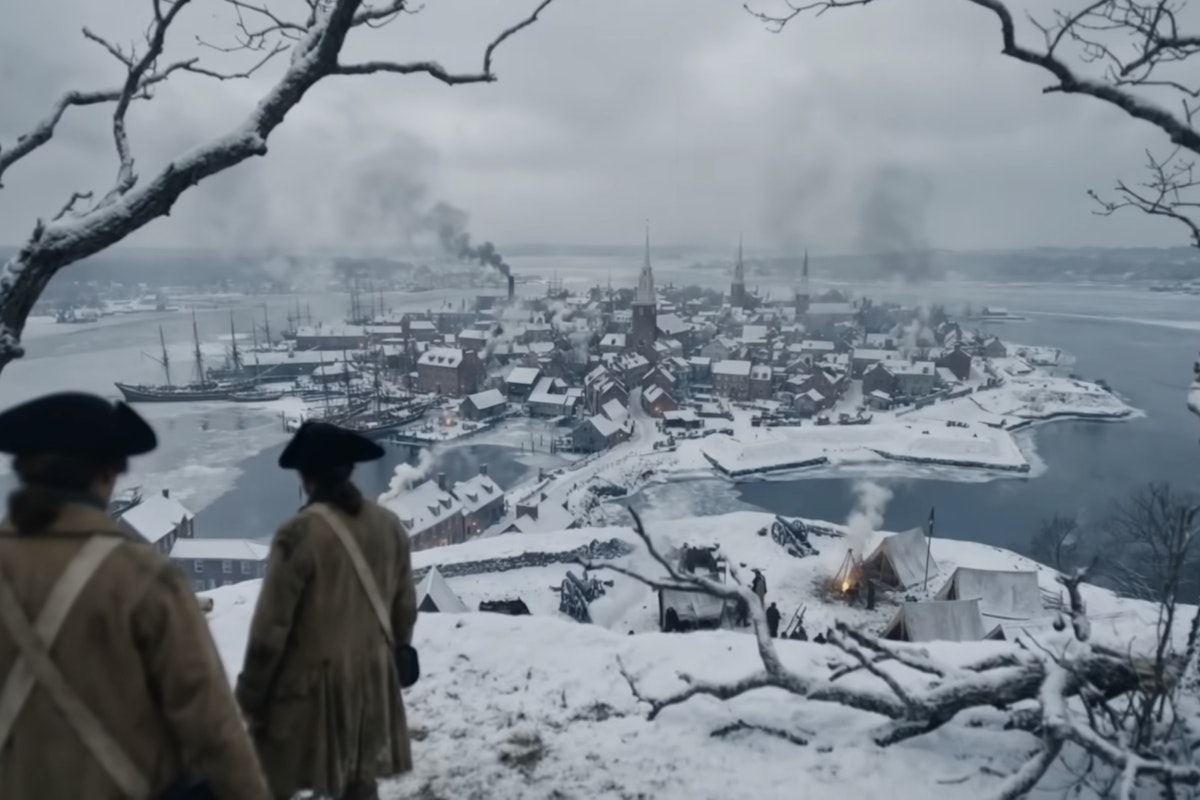
The first truly memorable moment of That day is a close-up of King George III. The general format of the series is that each mini-episode (the episodes thus far have all been less than five minutes long) dramatizes a particular pivotal event that occurred on the day of its release in 1776. The first episode, released on January 1 of this year, chronicles George Washington’s decision to fly the flag in continental colors on Prospect Hill on January 1, 1776. Before we turn to Washington, the episode begins with the king addressing his Parliament, declaring the colonies to be in rebellion against the throne. Aronofsky and his team are keen to point out that all of the voice actors hired for the series were SAG-AFTRA members and that their performances were recorded, one might say, the old-fashioned way. But the voices throughout the film strangely don’t match the movement of the characters’ animated mouths. Because as advanced as this technology is, it presents some of the eye-opening problems that digital animators have long worked out in the years since Robert Zemeckis’ bizarre motion-capture odyssey, The Polar Express. In other words, this series bears the marks of new and old digital technology.
Our view of George begins with a medium shot, alternating with images of wigged lords whispering scandalously among themselves. Despite the wavy synthetic background, George moves jerkily as he speaks. When not depicted in extreme close-up or slow motion, the series struggles to replicate the natural movements of human heads, if that’s something you think might bother you. Then we cut to a close-up of George, dead-eyed looking directly at the camera, and, with a thud, we get a chyron on screen telling us who he is. The series uses this stylistic signature in each episode when we meet a new key character. It reminded me of most of the Grind-House pulpy character intros in Kill Bill, and much of the series’ cinematography leans on that particular late-’90s style, post-Tarantino self-aware visual bravado.
But it was the next shot, a close-up of George in profile, that struck me the most. Here we have our longest and most lingering view of his face, and it really is a strange face. His skin is rubbery. His ear is strangely sharp, but his cheek is fuzzy and scaly, almost fishy. His eyes, nose and forehead are unique, however. Despite our close view, they are poreless, marked by fine topographical lines that look like a cross between the engravings that trace the portraits on our money and our fingerprints. Many central characters in the series are marked this way. Later in this episode, as Washington rallies his troops, the mount mimics a camera lens focusing on his face, but instead of rendering a clearer image, the mount only emboldens his cavernous crow’s feet. When the video is paused, the lines look like cracks in cracked clay, like the branching capillaries of silt in a river delta. The guy looks like a lizard. These are recognizable outlines, but not those of a human face.


