The road to the next insanely great Mac is paved with AI


The original Macintosh arrived 42 years ago. Draw a line between that event and this week, in which credible reports suggest Apple is finally close to delivering on many of the promises it made in 2024 about adding intelligent agents to its devices. Of course, it took licensing from Google Gemini to achieve this, but we may be about to see Apple Intelligence match what Apple announced almost two years ago.
The more I think about it, the more I think Apple Intelligence might actually be Apple’s latest attempt to realize the dream behind the original Mac. In an age where our devices are incredibly powerful and often frustratingly complex, perhaps we need a computer again for the rest of us.
The computer as a device
As the non-techie of the couple who founded Apple, Steve Jobs always focused on the end user. In the beginning, computers were incredibly complicated. Initially, you had to buy the parts and weld them all together. Over time, they began to resemble consumer products, but they remained obscure systems driven by blinking command lines that required you to know exactly what to type for the computer to do anything.
Jobs’ vision, which he kept returning to throughout his career, was that the computer should be more like a device. I’ve never needed to read a manual to know how to use my refrigerator, oven, toaster or washing machine. (If you have to read a manual for toasting bread, they ruin it.) Jobs knew that computers should be like that, too: nice little self-contained boxes of functionality.
Today’s iPhone (and iPad and Mac) have lost the plot when it comes to the simplicity that Jobs always held as his ideal.
His first push toward the concept was the original Macintosh – and when he returned to Apple, he made the same push again, with the iMac.
Today there are more of us than ever before. Not only are there more Mac users than ever (Apple’s installed base is at an all-time high), but there are many more Apple device users than ever, thanks to the iPhone.
Looking at an iPhone’s home screen, you might think we’ve reached the pinnacle of simplicity. There’s no pointer, no mouse, just a screen full of brightly colored icons that you tap to run software that’s also driven by taps and swipes.
And yet I can’t help but think that today’s iPhone (and iPad and Mac) have lost the plot when it comes to the simplicity that Jobs always held as his ideal. In the race to harness the absurd power of the devices in our hands and knees, Apple and its competitors have given these systems incredible powers, but at the cost of increased complexity.

Apple computers have always been about ease of use. Perhaps AI is the next step towards this goal.
Computer History Museum
From power to complexity
It’s funny. I became a Mac user in 1990, when every problem with the Mac was because it was slow. In those days, using a computer was about finding the limits of functionality, then pushing them to their limits – and looking forward to the next version of the device, which would allow the envelope to expand just a little bit.
At some point, the equation changed. For years, our devices have had all the power they really need. I can’t remember the last time I used an iPad and found it slow. The same goes for the Mac and iPhone. Apple continues to add CPU-intensive features to take advantage of this excess power, and these features can be nice, but they fill the limits, not push them.
Apple’s problem today is managing complexity. Every year, the company adds a half-dozen major new features, and many of them directly appeal to users who are focused on using their devices rather than learning new things. A few years ago, I sat down with my wife and showed her that she could set her iPhone’s lock screen to automatically alternate between photos of our kids – an awesome feature! – and it struck me that she would never in a million years discover this feature herself. The functionality was great, but it was hidden by complexity.
We live in a time where simply adding new features isn’t enough. A new feature that no one uses is a failure, even if it’s a great feature in isolation. This means our devices need to become easier to use, better organized and more visible. (This can be a tall order for an industry that has spent the last two decades rushing to outdo others in terms of shiny new features, while simultaneously downplaying the hard work of creating good user experience and information architecture.)
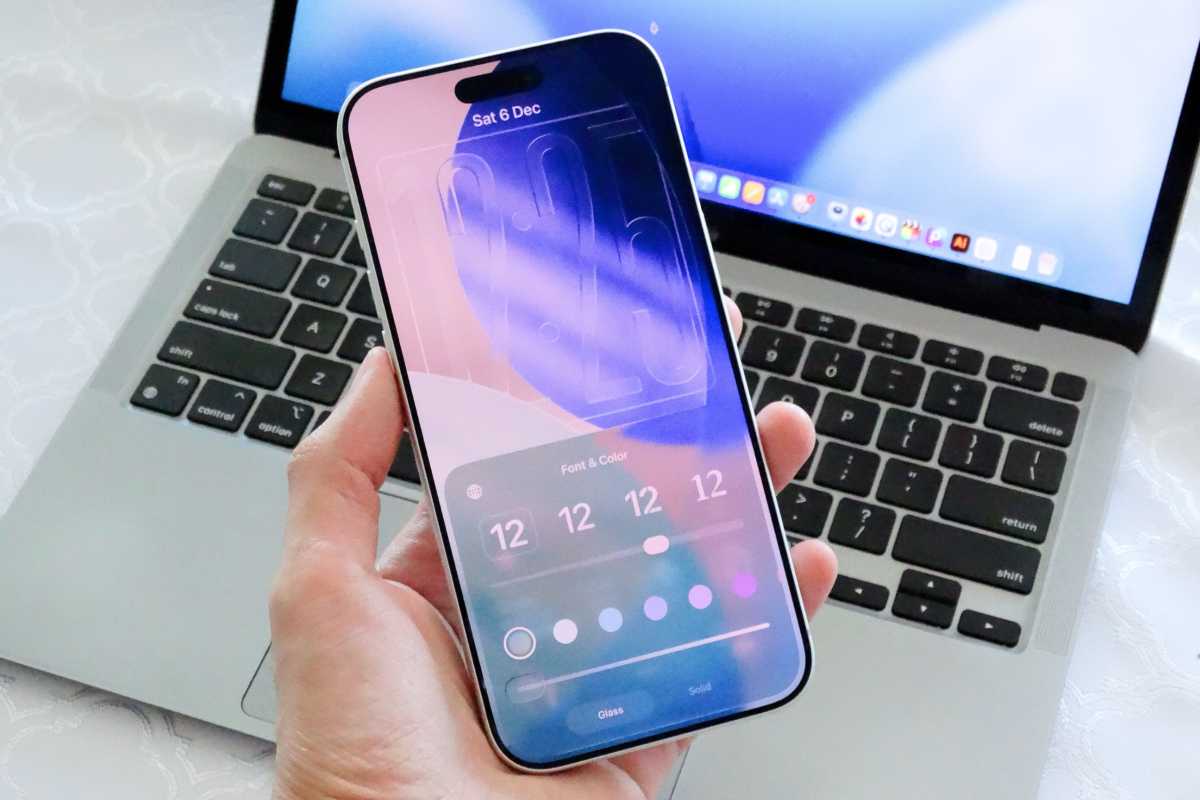
Our devices are now so complex that something as simple as changing the iPhone lock screen isn’t as simple as it should be.
Foundry
AI for the rest of us?
I am neither a supporter nor an opponent of AI. I think this is a potentially revolutionary technology that is also overrated and has some serious problems that need to be addressed.
That being said, it seems to me that one way Apple devices could become less complex would be to add AI-based assistants that could help users do what they want with their devices.
It’s part of the dream of being a “computer for the rest of us.” Apple’s history is littered with attempts to bring the power of a general-purpose programmable computer to the masses, from BASIC to AppleScript to Automator to Siri shortcuts. If today’s devices are so feature-packed, so complicated, that an ordinary user will never be able to enjoy more than a fraction of the features, perhaps the solution is to create a system in which we talk to our devices and tell them what we want them to do for us.
This does not absolve Apple of its usability obligations. The company really needs a culture change, alongside its transition to AI-based assistants. Functionality can still increase, but usability must be the priority. The visual design, content structure, and simplicity of the interface will help users navigate these times, with or without the help of Apple Intelligence.
Or, to put it another way: the last two decades have proven Apple’s prowess in building computers that can do just about anything we want them to do. The next step is to make it easier for us to do what we want with it. Again, we need a computer for the rest of us.


