The San Andreas and Cascadia Earthquake Faults May Be Linked


October 10, 2025
4 min reading
New evidence suggests the San Andreas and Cascadia faults could produce synchronized earthquakes
Seafloor samples reveal evidence of several earthquakes along the two major West Coast fault zones, occurring in rapid succession over the past 3,000 years.
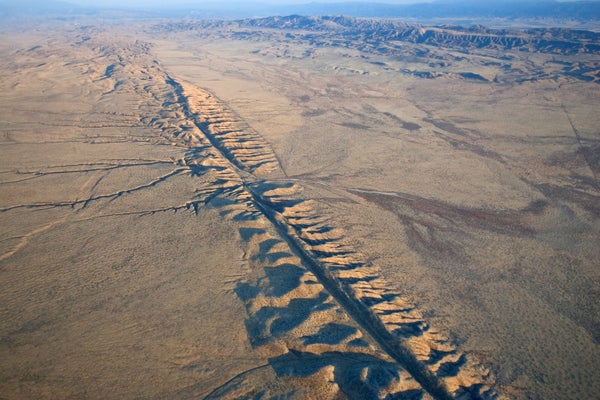
An aerial view of the San Andreas Fault crossing California’s Carrizo Plain.
Cavan Images/Peter Essick/Getty Images
The west coast of North America is a geologically tumultuous area where tectonic plates collide, subducting and brushing against each other. Over the centuries, this activity has regularly caused major earthquakes. New research reveals that some of these seismic events may have occurred in synchrony along the coast’s two major faults: the San Andreas Fault and the Cascadia Subduction Zone.
A team of researchers analyzed a trove of seafloor sediments from the region where the faults meet off the coast of Northern California. The researchers’ findings, published recently in Geosphere, reveal that fault systems have produced multiple synchronized earthquakes over the past 3,000 years.
Chris Goldfinger, a marine geologist at Oregon State University and lead author of the new paper, likens the process to tuning an analog radio, in which the device’s oscillators are synchronized to convert incoming signals. “When you tune an old radio, you make one oscillator vibrate at the same frequency as the other,” he says. “When these faults synchronize, one fault could match the other and cause earthquakes in pairs.”
On supporting science journalism
If you enjoy this article, please consider supporting our award-winning journalism by subscription. By purchasing a subscription, you are helping to ensure the future of impactful stories about the discoveries and ideas shaping our world today.
The Cascadia subduction zone, where the Juan de Fuca and Gorda plates slide beneath the North American plate, extends from Vancouver Island across northern California to join the San Andreas Fault. This fault extends south for 750 miles along a boundary where the North American and Pacific plates slide past each other.

Chris Goldfinger, a marine geologist at Oregon State University, with cores of seafloor sediment.
Since 1999, Goldfinger and his team have been drilling the seafloor at this tectonic crossroads, known as the Mendocino Triple Junction, to extract cores showing a cross-section of the sediments that accumulated there. For the new study, researchers examined more than 130 sediment cores that record about 3,000 years of geologic history. Many cores contained layered sediments called turbidites, created by marine landslides that move large amounts of material around the ocean floor. Many of these landslides are caused by earthquakes, making turbidite layers a useful indicator for identifying past seismic events.
Most turbidites have layers of coarser sediment at the bottom and finer silty sediment at the top, similar to what you get when you swirl a bucket of sand on the beach. But the turbidites in the Mendocino Triple Junction samples “appear to be upside down with all the sand on top,” Goldfinger says. “And as far as we know, gravity hasn’t changed.”
As they studied these puzzling features, Goldfinger realized that the cores contained two turbidites stacked on top of each other. This provides evidence of two separate seismic events that occurred in rapid succession: while the first earthquake deposited a layer of silt on the ocean floor, a second shock sent another avalanche of sand on top.
Some of the layered turbidites are so close together that these events could have occurred within minutes or even decades of each other. Analysis of the ages of shells in the sediment suggests that there have been at least eight large earthquakes along the San Andreas Fault over the past 3,000 years, occurring a few decades after significant earthquakes along the Cascadia subduction zone.
Meng Wei, a marine geologist and geophysicist at the University of Rhode Island, says the idea that fault systems close to each other might synchronize has been circulating for years and has been observed at smaller fault boundaries over short periods of time. But he says the new paper is impressive because it illustrates that the phenomenon is possible with larger fault systems over thousands of years.
Although the Cascadia and San Andreas systems have apparently been linked for millennia, there appears to be some variability regarding the timing between successive earthquakes. Wei, who was not involved in the new study, says it is possible that the two faults could produce tremors a few years apart at some point in the future, but more research is needed to assess how one earthquake triggers another. “Even if these two faults are synchronized, the time interval between earthquakes can still reach tens of years,” he adds.
The two systems are also not perfectly synchronized. The team found that some tremors, including the 1906 earthquake that devastated San Francisco, were one-off events caused exclusively by movements along the northern San Andreas Fault.

CT images of turbidites in deep marine sediment cores. On the left, a thin bed of turbidites from a 1906 earthquake. On the right, from an earthquake about 1,500 years ago, the typical “inverted doublets” – a doubling or tripling of the thickness of the turbidite. The thick sand at the top is the San Andreas Bed, with the Cascadia Bed at the bottom.
But if both fault systems end up producing major earthquakes in rapid succession, it could cause major disasters across the entire west coast of North America. A first earthquake along the Cascadia subduction zone would draw recovery resources as far as the Pacific Northwest, making it difficult to respond to a subsequent earthquake in San Andreas.
Goldfinger hopes the new work will help influence seismic risk planning for communities near the two fault systems. “In the paper, we stuck to the geology instead of dwelling on the potential pessimism,” he says. “But it’s pretty clear that if something like this happened – and we think the evidence is strong – we need to be prepared. »
It’s time to defend science
If you enjoyed this article, I would like to ask for your support. Scientific American has been defending science and industry for 180 years, and we are currently experiencing perhaps the most critical moment in these two centuries of history.
I was a Scientific American subscriber since the age of 12, and it helped shape the way I see the world. SciAm always educates and delights me, and inspires a sense of respect for our vast and magnificent universe. I hope this is the case for you too.
If you subscribe to Scientific Americanyou help ensure our coverage centers on meaningful research and discoveries; that we have the resources to account for decisions that threaten laboratories across the United States; and that we support budding and working scientists at a time when the value of science itself too often goes unrecognized.
In exchange, you receive essential information, captivating podcasts, brilliant infographics, newsletters not to be missed, unmissable videos, stimulating games and the best writings and reports from the scientific world. You can even offer a subscription to someone.
There has never been a more important time for us to stand up and show why science matters. I hope you will support us in this mission.


