The sea monster goes ‘bloop’—or does it?


In 1997, the United States National Oceanic and Atmospheric Administration (NOAA) detected an unusual noise in the remote South Pacific. In itself, this was nothing remarkable. NOAA’s underwater microphones or “hydrophones,” primarily used to monitor geological activity, often pick up sounds whose origin is not immediately apparent. NOAA researchers give these sounds nicknames, including Upsweep, Sea Train, and Julia (named because they sound like a woman’s muffled voice). But this particular noise was unlike anything scientists had heard before.
Extremely low in frequency, it was also extremely loud, picked up by sensors more than 3,000 miles away. The mysterious sound rose and fell within a minute. When sped up 16 times to make it audible to human ears, it sounded like a “bloop”. That became the nickname for the noise as scientists wondered what could have produced it.
What was special about the Bloop?
Because of its rapid changes in frequency, the Bloop somewhat resembled the sounds of marine animals. However, it was much louder than a blue whale, the loudest animal known. A blue whale’s call can be heard approximately 1,000 miles from its source. While impressive, this is less than a third of the distance covered by the Bloop.
“We suspect it’s ice off the coast of Antarctica, in which case it’s pretty darn loud,” NOAA oceanographer Chris Fox said of the Bloop in 2001. Although the Bloop was louder than the sounds typically associated with moving ice, it was so much louder than any known animal that NOAA considered the collapse of the polar ice pack as the most plausible explanation.
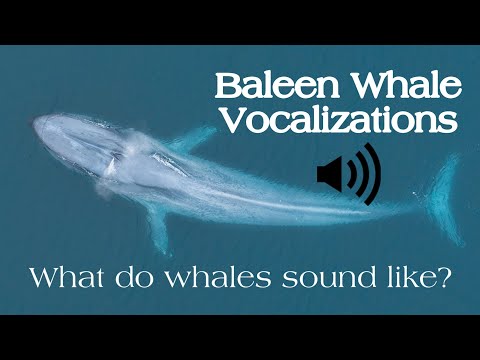
Baleen Whale Vocalizations: What Do Whales Look Like?
The blue whale, a type of baleen whale, is considered the loudest animal on the planet. Video: Baleen Whale Vocalizations: What Whales Sound Like, NewportWhales
However, in a separate interview, Fox said New scientist in 2002 he recognized that Bloop had similarities to animal sounds. This led New scientist Writer David Wolman speculated: “Is it even possible that a creature larger than any whale lurks in the depths of the ocean? Or, perhaps more likely, something that is much more efficient at emitting sound?”
Was the Bloop a sea monster?
Other media outlets quickly seized on this remote possibility and exploited it. “One theory is that [the Bloop] “is a deep-sea monster, perhaps a giant squid with many tentacles,” CNN reported in 2002. (Although the giant squid is real, it is not known to be capable of making noise.) The mystery of the Bloop has become a tantalizing symbol of how little we know about the ocean and a staple of the tradition of cryptozoology: the study of animals whose existence has not been confirmed, such as Bigfoot and the monster of the Loch Ness.
In 2003, cryptozoologist Loren Coleman reported that the Bloop “most likely came from a sea beast”, comparing it to mysterious sounds recorded in Loch Ness. However, Coleman noted that it was later confirmed that the sounds of Loch Ness came from geological activity and not from Nessie.
Cryptozoology is not considered a science because it generally does not follow the scientific method or depend on scientific standards of evidence. This leaves room for creative speculation that can reach the point of fantasy.
A Google image search for “the Bloop” reveals artwork of imaginary leviathans based on whales, anglerfish or squid. One of these creatures became a fan-made video game addition. Subnauticalin which players explore an alien ocean.
Sea ice may become noisy, thanks to climate change
Large glaciers, like those at the South Pole, can make noise when they rub against the ocean floor or against each other, or when chunks of ice break off from them, a process called calving. Extremely large calving can even cause the ground to shake, causing a glacial earthquake, also known as a cryoseism or icequake.
To confirm the origin of the Bloop, scientists compared it closely with recorded sounds that, although less loud, came from polar ice. The results confirmed NOAA’s initial speculation.
“Broad-spectrum sounds recorded during the summer of 1997 correspond to earthquakes generated by large icebergs as they crack and fracture,” NOAA reports. This includes not only the Bloop, but also the other named sounds that NOAA has recorded at the South Pole (even the eerily human “Julia”).
Other “At That Time” Stories
Arctic ice at the North Pole has caused similar phenomena, such as the Ping, a persistent underwater ringing sound recorded in the summer of 2017. At the time, local hunters blamed the Ping for spooking game.
The Bloop may not have been the sound of a sea monster, but it conveyed an important message for humanity: an early warning about climate change. As rising global temperatures threaten polar sea ice, loud and unfamiliar sounds of melting ice are becoming more frequent, impacting polar ecosystems.
A 2021 study on marine noise in the Southern Ocean describes it as “a form of ocean pollution that can affect wildlife ranging from tiny zooplankton to enormous whales.” Many marine animals use sonar sound for navigation, communication and even hunting. Marine noise can interfere with the migration and feeding habits of these animals, affecting their ability to survive.
Research into the ecological effects of marine noise is limited, particularly in Antarctica. The 2021 study calls on parties to the Antarctic Treaty to come together to consider options for managing and mitigating these disruptive (and very loud) noises in the polar ocean.
The sea is still full of mysterious sounds
Are you a little disappointed that a giant sea monster didn’t make the Bloop? Sometimes the strange sounds of the polar ocean actually come from animals. Australian surveyors first recorded a persistent underwater quack nicknamed the Bio-Duck sound in the 1960s. Its origin was unknown until 2014, when researchers proved the culprit was not a sea duck but a minke whale.
2014 also marked the first record of the “Biotwang” from the Western Pacific, near the Mariana Trench. Described as “Star Wars-like” and “a frog burping in space”, the Biotwang was later attributed to Bryde’s whale. “Anyone unfamiliar with whales would never think [the Biotwang] was made by an animal,” said NOAA researcher Ann Allen.
Then there are open cases, like that of the “52 hertz whale” call that has been drifting in the North Pacific since the 1980s. Named for its frequency, which is much higher than a typical whale song, this sound was once thought to come from a single animal. Current recording patterns suggest there are at least two. But because neither of the two aloud whales have ever been seen, scientists can’t say whether they represent unusual members of a known or unknown species.
As noisy as it is, the ocean has not yet revealed all its secrets to us.
In This time whenPopular Science tells the strangest, surprising, and little-known stories that have shaped science, engineering, and innovation.

The best new PopSci 2025 releases