The Supreme Court Has Always Been This Bad


September 23, 2025
From the authorization of segregation to abortion rights to avoid it, the reactionary sequence of the court is deep. A new collection shows why calls for reform are as old as the court itself.
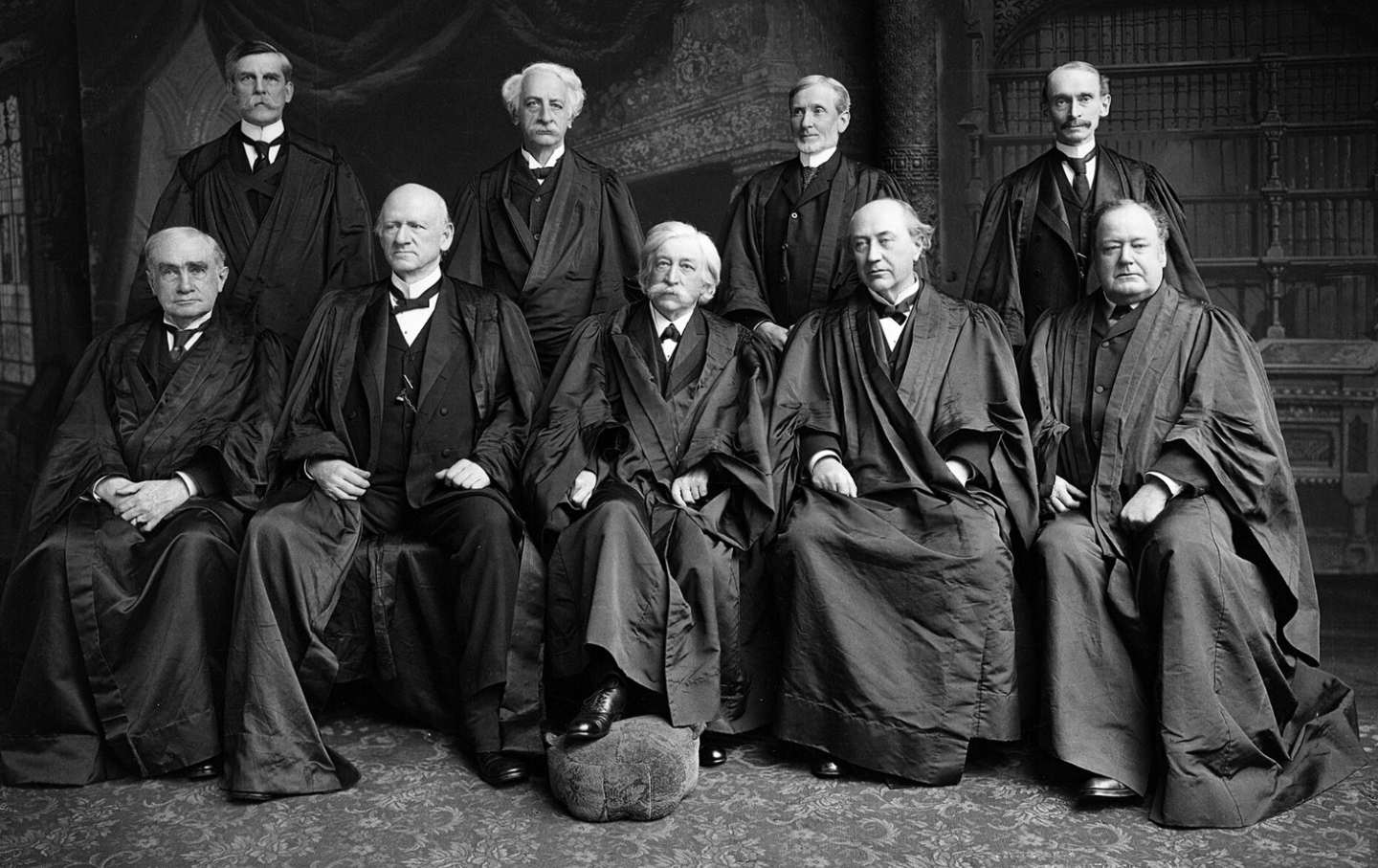
The Supreme Court in 1904. In front, from left to right: Henry Billings Brown, John Marshall Harlan, chief judge Melville Fuller, David Josiah Brewer, Edward Douglass White Jr. Standing, from left to right: Oliver Wendell Holmes.
(United States Supreme Court)
It would be difficult to overestimate the measure in which the current whole of narcotic problems of the American Republic and apparently intractable crises can be attributed to a single institution: the Supreme Court of the United States.
Other actors, of course, also have a responsibility: a highly distractionable consumer media, corporate kleptocrats, one or two generation of neoliberal and neoconservatives now dismeditated which push the national and foreign policy that it was clear at the time was unfair and impartable and did not work at all.
However, none of them would have been able to see their will, which has therefore been promulgated if they had not been empowered by the Supreme Court, which, in the past 40 years, has been consolidated and conglomeration of the media in green light, by digging local and independent journalism on which democracy depends; Transformed companies into people, opening the campaign financing taps and flooding public square with dark money; And even interrupted the counting of voting bulletins during a presidential election in order to give the victory to the preferred candidate by a nudity of its members.
Not to mention the decisions that dug the unions; overturned the protections hard won for the right to vote; And canceled the right to have an abortion which he himself had recognized as an inviolable. More recently, the court decided that the president was above and beyond the scope of the law-a decision it is not exaggerated to say at once an essential pillar of the constitutional system. It is terrifying to think that conservative judges on the ground have not yet completed their work. If it is for as long as Ruth Bader Ginsburg, Amy CONEY BARRETT will still hear business in 2059.
It is both freshly exasperating and strangely comforting, at one point, to take a long look back through the history of the Supreme Court and to see how long the questions and problems raised by the recent interventions of the judges have been the subject of conversations and debates. The nation Has disseminated and reported such debates since its foundation three months after the end of the civil war, when it was clear that the court would play a shameful vital role the nation which emerged from the ashes. Covering more than a century and a half, the articles, columns, letters and editorials included in these pages contain eloquent criticisms of the court intrusions on democracy, its selective application of supposed constitutional principles and the persistent mockery of the problem of justice is in question. As more than one contributor points out, the court often claims to be powerless when it comes to protecting individual freedoms, but in a way finds justification to act as an almighty sovereign when property rights or business interests are at stake.
The apogee of chief judge Earl Warren (1953 to 1969) offers a brief exception, an era when Nation Writers and publishers rediscovered the value of an activist court with other liberals. “Of course, the world cannot be improved by the law alone,” noted a contributor in 1954, after Brown c. Board of Education“But just as it cannot be improved without law.” The same magazine that two decades previously had pushed President Franklin Roosevelt to undertake an in -depth overhaul of a mashant court has now celebrated “wisdom and restraint of the congress” for having defeated these initiatives. The writer of this play, Maxwell Brandwen, applauded the first decisions of the Court of Warren in favor of civil freedoms as “in harmony with the traditional spirit of our country”, the proof of “sensitive respect for high ethical values”. These praise are understandable in the context of a period when Brandwen said, the judges “have confirmed and even extended the traditional rights of the individual”. What a contrast with our time, when the rights are not extended but canceled.
Current number
Curiously, the magazine did not notice at the time of some of the most important judicial decisions of the first decades of its existence. We are looking in vain for an answer to Plessy c. FergusonThe decision of 1893 which approved “separate but equal” public schools and other installations for black Americans, or the shameful Korematsu Rules (1943) which approved War Times of the Americans of Japanese origin. After Brown c. Board of Education overturned Judicial In 1954, The nationMore or less sautéed to the news in order to ask the following question, the case necessarily raised: what about racial segregation in the North?
Some of the best writings of the magazine on the Court emphasize the complicated relationship between legal strategy and political activism. Two years before BrownLawyer and accomplished activist Earl B. Dickerson The nation To urge his black American colleagues to “place less dependence on the goodwill of some named judges” and to focus more on the creation of “force in the political arena”. An editorial on the court’s decision Roe c. Wade (1973) asked:
What are the prerequisites for such attitude reversal at the highest judicial level? On the one hand, there must be a special district, imbued with zeal, equipped with reason and pushing hard for a change of law. Without activist vanguard, ancient concepts will not be questioned, much less critical.
Tragically, the right, not the left, received the message, at least with regard to reproductive rights. It is poignant and depressing to read several decades of warning The nation This, thanks to the anti-abortion “Vanguard activist” channel the political organization in federal judicial appointments, Deer Would soon be on the blockage. It was only 49 years old, but with the Dobbs The 2022 decision, the “special district” finally achieved its objective.
The nine spoke Contains repeated and coherent warnings according to which readers should not have too much hope regarding the possibilities of liberation via the judicial decree, nor to place too much confidence in a fundamentally non -democratic institution. “Not a few shy liberals still do not fear the reduction of the swollen powers of the court of fear that he will not be unable to protect us from fascism,” wrote the young If Stone (still Isidor Feinstein) in 1937, at the height of the “Court-Gacking” battle of Roosevelt. “It’s pure fantasy.”
Trump c. UNITED STATES (2024), where the book ends, offers more conclusive evidence that Stone could have hoped – or feared – to be able to bring together to support his case. “Far from being a bulwark against fascism,” wrote in a presidence in Stone, “the court could fulfill a double position increasing. If the continuous court of hamstrings and state legislatures, it will play directly in the hands of the fascist demagogue which retaliates to the ineffectiveness of democratic processes. On the other hand, a fascist regime will find elements passed in the past courts to offer legally with the legal. What could be more useful to such a regime than the court approval of the idea once put forward by Richard Nixon, to the howls of a horrified nation, that the president is forever protected from prosecution for crimes committed during his mandate?
For the informed and thoughtful Americans of the left, he never seemed cruel and absurd for a large part of our lives to be determined by nine Berotic lawyers effectively granted as an insurmountable authority and, with the mandate of life, immune to the dissatisfaction of the governed. All the more these days, when many of the judges are known in their privacy to have little personal integrity and align themselves with the insurrectionists against the government, they are sworn to serve.
From the stone and other first Nation The requests of writers for the reform of the court to justice to justice Elie Mystal have been passionate about Elie Mystal and a clever coverage of recent years, this collection of Nation The writings on the court put the choices that we face today in an appropriate historical perspective. This shows that the recent series of reactionary decisions of judges is not a gap in history but a return to the norm, and that the proposal of ideas for the revision of the Court should not be considered particularly radical or beyond the pale. On the contrary, questioning the legitimacy of the Court, demanding a more democratic and responsible federal judicial system, is a tradition almost as old as the Court itself.
Don’t let JD vance silence our independent journalism
On September 15, vice-president JD Vance attacked The nation by hosting The Charlie Kirk Show.
In a clip given millions of times, Vance has chosen The nation In a whistling dog to his far -right disciples. As you would expect, a torrent of abuse followed.
Throughout our 160 years of publication of fierce and independent journalism, we worked with the conviction that dissent is the highest form of patriotism. We were criticized by democratic and republican office holders – and we are delighted that the White House is reading The nation. As long as Vance is free to criticize us and we are free to criticize it, the American experience will continue as it should.
To correct the file on the false allegations of Vance on the source of our funding: The nation is proudly supported by readers by progressives like you who support independent journalism and will not be intimidated by those in power.
Officials of the Vance and Trump administration also established their plans for general repression against progressive groups. Instead of calling for national healing, the administration uses Kirk’s death as a pretext for a concerted attack on Trump’s enemies on the left.
Now we know The nation is at the front and center of their mind.
Your support today will make our critical work possible in the months and years to come. If you believe in the right of the first amendment to maintain a free and independent press, please make a donation today.
With gratitude,
Bhaskar Sunkara
President, The nation


