The Tortured Paths of the Wound Man


Explore
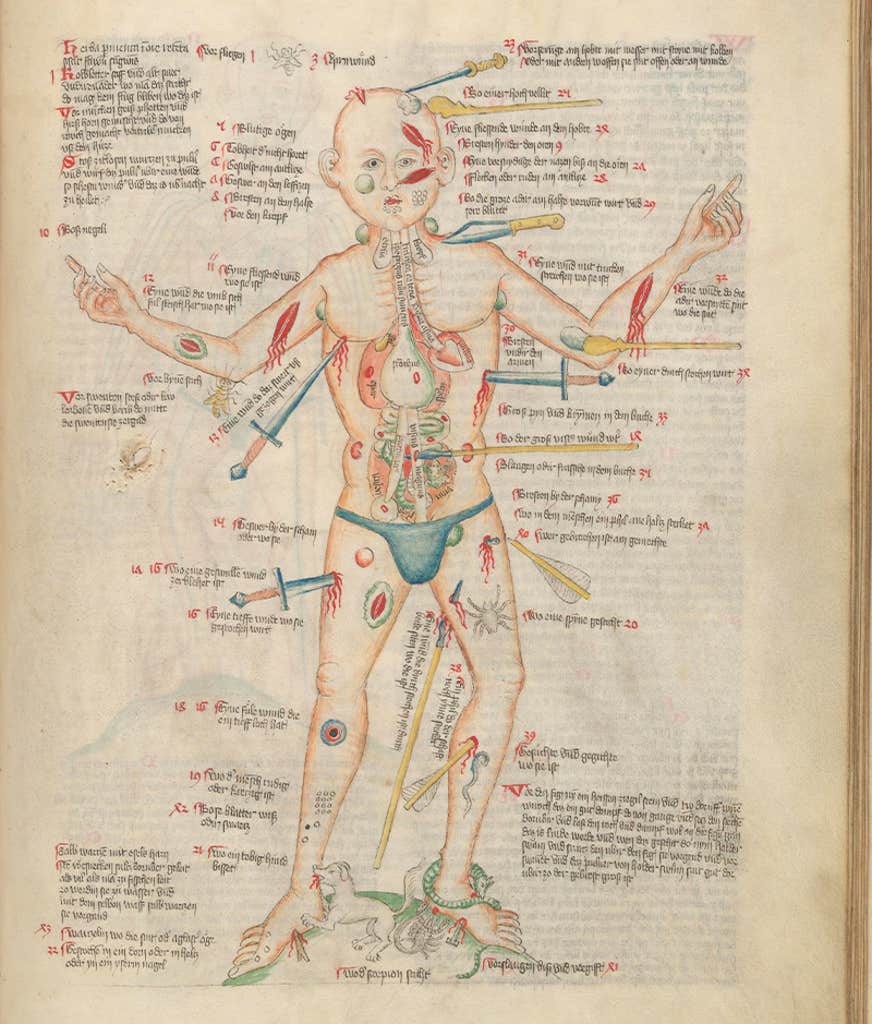
THe wounded is an image that is both disturbing and enigmatic. A male silhouette looks at the parchment page bearing a multitude of graphic injuries. His skin is covered with bleeding cuts and lesions, stabbed and torn by knives, lances and swords of different sizes, many of which remain stuck in the body. His head and thighs are pierced with arrows, some intact, some have broken on their heads or trees, sink their shape. A club meets a trauma dull in the shoulder, while in its chest – was strangely transparent to reveal the structure of its intestines, lungs, spleen – the point of a dagger punctuates its heart.
The figure also carries traces of a more daily accident. Its tibias and feet are grouped with thorny stripes and traded blades. It is dotted with itching insect bites. And to wipe out her appalling and cumulative misfortune, the wound is also deeply ill. Its armpits and sports of rounded groin and dark red broths. A label tells us that he is assaulted by “Pruritus by Corpus Totum(Itching across the body), which alongside rastered rashes and swelling represented suggest that the contraction of several diseases. The violence and the disease rendered to his body are total and consumed.
However, despite such a horrible dam, the expression of the figure is disturbing. He stands with his eyes wide open, quite still alive, and in this simple act, the goal of the image is crystallized. Because despite its free display, the injury was not a figure originally designed to inspire fear or threat. Instead, he represented something quite more optimistic: an imaginative reminder and striking the powerful knowledge that could be channeled and exempt thanks to the practice of pre -modern medicine.
Today, the image leads a spectacular life. Recently, his broken body provided a grotesque lure to a diversified and somewhat bizarre variety of modern constituents. In 1995, the figure was included as part of the new official coat of arms of the Royal College of Emergency Medicine of the United Kingdom, reworked with ABS and Ken-Doll hair to easily present in a single body the many trauma injuries that college members were equipped to attack. For the administrators of the castle of Mont Orgeuil, a 13th century fortress overlooking the port of Gorey on the island of Jersey, the injury was a more fun thing, an appropriate inspiration for a sculpture by the artist Owen Cunningham, who produced a giant pleasure of visitors.
This same horrible sensitivity, relaunched and mercilessly amplified, inaugurated the image on television screens, adorning the office of Mads Mads Mikkelsen, the cannibalistic doctor Hannibal Lecter in the NBC 2013 series HannibalA show in turn based on the novel by Thomas Harris in 1981 Red dragon. Harris relied on the injury as a model for many of the particularly spectacular murders of his book, but he was not the first writer to quote the figure as their muse. In 1957, no less a literary luminaire that Ian Fleming had written to his publisher to suggest that instead of his current title, Dr noMaybe the sixth book of his James Bond espionage thrillers should be renowned The injuryAfter a historic photo, he had recently met a brochure and for which he claimed to have a great affection. The publisher refused.
ADVERTISEMENT
Nautilus members benefit from experience without advertising. Connect or join now.
During the last decade approximately, the image has inspired the music of a group of Heavy Metal, a book of Scottish poetry, a piece of narration theater in one-man entitled The adventures of Wound Man and ShirleyA Protestant anarchist tea touch against business profits, and a diagram in a respected veterinary newspaper describing commonly supported injuries in duel cats.
But the injury is much more than the show. From the very moment of its creation, the injury was an image intimately linked to real practice. It was actually a lot, a lot at the same time: epistemic diagram, medical tool, emotional muse, technical spur, works of international art. The injury can be considered one of the most unusual results of a long line of surgical literary reformulations, as we find the figure closely combined with a specific group of surgical books whose structure and content aimed to make large strips of well -established medical knowledge and to rework it in an innovative way.
On the one hand, the injury gathered boldly in a single space, an encyclopedic host of contemporary techniques to cut, suture, bandage, administer, adjust and leave. But he also associated these instructions with a sharp capacity to rely on parallel innovations in visual diagnosis and diagrammatic aesthetics. The image of the large body of the injury would have attracted the reader’s eye much more effectively than a simple list of content, quickly assuring them that a particular remedy could be found inside. Likewise, the orderly cartography of the disease on its physical form could serve a mnemonic function for readers wishing to memorize the content of his body and therefore the content of the treaty.
The textual remedies according to the image would include a brief set of practical procedures to deal with the problem, for example, of the instructions on how to clean and sew an injury or create drugs composed for application or ingestion. Registrations are generally supplemented by a brief comment on monitoring, recommending that the patient is monitored for specific signs, either that certain prescriptions are repeated at special times. Many also end with occasional assurance that a certain balm is particularly effective, that a rash will soon diminish, or that a patient will undoubtedly return in good health.
However, it is difficult to know exactly how these injuries were received or for whom they were specifically intended. Few iterations have reached us with sufficiently clear evidence or collection of origin to link them to particular medieval individuals with great certainty. We could reasonably assume that their visual diversity and their beautiful lines indicate that customers who could afford the costs of a relatively accomplished artist. The regular incorporation of other forms of parallel materials calendar and medical – iron figures, urine tables, zodiac men – indicates that the books in which these images were contained were also intended for health professionals, or at least for non -specialists invested in impressive learning represented by the arts of healing.
ADVERTISEMENT
Nautilus members benefit from experience without advertising. Connect or join now.
Following the history of the injury is to explore a distribution in the development of characters that interacts with the image of different points of view through its occupied chronological and geographic scan. Committed by healers and patients, but also by engraver and poets, scribes and students, nuns and monks, and modern writers and artists today, injury and its injuries have experienced a surprisingly robust and vital longevity.
Main image: Wellcome, London collection, Public domain


