The US Is a Violent Petro-State


Environment
/
January 8, 2026
Trump’s attack on Venezuela illustrates the many perils of fossil fuels.
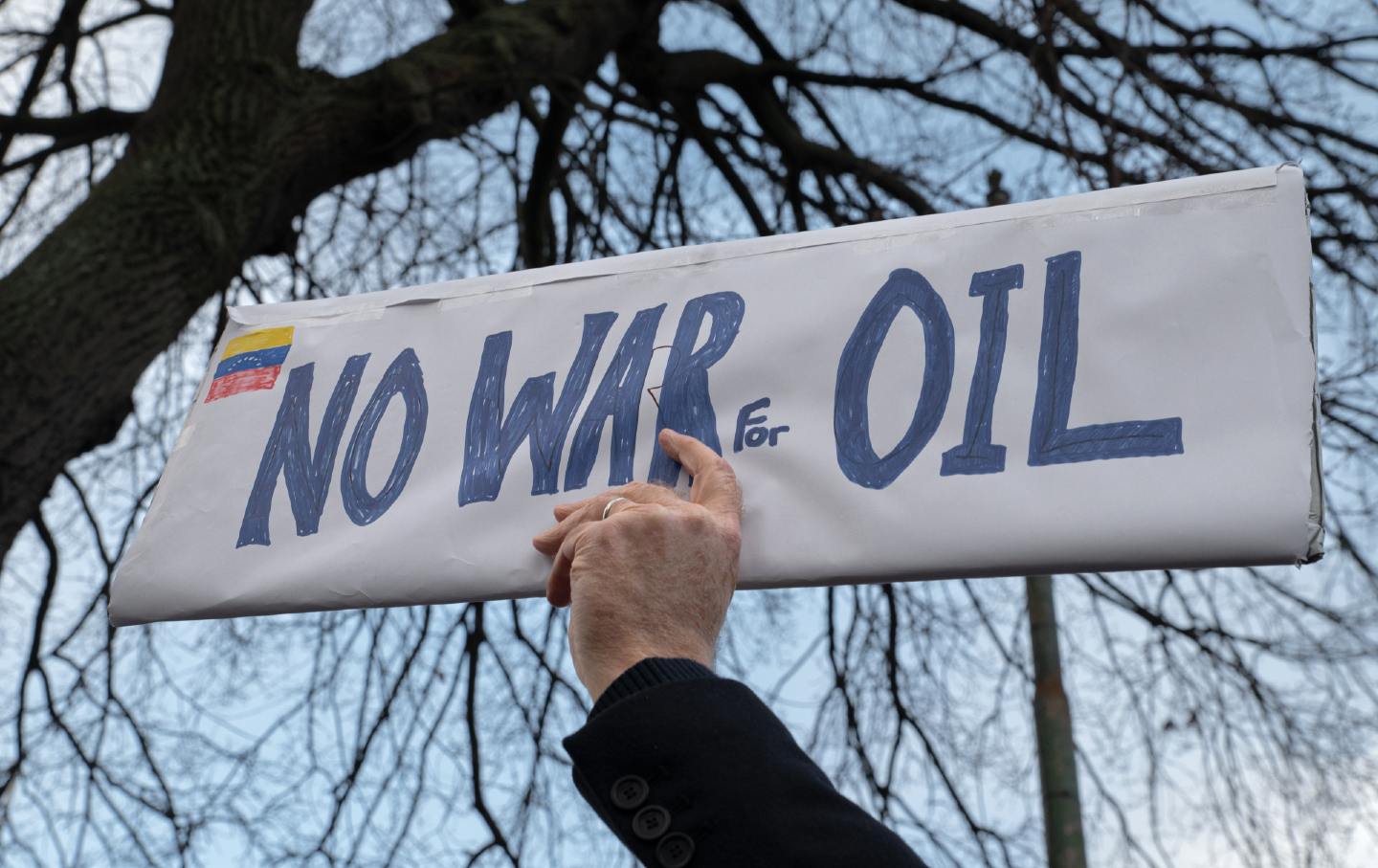
A man holds a plaque reading ‘No War for Oil’ outside the US Embassy in Dublin.
(Natalia Campos/Getty Images)
“Petrostate” is a term generally applied to countries like Saudi Arabia, Russia or Nigeria, where the production and, above all, the export of oil and gas is fundamental to the national economy and foreign policy. However, this term is rarely applied to the world’s oldest, richest and most powerful petrostate. That distinction goes to the United States, which a few days ago attacked another oil state, Venezuela, with the stated aim of taking control of its oil operations. Oil is clearly at the heart of Venezuela’s story, which means climate change is too.
Even though most reports have neglected the climate aspect, one Tutor The article published on January 6 offers an illuminating exception. Noting that Venezuela holds the largest known oil reserves in the world, The Guardian reported that “even increasing production to 1.5 million barrels of oil per day from current levels of around 1 million barrels would produce… more carbon pollution than is emitted annually by major economies like the United Kingdom and Brazil,” citing Professor Paasha Mahdavi of the University of California, Santa Barbara. According to Mahdavi, this would be “terrible for the climate”.
The United States was a petrostate long before Donald Trump came to power, under both Democratic and Republican presidents. It was under Democratic Presidents Barack Obama and Joe Biden that the United States regained its position as the largest annual oil producer and gas exporter. Oil company CEOs populated the cabinets of Republicans George HW Bush and George W. Bush (whose family wealth was based on fossil fuels).
Current number
“The United States is as much an OPEC nation as most OPEC countries. This is what Everett Ehrlich, who chaired interagency deliberations on climate change in the Bill Clinton administration, said in an interview for my 2010 book: Hot: Living the next fifty years on Earth. Ehrlich explained why a government that boasted Al Gore as vice president was much more timid about reducing greenhouse gas emissions than its European and Japanese allies were. “The United States is more like an OPEC country – an energy producer – while the Europeans and Japan are energy consuming countries,” Ehrlich added.
The United States’ vast oil reserves have been the key to its superpower status for more than a century. During World War I, the United States provided most of the oil that helped Britain and France defeat Germany. Since then, U.S. oil companies have worked alongside the White House, the State Department, and other U.S. agencies, domestically through pro-monopoly regulations that pushed prices above free market levels, and abroad through collaborations such as the Red Line Agreement, which in the 1920s gave U.S. companies access to Middle Eastern oil.
Discoveries of massive deposits in Texas, Oklahoma, and California in the 1930s solidified the country’s dominance; Unlike any of the Axis or Allied powers, the United States had its own oil to fight World War II. Its abundant domestic supply also transformed the U.S. economy after the war, allowing Americans to buy more cars, move to expanding suburbs, and travel on new highways. Building all those cars, suburbs and highways propelled a decades-long economic boom that is among the most spectacular in human history.
But the climate crisis underscores a truism about petrostates: Oil can be more of a curse than a blessing. Scholars and journalists have demonstrated that most oil states are plagued by gross corruption and inequality. Elites seize income; poverty engulfs the masses. Violence is another byproduct: Since 1973, between a quarter and half of the world’s wars have been “related to oil interests,” according to Jeff D. Colgan of the Belfer Center for Science and International Affairs at the Harvard Kennedy School. And of course, burning oil is one of the main drivers of climate change.
The US attack on Venezuela is only the latest example of these destructive trends. Journalists must help their audiences understand the links between the attack and oil, as well as what scientists have long warned: that the future of humanity depends on the rapid elimination of fossil fuels.


