The Vera C. Rubin Observatory Recently Spotted Around 11,000 Asteroids — and This Is Just Beginning


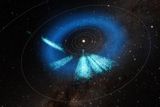
The first images from the NSF-DOE Vera C. Rubin Observatory were revealed in June 2025, showing clusters of twinkling galaxies, glowing gas clouds, and swarms of asteroids, more than 1,500 of which were confirmed as “new” after the first images were released. Today, nine months after the Rubin First Look, the observatory has identified more than 11,000 additional asteroids in our solar system.
Confirmed with the International Astronomical Union’s Minor Planet Center (the global organization that collects official observations of asteroids and comets) and announced in April 2026, the findings come from Rubin Observatory’s preliminary optimization studies, conducted over the past summer to test the telescope’s capabilities and set its priorities for the future. Nonetheless, these preliminary observations constitute the largest batch of asteroid discoveries in the past year, demonstrating the power of the observatory and highlighting its incredible potential.
“This first major submission after Rubin First Look is just the tip of the iceberg and shows that the observatory is ready,” Mario Juric, a University of Washington professor and Rubin’s lead solar system scientist, said in an April 2026 press release. “What took years or decades to discover, Rubin will discover in a few months.”
Learn more: How Vera C. Rubin revolutionized dark matter
A big batch of asteroids
Before the Rubin Observatory opened, all observatories, ground-based and space-based, discovered an average of about 20,000 asteroids each year, according to a June 2025 press release. However, after Rubin’s first glimpse, it was determined that the Rubin Observatory could capture thousands of new asteroids and hundreds of recovered asteroids (which were observed and then later “lost”) in just a few hours of observation.
Since then, scientists have submitted about 1 million additional observations from the Rubin Observatory to the Minor Planet Center, covering more than 11,000 previously unknown asteroids and 80,000 familiar ones, observed in a month and a half. The previously unknown asteroids contain 33 near-Earth objects, or NEOs, that pass within 1.3 astronomical units of the center of our solar system at their closest point to the sun. They also include more distant asteroids, including those in the asteroid belt between Mars and Jupiter, planets located about 1.5 to 5.2 astronomical units from the center of our solar system.
“Even with just With early, engineering-grade data, Rubin discovered 11,000 asteroids and measured more precise orbits for tens of thousands more,” University of Washington researcher Ari Heinze said in the April 2026 press release. “It seems pretty clear that this observatory is going to revolutionize our knowledge of the asteroid belt.
Sensitive and fast
Armed with massive mirrors and impressive sensitivity and speed, the Rubin Observatory scans the sky and captures objects about six times fainter than most other observatories searching for asteroids today, bringing smaller, more distant objects into focus for the first time.
In fact, during the first years of the Legacy Survey of Space and Time (the planned 10-year study of the entire southern sky, expected to begin this year), the observatory could discover as many as 11,000 new asteroids every two or three nights, ultimately tripling the number of such objects ever seen. Among the asteroids discovered will certainly be near-Earth objects, including those that pose a greater threat to Earth, measuring more than 460 feet in diameter. (Indeed, the Rubin Observatory could also double the number of near-Earth objects discovered, once its full-fledged operations begin.)
“We are beginning to fulfill Rubin’s promise to fundamentally reshape our solar system inventory,” Juric said in the April 2026 press release, “and open the door to discoveries we have not yet imagined.”
Learn more: Meet 10 women scientists who changed the world
Article sources
Our Discovermagazine.com editors use peer-reviewed research and high-quality sources for our articles, and our editors review the articles for scientific accuracy and editorial standards. See the sources used below for this article:


